GLOBALLY, subsidies and social assistance are a powerful tool in developing countries to help shape socio-economic outcomes and addressing societal challenges.
The non-contributory transfer programmes that come in many forms vary by country, including cash transfers, in-kind transfers, workfare programmes and price subsidies.
The different types of subsidies and social assistance programmes are provided to support low-income households, vulnerable groups and specific sectors through various mechanisms, including direct cash payments, cheaper loans and financing, and indirect support such as supply and price controls or subsidies, and the government purchases of goods and services at favourable terms.
These subsidies can target economic sectors such as agriculture, utilities, public transport, healthcare, education and housing.
Subsidies and social assistance can help governments achieve various socioeconomic goals, such as ensuring stable production and supplies, supporting essential goods and services at affordable prices, correcting market failures, promoting social equity distribution, reducing poverty, and cushioning economic shocks.
The World Bank’s The State of Social Safety Nets 2018 report shows subsidies and social-assistance programmes in high-income countries made up 1.9% of gross domestic product (GDP) and 1.6% of GDP for upper-middle-income countries.
While these programmes are intended to meet socioeconomic objectives, the design of subsidy programmes and costs, as well as unintended consequences, must be well managed to ensure they effectively reach intended recipients and are fiscally sustainable.
There has been a shift away from broad-based to targeted subsidies as it is more sustainable, creates fewer market distortions and more impact for the deserving, redirecting savings to more productive spending on healthcare, housing, transportation and community services.
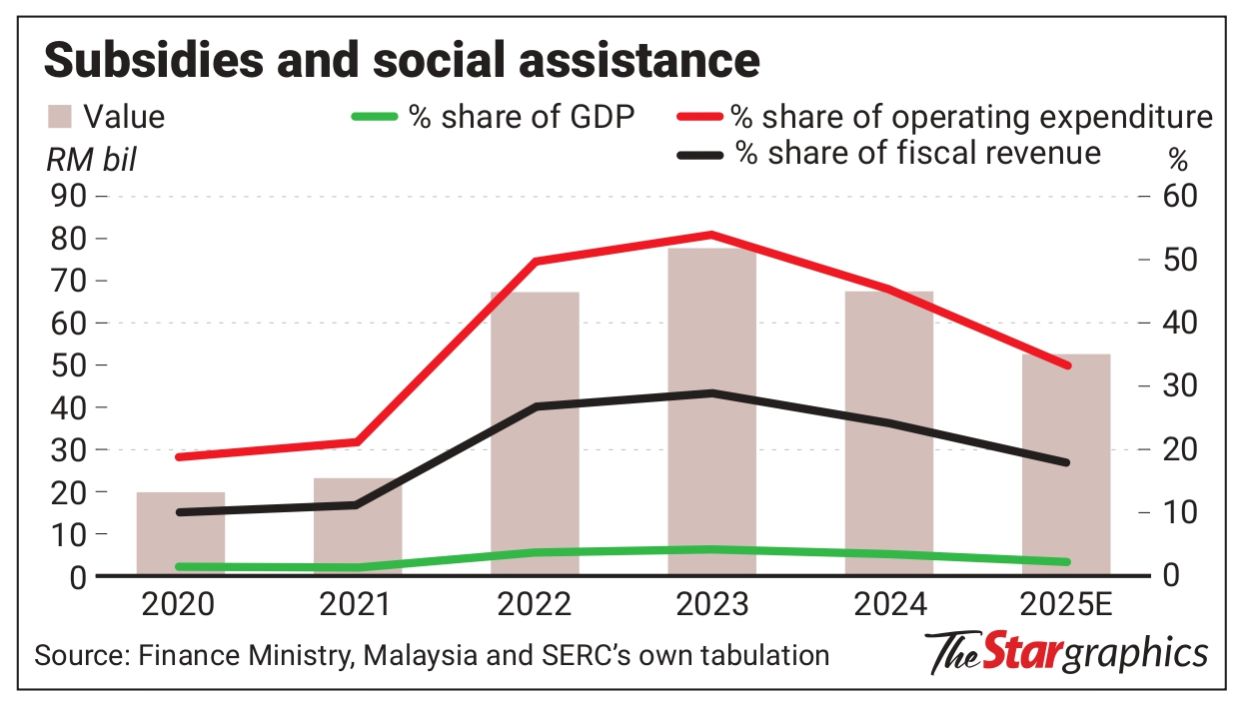
In Malaysia, subsidies and social assistance constituted the second-largest component of total operating expenditure, with an average share of 17.9% a year from 2020 to 2025.
Expenditure on subsidies and social assistance increased by an average of 7.1% a year from 2008 to 2019, rising from RM10.5bil in 2007 to RM23.9bil in 2019, taking its share to total expenditure to an average of 15% a year during the time frame.
Growth in subsidies and social assistance expanded strongly by an average of 21.6% a year to RM52.6bil (15.7% of total expenditure) in Budget 2025 from RM19.8bi in 2020 (8.8% of total expenditure).
This expenditure surged to RM67.4bil in 2022 and RM77.9bil in 2023 before dropping to RM67.4bil last year and RM52.6bil in Budget 2025.
About 60% to 64% was channelled to subsidies in 2024 to 2025 while the balance was for social assistance and incentives.
Based on publicly available data from the Finance Ministry (See Table 1) and other sources, the government spent RM223.5bil on subsidies or 8.9% of the total operating expenditure from 2012 to 2022.
The bulk of the subsidies was mainly for fuel at 71.6% while the rest was for interest rates, agricultural inputs, cooking oil, electricity, toll compensation, transportation, and chicken and eggs.
Total subsidies for RON95 petrol increased substantially by 571%, from RM2.9bil in 2019 to RM19.8bil in 2023 and RM18.4bil in 2024.
Based on a Khazanah Research Institute research report covering 2012 to 2020, the number of federal social assistance and subsidy programmes increased to 137 in 2020 from 95 in 2012
After the Covid-19 pandemic recovery in 2021 to 2022, the government embarked on the difficult move to streamline subsidies and reform market and price structures for goods and services, moving away from government controls towards market-based systems to reflect true costs and demand.
This included phasing out price controls and subsidies for chicken and the full removal of egg subsidies.
Diesel saw the phasing out of blanket subsidies to prevent leakage and smuggling.
Electricity tariffs, including monthly adjustments to the Automatic Fuel Adjustment mechanism, were fine-tuned to align electricity prices with market fluctuations to improve transparency in fossil-fuel costs, encourage energy efficiency and adoption of clean energy.
The latest rationalisation of RON95 petrol subsidies places a cap of 300l of the fuel for Malaysians while floating the price for non-eligible consumers.

See Table 2 on fiscal savings from subsidy rationalisation and price reforms.
The phased subsidy rationalisation underscores the government’s commitment to fiscal consolidation, which involves increasing tax revenue via a broadening of the revenue base, enhanced revenue collection, and better expenditure management as well as better management of cash balances to reduce borrowing and interest costs.
Implementing and institutionalising a systematic process for subsidy rationalisation entails subsidy reviews and adjustments.
This allows economic actors to better adjust to domestic and global realities.
For households, the removal of subsidies and price controls can result in positive behavioural changes in the consumption of goods and services, shifting to increased consumption of alternatives, such as public transport, electric vehicles, alternative energy sources, and a more efficient allocation of resources.
Subsidy rationalisation can cause concern over general short-term economic and financial impacts such as potential inflation, reduced real income for households, higher costs for business.
As such the government has implemented mitigating measures such as cash transfers to vulnerable households, set consumption quotas for subsidised goods as in the case of fuel and provided targeted support to specific industries such as transportation and logistics players to help them adjust to the new market conditions.
To address these concerns, subsidy rationalisation and price reforms must be accompanied by the government’s long-term commitment to following through on transparent and well-informed changes in prices as well as adequate social safety nets for vulnerable groups.
A functioning social safety net should be in place to ensure low-income groups can be protected from price increases and, thus, avoid public pressure to reintroduce subsidies.
Successful implementation of an automatic pricing mechanism can facilitate the transition to liberalised pricing by getting the public used to frequent changes in domestic energy prices.
Successful and durable targeted reforms require a depoliticised mechanism for setting prices, especially fuel prices.
Many countries have implemented reforms only to see subsidies reappear when international oil prices increase.
Automatic pricing mechanisms can help reduce the chances of reform reversal.
The current structure, with subsidised RON95 fuel sold at RM1.99 per litre and a monthly quota of 300l against a market price of RM2.60 per litre, requires more clarity.
The government has to be more transparent in the setting of the non-subsidised price, with the difference of RM0.61 per litre representing the subsidy. Is there a cap on the amount of the fuel subsidy per litre?
Useful information to be disseminated includes the magnitude of subsidies and how they are funded as well how the savings will be utilised.
Releasing data enhances transparency, leading to better decision-making, increased public trust, and better accountability.
While there is growing recognition subsidy rationalisation is necessary to manage fiscal sustainability, curb wastage, and reallocate resources, there is often little confidence the government will use savings wisely.
The worry is corruption and lack of transparency in the management of public finances, and inefficiencies in public spending.
Some may also resist the removal of subsidies because they are viewed as one of the few concrete benefits they receive from the government.
Backed by the Public Finance and Fiscal Responsibility Act 2023 and the impending enactment of Government Procurement Bill 2025, effective financial management systems are crucial to ensuring subsidies and cash assistance reach intended recipients.
The system must accurately identify and validate beneficiaries and prevent the risk of fraud and duplication.
Lee Heng Guie is the executive director of the Socio-Economic Research Centre. The views expressed here are the writer’s own.