
PETALING JAYA: While corporate Malaysia’s manufacturing sector is anticipated to come under pressure in the second half of the year (2H25) as the manufacturing activities of several key Asian economies slow down, it is not expected to be significant.
This is attributed to the country’s strong domestic demand and its diversified and wide export base.
Asian export powerhouses such as Japan, South Korea and Taiwan saw their manufacturing activity shrink in August due to weak overseas demand and the ongoing impact of US tariffs.
The situation highlights challenges for export-reliant nations, although the Philippines, Indonesia, Malaysia and Singapore saw an expansion in their August manufacturing activity.
The seasonally adjusted S&P Global Malaysia Manufacturing Purchasing Managers’ Index edged up to 49.9 in August from 49.7 in July.
A reading below 50 signals a contraction while one above that threshold suggests expansion.
China’s manufacturing activity unexpectedly returned to growth last month on the back of a recovery in new orders and export business, underpinned by an extended truce in the trade war with the United States.

Sunway University economics professor Yeah Kim Leng, who is also a government adviser, said manufacturing expanded by 4% year-on-year (y-o-y) in 1H25, quicker than in 1H24’s growth at 3.5%.
He said it suggests some front-loading effects, as the second quarter of the year (2Q25) manufacturing growth was slightly lower at 3.9% than 1Q25’s 4.2%.
“Earlier concerns over a sharp slowdown this year have dissipated slightly as manufacturing output growth appears to be holding up in both domestic and export-oriented industries.
“In particular, electrical and electronics (E&E) recorded a robust 7.5% expansion in 1H25 compared to 2.2% in 1H24.
“Nonetheless, US import demand is expected to slow down with US President Donald Trump’s tariff hikes coming into effect in 2H25 amid continuing tariff uncertainties for a number of US trading partners,” he told StarBiz.
Yeah said, while Malaysia’s export-orientated manufacturing is expected to slow down in line with regional countries’ shrinking manufacturing activity Malaysia’s domestic demand remains buoyant and this will provide support for positive manufacturing growth in 2H25.
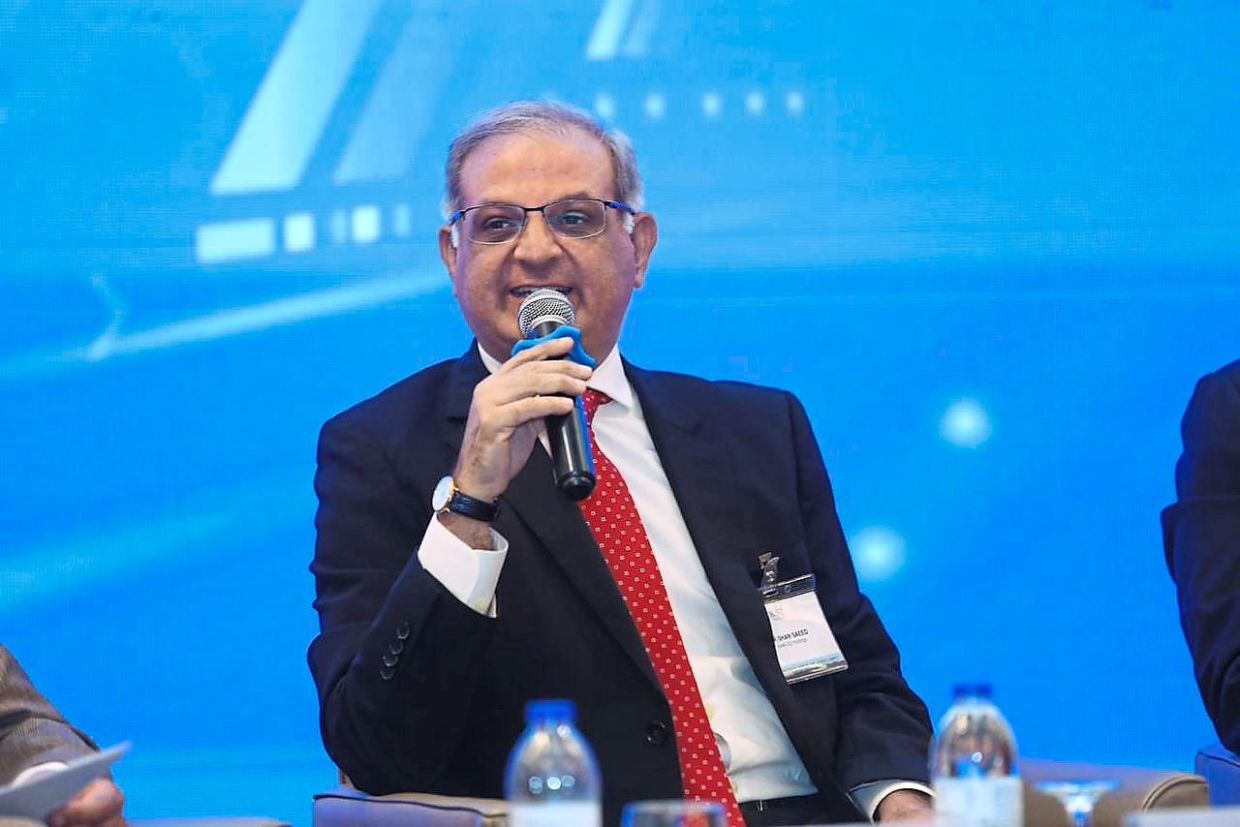
Shan Saeed, who is global chief economist at international real estate technology group Juwai IQI, said while some front-loading of exports to the United States may taper off in the coming months, he does not anticipate a significant slowdown in Malaysia’s manufacturing activities.
“Unlike Japan and South Korea which recorded contractions in August, Malaysia enjoys a broader export base, diversified across Asean, the Gulf Cooperation Council countries and Africa,” he said.
“The geographical spread cushions the downside risk of weaker shipments to the United States.
“Moreover, Malaysia’s strong positioning in the information and communication technology (ICT), semiconductors, data centres, E&E and liquefied natural gas (LNG) exports provides structural resilience compared to north-east Asian peers that are more concentrated in cyclical electronics,” he added.
He said within the manufacturing landscape, some sub-sectors, particularly consumer electronics and apparel, may face pressure in 2025 due to softer US and European demand.
However, high-value sectors such as E&E, ICT hardware, and LNG are expected to remain robust.
Furthermore, he said Malaysia is also strengthening its role as a global semiconductor assembly and testing hub, backed by over RM55.8bil in new E&E investments last year.
“With manufacturing currently a significant contributor to the nation’s gross domestic product (GDP), we expect this sector to remain broadly stable for this year.
“Any cyclical slowdown in low-value segments is likely to be offset by capacity expansions in semiconductors, green energy components and digital infrastructure.
“The government’s continued infrastructure build-out and commitment to Industry 4.0 also supports medium-term growth momentum.
“Infrastructure investment has direct correlation with GDP growth. The idea was coined the famous economics Nobel Laureate Robert Fogel from University of Chicago in the United States in 1964,” Shan noted.

OCBC senior Asean economist Lavanya Venkateswaran expects manufacturing activities in the country to slow in the coming quarters driven by slower output in external oriented sectors.
“Our forecast is for industrial production (IP) growth to slow to 1.3% y-o-y in the second half of 2025 from 4% in the first half of the year, as the impact of frontloading activities fade, higher tariff rates start to bite, and broader external demand conditions weaken.
“We expect the slowdown to reflect in external oriented sectors including chemicals, rubber processing, machinery, and equipment.
“IP for electrical and electronics products could hold up until semiconductor tariffs are announced.
“The anticipation of higher tariffs, however, will likely preclude firms from bringing more productive capacity on board in the near-term,” Lavanya said.
She said the manufacturing sector share of GDP was 23.1% in the first half of the year contributing 0.9 percentage point (pp) to headline GDP growth.
It is a significant contributor to GDP, she said, noting that for 2025, OCBC expects the contribution of the manufacturing sector narrowing to 0.6pp from one pp in 2024.

Bank Muamalat Malaysia Bhd chief economist Mohd Afzanizam Abdul Rashid expects some weakness in Malaysia’s manufacturing sector, especially the export-oriented industries.
He said this was in line with slower export growth in some regional economies.
He said the tariff exemptions in the semiconductor sector has allowed the growth in E&E, which grew by 17.4% in the seven months of 2027 and accounted for 43.5% of total exports, and which has managed to buffer the decline in some export products.
On whether he expects weakness in the local manufacturing activities to impact the nation’s economic growth, Mohd Afzanizam said: “We are still maintaining our GDP growth projection of 4.1%.
“The pre-emptive overnight policy rate cut in July as well as expansionary fiscal policy would provide a booster to the domestic demand.
“In addition, Malaysia’s labour market is still in full employment status which means most adult Malaysians are employed and have been getting their income.
“This would allow them to spend. Of course, there are structural issues such as underemployment, stagnating wages and skills mismatched which will continue to present challenges to the labour market,” he said.
However, he said this would require long term policies on education, healthcare and infrastructure that would require time in order to see its impact.
“The immediate concern now will be how the short-term growth would fare in the remainder of 2025 and macroeconomic policies such as monetary and fiscal policies will be the main tools that will be used in order to steer the aggregate demand,” Mohd Afzanizam said.
OCBC’s Lavanya expects the second half 2025 GDP growth to slow down to 3.5% y-o-y from 4.4% in the first half of the year, as the frontloading effects of exports to the United States fade, broader external demand conditions slow and domestic demand slows modestly.
She projects the full year 2025 GDP growth to be at 3.9%. Malaysia is projecting a GDP growth of 4% to 4.8% for this year, a reduction from its previous forecast of 4.5% to 5.5%.
Yeah said while downside risks have increased, supportive domestic conditions such as low inflation and interest rates, stable labour market with low unemployment rate, wage increases and government cash aids, as well as a healthy pipeline of public and private investment projects, are key factors that would enable the economy to expand above 4% this year.
“While slower manufacturing will lower GDP growth, it is noted that a resilient services sector which is largely domestic demand driven could also help smoothen a negative external demand shock on Malaysia’s output growth given its sizeable 60% contribution to GDP,” he added.