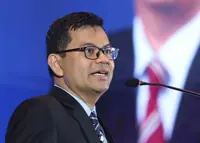
WASHINGTON: The World Bank’s board has agreed to end a longstanding ban on funding nuclear energy projects in developing countries as part of a broader push to meet rising electricity needs, the bank’s president Ajay Banga says.
Banga outlined the bank’s revised energy strategy in an email to staff after what he called a constructive discussion with the board on Tuesday.
He said the board was not yet in agreement on whether the bank should engage in funding the production of natural gas, and if so, under what circumstances.
The global development bank, which lends at low rates to help countries build everything from flood barriers to railroads, decided in 2013 to stop funding nuclear power projects.
It announced in 2017 it would stop funding upstream oil and gas projects beginning in 2019, although it would still consider gas projects in the poorest countries.
The nuclear issue was agreed fairly easily by board members, but several countries, including Germany, France and Britain, did not fully support changing the bank’s approach to embrace upstream natural gas projects, sources familiar with the discussion said.
“While the issues are complex, we’ve made real progress toward a clear path forward on delivering electricity as a driver of development,” Banga said, adding that further discussion was required on the issue of upstream gas projects.
Banga has championed a shift in the bank’s energy policy since taking office in June 2023, arguing the bank should pursue an “all of the above” approach to help countries meet rising electricity needs and advance development goals.
In his memo, he noted that electricity demand was expected to more than double in developing countries by 2035, which would require more than doubling today’s annual investment of US$280bil in generation, grids and storage.
The Trump administration has been pushing hard for ending the ban on nuclear energy projects since taking office.
The United States is the bank’s single largest shareholder – at 15.83%, followed by Japan with 7% and China with close to 6% – and the bank’s decision to broaden its approach to energy projects will likely please President Donald Trump, who withdrew the United States from the Paris Climate Agreement and its emission-reduction targets as one of his first acts in January.
About 28 countries already use commercial nuclear power, with 10 more ready to start and another 10 ready by 2030, according to the Energy for Growth Hub and Third Way.
Banga said the World Bank Group would work closely with the International Atomic Energy Agency to strengthen its ability to advise on nuclear non-proliferation safeguards and safety. — Reuters