
WHEN the fourth quarter (Q4) gross domestic product (GDP) data was released last month, one of the most startling revelations made by Bank Negara was the surprise jump in net foreign direct investments (FDIs) that were registered for the quarterly period.
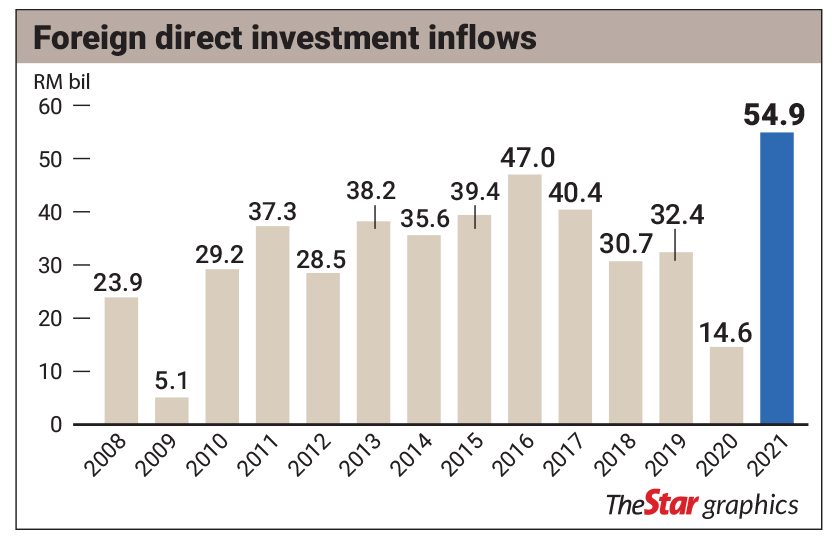
As we are aware, Malaysia has not been doing well in attracting large FDIs for a while now and the performance for 2020 was a talking point among many economists and market enthusiasts as net FDIs for the year then fell to just RM14.6bil, down 54.7% year-on-year (y-o-y).
The 2020 net FDI was the lowest since the RM5.1bil net FDI amount that was recorded in 2009, post-Global Financial Crisis.
Of course, one of the clear reasons as to the drop in 2020 itself was the change at the federal government level when the Pakatan Harapan government collapsed, while Covid-19 and the subsequent economic lockdown made matters worse for Malaysia in attracting FDIs.
Before the release of the Q4 2021 data, Malaysia seems to have been back on its feet as nine-month cumulative net FDIs surged to RM30.2bil, and clearly the year 2021 was going to be better as far as net FDIs are concerned.
RM24.7bil in net FDIs in Q4 2021
An astonishing figure by any standard as the Q4 net FDIs were higher than the previous record-high quarterly net FDIs of RM19.5bil posted in Q1 of 2017 by as much as 26.8%.
The year 2021 also recorded the highest gross FDI inflow of RM194.5bil, up 39.5% y-o-y, while FDI outflow expanded at a slower pace, rising by 11.9% y-o-y to reach RM139.6bil, thus resulting in net FDI of RM54.9bil in 2021, the highest ever recorded (see chart).
Of the total amount, the Q4 period alone saw some RM70.2bil in FDI inflows, accounting for 36.1% of the total gross inflow for 2021, which is also a new record high for quarterly gross inflow.
Manufacturing-focused FDIs
Malaysia continues to enjoy a brisk and sustained inflow of FDIs in the manufacturing sector whereby some RM115.0bil of gross inflow was recorded last year, based on data from Bank Negara.
This accounts for about 59.1% of the total gross inflow.
Next to the manufacturing sector is the finance and insurance/takaful sub-sector where some RM34.1bil in gross inflows were recorded in 2021 and accounted for 17.5% of the total.
The wholesale and retail trade sub-sector was the third-largest recipient of FDI flows with RM18.6bil, accounting for 9.6% of the total in 2021.
While the manufacturing sector is always the key magnate for FDIs, it is interesting to note that both the finance and insurance/takaful sub-sector and the wholesale and retail trade sub-sector are seeing substantial interest among investors.
Not only do these two sub-sectors contribute significantly to the growth in 2021 but the data shows that last year’s gross inflow for the finance and insurance sub-sector was almost equivalent to the combined amount received in 2019 and 2020, while for the wholesale and retail sub-sector, growth of 26.5% was recorded year-on-year.
Malaysia must move away from resource-based FDIs
The trend seen in 2021 with respect to FDI inflows into services-based sectors shows that Malaysia has room to grow the services sector even further in the coming years.
The services sector gross FDIs, which grew by 48% y-o-y against the growth of 33% in the manufacturing sector, presently accounts for 34% of all gross FDIs.
However, as a percentage of the economy, the services sector has the lion’s share of 57% while the manufacturing sector is just under a quarter of the Malaysian economy in terms of GDP output.
Malaysia’s niche in attracting new FDIs in the manufacturing sector is still reliant on selling the country as a cheaper cost alternative, be it in the form of wages and utility cost, and driven by an abundance of tax incentives.
On the other hand, the services sector is less labour intensive, especially in the finance and insurance sub-sector, although the same cannot be said for the wholesale and retail trade sub-sector.
Based on statistics provided by the Malaysian Investment Development Authority (Mida), Malaysia recorded a total approved FDI valued at RM208.6bil for 2021, more than triple the previous year’s total of RM64.2bil.
The manufacturing sector took in the lion’s share of approved FDI, totalling RM179.6bil or 86.1% of the total, while the services and mining industry saw approved investments amounting to RM24.9bil and RM4.1bil, respectively.
Hence, based on the pipeline numbers, it does seem that Malaysia continues to see the dominance of the manufacturing-based FDIs rather than FDIs for services-based industries.
While Malaysia has upped the game on the regional front when it comes to attracting FDIs as seen in both the approved data as provided by Mida and realisation of these investments as seen from the data provided by Bank Negara, more efforts should be made to improve the FDIs that are coming to non-manufacturing activities as we should focus on FDIs that add value to our economy and not those that drain our resources, especially if the choice of Malaysia is driven by cheap cost factors, especially labour and utility cost.
Pankaj C. Kumar is a long-time investment analyst. The views expressed here are the writer’s own.
Already a subscriber? Log in
Get 20% OFF The Star Digital Access
Cancel anytime. Ad-free. Unlimited access with perks.