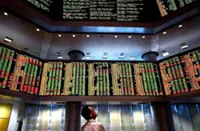
NEW YORK: U.S. stocks plunged in highly volatile trading on Monday, with the Dow industrials falling nearly 1,600 points during the session, its biggest intraday decline in history, as investors grappled with rising bond yields and potentially firming inflation.
The benchmark S&P 500 and the Dow suffered their biggest percentage drops since August 2011 as a long-awaited pullback from record highs deepened.
The financial <.SPSY>, healthcare <.SPXHC> and industrial <.SPLRCI> sectors fell the most, but declines were spread broadly as all major 11 S&P groups dropped at least 1.7 percent. All 30 of the blue-chip Dow industrial components finished negative.
With Monday's declines, the S&P 500 erased its gains for 2018 and is now down 0.9 percent in 2018.
Many investors have been bracing for a pullback for months, as the stock market has minted record high after record high with investors encouraged by solid economic data and corporate earnings prospects, the latter bolstered by recently passed U.S. corporate tax cuts.
Friday's January jobs report sparked worries over inflation and a surge in bond yields, as well as concerns that the Federal Reserve will raise rates at a faster pace than expected.
"The market has had an incredible run," said Michael O’Rourke, chief market strategist At JonesTrading In Greenwich, Connecticut.
"We have an environment where interest rates are rising. We have a stronger economy so the Fed should continue to tighten ... You're seeing real changes occur and different investments are adjusting to that," O'Rourke said.
The Dow Jones Industrial Average <.DJI> fell 1,175.21 points, or 4.6 percent, to 24,345.75, the S&P 500 <.SPX> lost 113.19 points, or 4.10 percent, to 2,648.94 and the Nasdaq Composite <.IXIC> dropped 273.42 points, or 3.78 percent, to 6,967.53.
The S&P 500 ended 7.8 percent down from its record high on Jan. 26, with the Dow down 8.5 percent over that time.
Even with the sharp declines, stocks finished above their lows touched during the session. At one point, the Dow fell 6.3 percent or 1,597 points, the biggest one-day points loss ever, as it breached both the 25,000 and 24,000 levels during trading.
The stock market has climbed to record peaks since President Donald Trump's election and remains up 23.8 percent since his victory. Trump has frequently touted the rise of the stock market during his presidency.
As the stock market fell on Monday, the White House said the fundamentals of the U.S. economy are strong.
The CBOE Volatility index <.VIX>, the closely followed measure of expected near-term stock market volatility, jumped 20 points to 30.71, its highest level since August 2015.
Until recently, gains for stocks have come as the market has been relatively subdued, and any declines were met with buyers looking for bargains.
“People who have been buying the dip are now going to be selling the rip," said Dennis Dick, a proprietary trader at Bright Trading LLC in Las Vegas. "The psychology of the market changed today. It’ll take a while to get that psychology back.”
About 11.5 billion shares changed hands in U.S. exchanges, well above the 7.6 billion daily average over the last 20 sessions.
Declining issues outnumbered advancing ones on the NYSE by a 8.64-to-1 ratio; on Nasdaq, a 6.92-to-1 ratio favored decliners.
The S&P 500 posted 1 new 52-week highs and 38 new lows; the Nasdaq Composite recorded 17 new highs and 164 new lows. 37.32 - Reuters
Fact Box:
** The S&P 500's <.SPX> 4.10 percent slump on Monday was the deepest one-day percentage drop since Aug. 18, 2011, when the index fell 4.46 percent over fears about a weakening economy;
** Since last Thursday's close, the S&P 500 has declined 6.13 percent, its deepest two-session loss since August 2015;
** The S&P 500 is down 7.79 percent from a record closing high on Jan. 26, and has declined 0.92 percent year-to-date. Monday was the first time in 2018 that the S&P 500 closed in negative territory for the year-to-date;
** The Dow Jones Industrial Average's <.DJIA> 4.6 percent loss on Monday was its largest in percentage terms since August 10, 2011, and the day's 1,175 point loss was its largest ever in absolute terms. The index was briefly down more than 6 percent before recovering;
** Wall Street has been in a nine-year bull market that has tripled the S&P 500's value since the 2008/2009 financial crisis. Investors in recent months have become more wary of a pullback;
** The Dow's worst-performing stock on Monday was Boeing
** Microsoft
** Around 6,986 U.S. stocks fell during the session, the greatest number in a single session since September 2016;
** Trading volume on Wall Street reached 11.5 billion shares, the highest since November 2016.
Comments:
JACK ABLIN, CHIEF INVESTMENT OFFICER, CRESSET WEALTH ADVISORS, CHICAGO.
“One thing is that going into the last week or so, investor bullishness was in the top decile of its historical range, which suggests that investors were pretty optimistic, with high expectations and largely complacent. There’s kind of an emotional reversal that’s going on.”
“I also think that perhaps this did coincide with the transition of Fed chairs from Janet Yellen to Jerome Powell. Investors don’t know much about Powell, where we did really know a lot about Yellen before she took her role."
GREG ADAMSICK, DIRECTOR OF GLOBAL FUTURES AND OPTIONS, RCM ALTERNATIVES, CHICAGO
“Equities had had such a muted reaction to higher yields. We reached a point that yields reached high enough that stocks look vulnerable. When S&P 500 broke 2,700, a lot of sell orders were activated. You have a lot of index exposure through passive investing with ETFs. Once the indexes get hit, selling follows."
JOE SALUZZI, CO-MANAGER OF TRADING, THEMIS TRADING, CHATHAM, NEW JERSEY:
"It looks to me like a typical type of scenario when you see a single stock flash crash where you'll see bids just disappear, stop orders get kicked, in those particular names. The overall market could have taken a cue from some of the bigger names. There was also heavy futures activity at the time as well."
"It's tough to blame any particular person or event but it tells you the type of structure we have now certainly can't handle this type of volatility and volume still."
"I think there's still going to be pressure. There's going to be more. But then I think we're going to firm up. People will realize that the event we've been waiting for is now over. But the event has to get itself out of the way first."
STEVE WACHTEL, PORTFOLIO MANAGER, SSI INVESTMENT MANAGEMENT, LOS ANGELES
“Sharper sell-off than we expected but it’s technical based with mostly the machines selling. Seemed like there was a minor flash crash there around noon. We look at the credit markets closely when there is a large equity sell-off and the credit markets are still very healthy, just moderate spread widening today.”
NAEEM ASLAM, CHIEF MARKET ANALYST, THINKMARKETS, LONDON
“I have a strong feeling that this selloff is going to intensify because bears are seeing blood on the Street and all they want is right in front of them.”
LARRY MILSTEIN, HEAD OF GOVERNMENT AND AGENCY TRADING, R.W. PRESSPRICH & CO., NEW YORK
“We had a nice bounce from the lows there. It’s unsettled where we go from here at this point. Some technical levels were hit in the equity market where selling beget more selling. It was probably some ‘blackbox,’ algo selling in stocks and buying in bonds.
DENNIS DICK, PROPRIETARY TRADER, BRIGHT TRADING LLC, LAS VEGAS
“You’ve got to be prepared for all types of markets, and a lot of people who have been in this market for the past three or four years have never seen this before.”
“People who have been buying the dip are now going to be selling the rip. The psychology of the market changed today. It’ll take a while to get that psychology back.”
JEFFREY KLEINTOP, CHIEF GLOBAL INVESTMENT STRATEGIST, CHARLES SCHWAB & CO, BOSTON
"I certainly don't see anything fundamental. It wasn't driven by any macro event, rather it appears to be computer driven trading that led to an order imbalance. These things can happen quickly and tend to be corrected quickly.
"Last week we saw a broad pullback that was macro related. Instead of being tied to fears of economic weakness it was tied to too much growth and fears of inflation. Certainly fears that the Fed in the U.S. might get more aggressive in reigning in stimulus. But as long as growth remains intact, and we believe it will, stocks should rebound."
LOU BRIEN, MARKET STRATEGIST, DRW TRADING, CHICAGO
“The velocity of the market selloff picked up. For the first couple of days of it there hadn’t been much of a reaction in the long-end of the treasuries. Usually during a selloff there will be some kind of reaction. The magnitude of the selloff versus how far it’s come really didn’t raise any alarm bells in the stocks until the velocity picked up this afternoon.
"Partly, I think the argument could be made too that the heightened inflation expectations from the tax bill and from infrastructure output, and then you had that very misleading wage number the other day, all fed into inflation expectations and it wasn’t that the Fed was going to raise rates to much it was that they weren’t going to be quick enough.”
MICHAEL O’ROURKE, CHIEF MARKET STRATEGIST, JONESTRADING, GREENWICH, CONNECTICUT
"People who were not active, who tend to be in index products were looking to take profits today. They don't price until the end of the day. They probably put orders in to sell and book some profits."
"These orders have to be done by the end of the day. You want to make sure you get them done."
MARKETS:
BONDS: The 2-
FOREX: The dollar index <.DXY> was up 0.33 percent.
VIX: The Cboe volatility index more than doubled to 35.73, its highest since August 2015 and was last up 14.84 at 32.15. - Reuters
Already a subscriber? Log in
Get 20% OFF The Star Digital Access
Cancel anytime. Ad-free. Unlimited access with perks.