
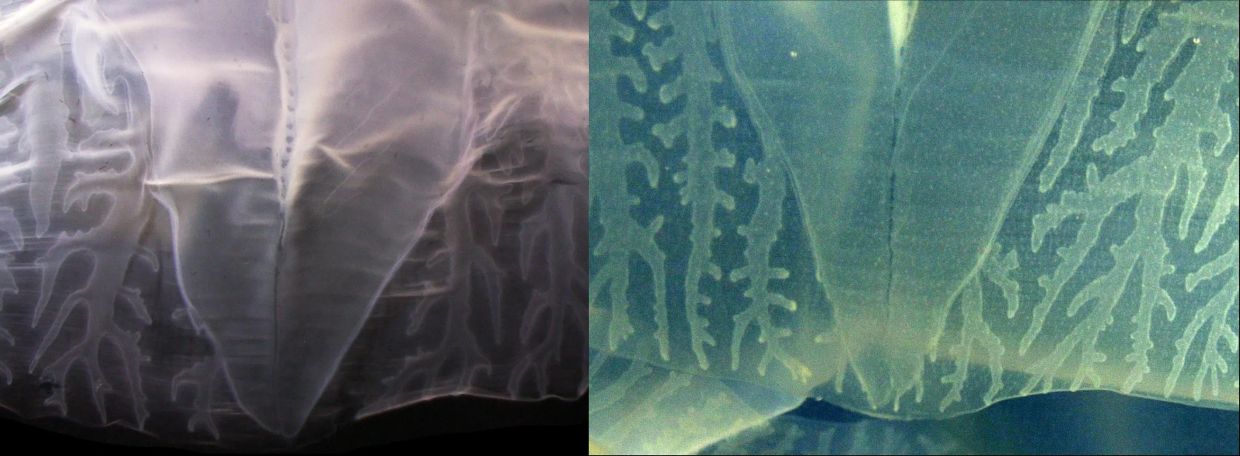
This is the first discovery of a jellyfish of the Chironex genus since 2017, adding to one of the world’s most venomous animal groups.
The researchers from Tohoku University and the National University of Singapore’s Lee Kong Chian Natural History Museum and Tropical Marine Institute have named this new species Chironex blakangmati, after Sentosa’s original name: Pulau Blakang Mati, or Island of Death Behind.
It is the fourth known species of box jellyfish in the Chironex genus in the world.
The precise population of this new species of venomous jellyfish in Singapore’s waters remains unknown. So far, confirmed sightings have been both rare and sporadic.
The researchers advised beachgoers to take precautions while swimming in the ocean, such as by wearing covered swimsuits and using a high-visibility buoy if away from shore.
The research project received funding from the Tohoku University & Japan Agency for Marine-Earth Science and Technology (JAMSTEC) Advanced Institute for Marine Ecosystem Change (WPI-AIMEC) and the Sasakawa Peace Foundation’s Ocean Shot Project.
Named after their cube-like bell, box jellyfish are a carnivorous species considered highly advanced among jellyfish. Unlike other jellyfish, they are able to swim, rather than simply floating on the current. They have also developed the ability to see, allowing them to target prey more effectively.
Being transparent, box jellyfish are also extremely difficult to spot, which in combination with their highly venomous tentacles makes them a dangerous swimming partner. The Chironex genus is particularly dangerous, earning the nickname of ‘sea wasps’, with venom so strong that their sting can be fatal to humans.
While box jellyfish stings do not occur frequently in Singapore, swimming was temporarily banned in Sentosa’s Siloso Beach in 2020 after box jellyfish were sighted in the waters around the area.
A recent death is the widely-reported case of a two year-old Russian boy who died due to complications after a box jellyfish sting in Langkawi in Nov 2025.
Before its discovery, this particular species of box jellyfish was assumed to be one of the three previously known species.
“C. blakangmati looks remarkably like Chironex yamaguchii - a jellyfish species I first discovered in Okinawa while doing my master’s degree there” explained researcher Cheryl Ames, a professor at the Graduate School of Agricultural Sciences and Advanced Institute for Marine Ecosystem Change (WPI-AIMEC), Tohoku University & JAMSTEC.
“But we realized they were completely distinct. I actually went back to dust off an old sample of C. yamaguchii I still had in storage in Okinawa to help with the comparisons.”
After conducting genetic analysis to determine if the two species were distinct, the research team also identified a visual difference between them.
Uniquely among the Chironex genus, C. blakangmati lacks pointed canals on its perradial lappets, a muscular flap used to support the velarium, another flap that the jellyfish use to propel themselves forward. This anatomical distinction confirmed that this was a fourth separate species.
Besides the new species, the team also found samples of Chironex indrasaksajiae, the first time this species of jellyfish has been reported in Singaporean waters. It is usually found in Thai waters, further north of Singapore.
“We were surprised to find C. indrasaksajiae so far away from Thailand,” says Ames, “Recording range expansions like these is really important, as we currently know so little about the biodiversity and spatial distribution of box jellyfish.”
Research projects such as these remain necessary to create the best possible guidelines and safety procedures to protect beachgoers.
The National Parks Board (NParks) reccommends covering as much exposed skin as possible, avoiding venturing into the ocean alone and bringing a bottle of plain vinegar with you as precautions against jellyfish stings.
Plain vinegar is known to prevent box jellyfish tentacles from releasing more venom when poured onto the sting. It is also advised to stay clear of any jellyfish in sight, either in the water or on the beach.
Victims stung by a jellyfish should stay calm and seek immediate medical attention.
Do not attempt to remove the tentacles with bare hands as this can cause them to release more toxins.
Instead, flood the area with seawater or plain vinegar for at least 30 seconds, before removing the tentacle with a towel or tweezers. But if plain vinegar worsens stings from jellyfish, use only seawater to flush the area.
For further information, visit the NParks website. - The Straits Times/ANN