




Scientists have discovered a thriving and previously unknown ecosystem in the planet’s deepest ocean trenches, feeding on organic debris from above.
At those depths the pressure is enough to crush a submarine, and combined with perpetual darkness and temperatures near freezing, it makes the deepest reaches of the oceans among the least explored places on Earth.
Until now, researchers believed that only a few anemones, sponges or bacteria could survive under such conditions.
But an international research team supported by China’s crewed submersible the Fendouzhe, or Striver, has uncovered an unexpectedly rich community living on rocks in trenches deeper than 9km (5.6 miles).
The team – led by Professor Peng Xiaotong from the Institute of Deep‑Sea Science and Engineering at the Chinese Academy of Sciences – reported their findings in the journal Science on May 14.
“Between 2020 and 2024, we used the submersible Fendouzhe to investigate seven hadal trenches, fracture zones and basins in the Indo‑Pacific region, uncovering previously unknown faunas inhabiting extreme hadal depths,” Peng wrote in the paper.
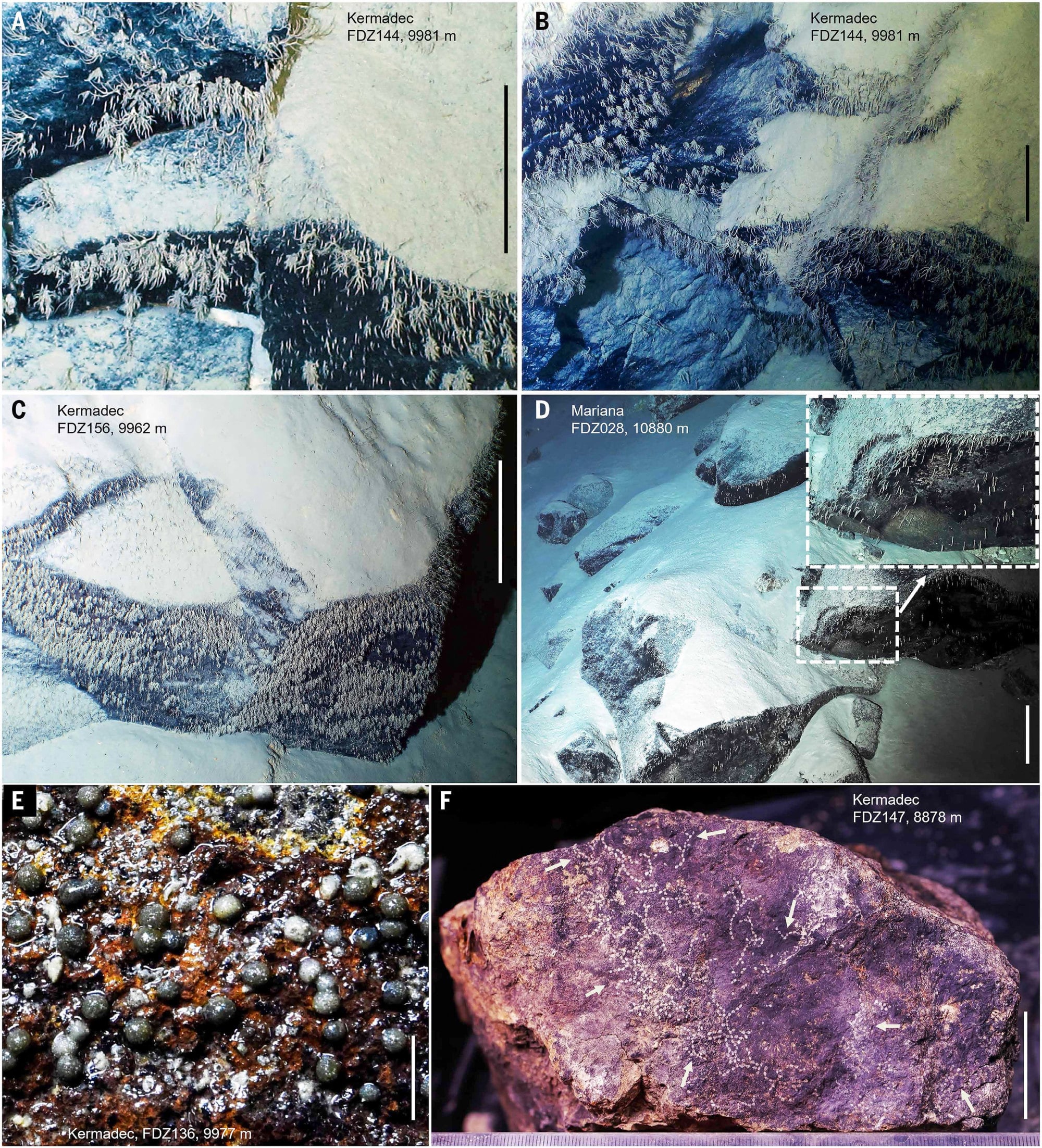
The team recorded 32 species across six phyla, most of them new to science.
“The most unexpected components, however, were four new and much smaller (millimetre‑scale) species that occurred in high densities and dominated the hard‑substrate Kermadec Trench assemblages,” Peng said.
These millimetre‑sized organisms are known as filamentous foraminifera.
Their forms can be thread‑like, tubular, chain‑like or dome‑like – creating what looks like miniature gardens on the rocky sea floor – and there could be up to 4,300 of them packed in per square decimetre.
Scientists once thought these tiny deep-sea organisms might get their energy from symbiotic bacteria, as creatures living near hydrothermal vents do.
But the new study shows they actually “eat dust” – meaning they are heterotrophs that feed on organic debris.
Through genome sequencing, the team found that while these foraminifera host multiple species of bacteria, the bacteria lack the genes needed for chemosynthesis.
Instead, they have genes for breaking down fats and proteins – a clear sign that they live a predatory or scavenging lifestyle.
The researchers also found pine pollen grains inside the organisms, many partly digested. These particles sink from the ocean surface and are carried by deep-sea currents, providing a food supply for these organisms.
Beyond Kermadec and Mariana, the research team has observed similar filamentous protist communities on rocks in the Aleutian, Kuril‑Kamchatka, Atacama and Mussau trenches. This suggests that this protist‑dominated ecosystem could be widespread across the world’s deepest ocean trenches.
Peng estimated that the live biomass carbon of these foraminiferal assemblages amounted to some 2,300 to 14,000 metric tonnes, corresponding to about 2 to 11 per cent of the total eukaryotic biomass carbon in hadal environments.
“Our results suggest that hadal hard‑substrate faunas form an important carbon pool,” Peng said.
“Despite their tiny size, their broad distribution yields a non-trivial eukaryotic biomass, representing a previously unrecognised carbon hotspot in hadal environments.”
Peng’s team previously discovered a new type of mud volcano in the Mariana Trench and they were the first to report that microplastics had reached its deepest point.
Last year, also using the Fendouzhe submersible, they observed the world’s largest chemosynthetic life community near 10km deep. -- SOUTH CHINA MORNING POST



