PHNOM PENH: Nearly six weeks after a ceasefire was meant to quiet the guns along the Cambodia–Thailand frontier, coils of barbed wire and concrete culverts now cut across land inside Cambodian territory at the O’Smach International Border Gate — an area once defined by cross-border trade but now marked by deserted markets, damaged homes and lingering fear among residents.
Thai troops erected barbed wire and installed large-diameter box culverts 420 metres inside Cambodian territory near boundary marker 15 on Dec 28, 2025 — just one day after the ceasefire between the two armies took effect.
The O’Smach International Border Gate, linking Samrong City in Cambodia with Surin Province in Thailand, has served as a key crossing point for travel and trade since its establishment in 2002.
However, Thailand unilaterally closed the gate in June 2025 following escalating border tensions.
Met Measpheakdey, deputy provincial governor of Oddar Meanchey, confirmed during a visit by reporters on Thursday (Feb 5) that the structures were placed well within Cambodian territory despite both governments officially recognising the boundary marker.
“This indicates that the Thai side has aggressively invaded and is not afraid of international scrutiny in violating Cambodian territory,” he said.
He warned that the military presence and defensive construction threaten security in the border zone, forcing businesses to shut down and leaving residents fearful.
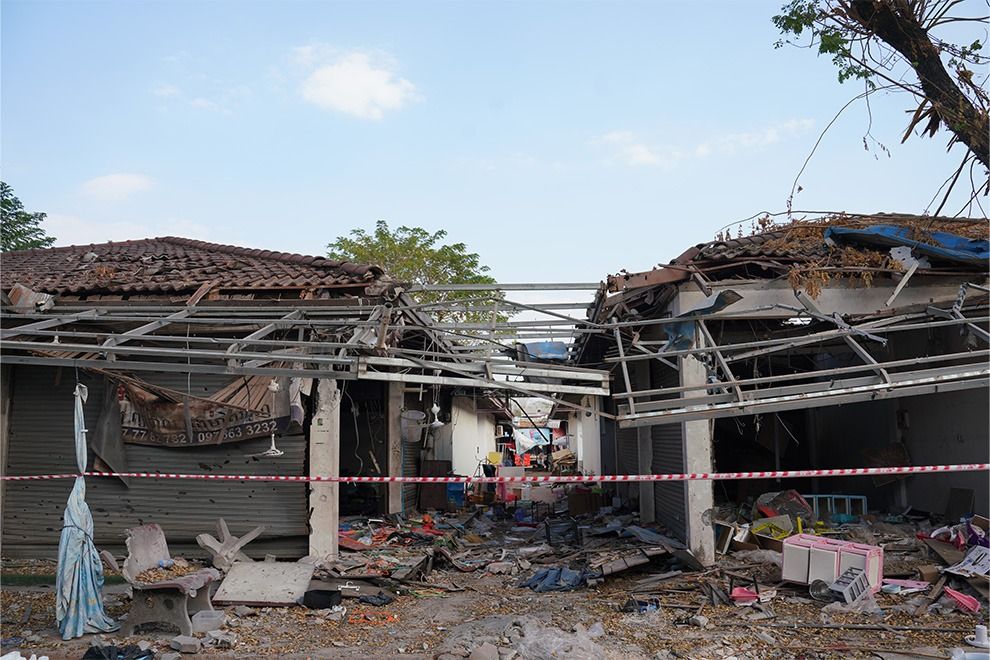
The once-busy O’Smach market — home to more than 600 stalls — has largely ceased operations, while several public service buildings were either closed or damaged during the fighting which took place between Dec 8 and 27.
Pheakdey described the conflict as having far-reaching consequences beyond the immediate border.
The fighting extended up to 100 kilometres inland, affecting areas such as the O’Jik bridge near the Siem Reap frontier and locations close to Phnom Sampov in Battambang province.
Pheakdey said the violence left “two tragedies: the impact on the people and the damage to the sites”.
About 50,000 families in Oddar Meanchey were affected, out of roughly 70,000 evacuated from their homes. In neighbouring Banteay Meanchey province, at least 10 people were killed and 15 injured.
Public infrastructure suffered extensive damage. Authorities reported that 650 civilian houses were hit, nearly 150 of them completely destroyed across 50 villages.
Private businesses — including four hotels and three petrol stations — were also damaged or destroyed, along with numerous vehicles and heavy machinery.
State properties were not spared. Two ancient Khmer temples, Ta Krabei and Chan near Tamone, were bombed, while the O’Jik bridge, four pagodas, three health centres and 15 schools sustained damage.
Pheakdey noted that Thai forces used heavy weapons during the conflict, arguing the scale of operations “was not a border dispute but a war of aggression”.
The humanitarian situation remains fragile. Three safety centres remain open in Oddar Meanchey, sheltering about 7,000 people, while 213 families from three villages still require long-term temporary housing.
The once-busy O’Smach market — home to more than 600 stalls — has largely ceased operations. Hong Raksmey
Evidence of the conflict is visible on National Road 58 in Banteay Ampil district, where a crater left by an MK-84 bomb measures more than 15 metres across and 10 metres deep, according to Jin Bunhoet, deputy head of the Cambodian Mine Action Center’s (CMAC) North Meanchey unit.
Bunhoet said such destruction has effectively cut off transportation routes.
For many residents, the losses are deeply personal. Sun Srey, 40, whose home was destroyed by shelling, recalled fleeing with her family.
“I sat on the ground and cried. All my children were asking, ‘How do we live?’ If we don’t have anything, we can only live in a tent. It’s so sad. I’ve worked hard for half my life to get a house. What else can I do?” she said.
Cambodia registered strong objections after Thai officials led a group, reportedly including journalists, foreign military personnel and US Federal Bureau of Investigation (FBI) officials, on an inspection tour of a site located about 397 metres inside Cambodian territory.
In a Feb 4 press release, the Ministry of Foreign Affairs and International Cooperation said it had lodged a formal protest over the Feb 2 visit in the O’Smach area, describing it as an unauthorised action conducted without Phnom Penh’s consent and a violation of Cambodia’s sovereignty, territorial integrity, international law and the UN Charter.
The ministry said the hotels and locations inspected were situated near Border Post 15 in an area it claims was occupied by Thai armed forces during the December 7–27 offensive.
Cambodia “rejected and strongly objected” to what it called the illegal exercise of Thai sovereignty through organising the visit, warning that it appeared to be an attempt to legitimise the occupation of Cambodian territory and create a new status quo on the ground.
Cambodian officials and analysts further viewed the tour — led by the Thai Army intelligence chief and attended by foreign attachés from 20 countries and international journalists — as an effort to divert global attention toward anti-scam operations rather than the alleged territorial violation.
Despite the tensions, the ministry reaffirmed that Cambodia remains firmly committed to resolving all border disputes peacefully and maintains that borders must not be altered by force.
At the national level, Cambodia has intensified efforts to frame the dispute within international law and human rights mechanisms.
During talks on Thursday (Feb 5) with John C. Coughenour, senior US district judge for the Western District of Washington, Cambodian Human Rights Commission (CHRC) president Keo Remy outlined what he called serious violations by Thai forces, despite the ceasefire.
Remy said Cambodia has consistently respected the 1904 and 1907 Franco–Siamese treaties, which are recognised under international law, while accusing Thailand of relying on a unilaterally drawn map.
He also alleged that Thai forces conducted large-scale operations inside Cambodian territory using heavy weapons, cluster munitions, poison gas and fighter jets.
“These actions constitute serious violations of international law, including human rights and humanitarian law,” Remy said.
Judge Coughenour reportedly expressed support for Cambodia’s restraint and its commitment to resolving the dispute lawfully, while voicing disappointment over what he described as aggressive actions that harmed civilians.
Meanwhile, provincial authorities caution that displaced residents should return only when conditions are secure.
Governor Mean Chanyada explained that the ceasefire “does not automatically mean all areas are safe”, noting that red zones along more than 200 kilometres of border remain off-limits, while yellow zones contaminated by unexploded ordnance require clearance.
“The ceasefire allows people to return, but only when safety can be guaranteed,” he said.
As tensions persist, officials warn that stability along the frontier will depend on dialogue and adherence to international law rather than military pressure — while thousands of civilians continue to grapple with the aftermath of a conflict that has reshaped communities on Cambodia’s northern border. - The Phnom Penh Post/ANN