VIENTIANE: The government has earmarked 2026 as the year when administration systems will go digital, instructing ministries and provincial authorities to take direct responsibility for reform under a unified national roadmap.
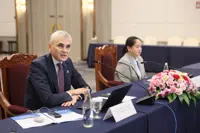
The goal was announced when Prime Minister Sonexay Siphandone chaired a meeting of the National Digital Transformation Committee on Tuesday to review progress to date and outline priorities for the next phase of digital development.
The Prime Minister said digital transformation is no longer the responsibility of a single ministry or technical agency, but a shared national task requiring strong leadership, coordination, and accountability across all sectors and localities.
He emphasised that ministers and provincial governors must personally lead digital transformation efforts in their respective areas.
He also instructed all sectors to develop concrete digital transformation plans based on three core pillars — digital government, digital economy and digital society — and to ensure implementation produces clear and measurable outcomes.
Prior to the Prime Minister’s address, Deputy Minister of Technology and Communications and Head of the National Digital Transformation Committee Secretariat, Mr Keovisouk Solaphom, delivered a progress report.
He said notable advances have been made in enacting and improving laws, decrees, strategies and regulations supporting digital governance, cybersecurity, education, finance, banking and startup promotion. An Artificial Intelligence (AI) Strategy is currently being drafted.
Telecommunications and internet infrastructure has been expanded to cover almost all urban and rural areas, while data centres and electronic signature systems have been established.
The Government Network (G-Net) has been integrated across all ministries and provinces, and the e-Office system has been widely deployed, improving efficiency and coordination within the public sector.
Digital trust and security have been strengthened through the use of electronic signatures in the Ministry of Finance’s revenue and expenditure systems, together with the establishment of a Cyber Security Operations Centre to monitor and protect critical infrastructure.
To safeguard citizens online, authorities have launched the 1533 Online Scam Anti-Fraud Centre, while cybersecurity and cybercrime laws have been updated in line with the United Nations Convention on Cybercrime, which Laos signed in 2025.
The meeting also noted the completion of the electronic population database (e-ID) and issuing of the first electronic ID cards. The 2025 Population and Housing Census was also conducted electronically, creating a vital national database to support future economic and social development.
Digital technologies are increasingly being applied across key sectors. In finance, the successful rollout of Lao QR Payment, now interoperable with ASEAN payment systems, has facilitated cross-border trade and tourism, while the Bank of the Lao PDR continues to pilot a central bank digital currency.
In agriculture, drones are widely used for spraying and fertilising large-scale farms, while blockchain technology is being used to trace the origin of agricultural products such as coffee and fruit for export to Europe and China.
In health and education, telemedicine services connect specialists with patients in remote areas, and AI-based platforms are being used to personalise learning for students.
The expansion of online ticketing for the Laos-China Railway, integrated tourism platforms, GPS tracking and modern warehouse management systems has helped to bolster tourism and strengthen logistics, supporting Laos’ transition from a landlocked to a land-linked country.
Looking ahead, the Prime Minister instructed the relevant agencies to review the Digital Economy Development Plan for 2021-2025 and finalise the National Digital Transformation Plan for 2026-2030 for submission to the National Assembly.
He also called for continued expansion of internet access to remote villages, accelerated development of LaoAI, establishment of an AI Data Centre, improved financial integration through LapNet, and closer linkage of tax, customs and treasury databases with land, vehicle and labour databases to strengthen revenue collection.
Over the next five years, the Prime Minister outlined a phased approach, beginning with a foundation-building phase in 2026-2027, followed by a strengthening phase in 2028-2029, and concluding with a comprehensive review of achievements in 2030.
He said sustained commitment and coordinated action across all sectors will be essential to ensure digital transformation delivers long-term and inclusive benefits for Laos. - Vientiane Times/ANN