If there was a sense of panic gripping European leaders at last week’s conclave of elites at the World Economic Forum, they could be forgiven a moment of relief as they departed the snowy peaks of Davos.
That was not only because US President Donald Trump used a long, rambling speech to rule out taking the Danish territory of Greenland by force.
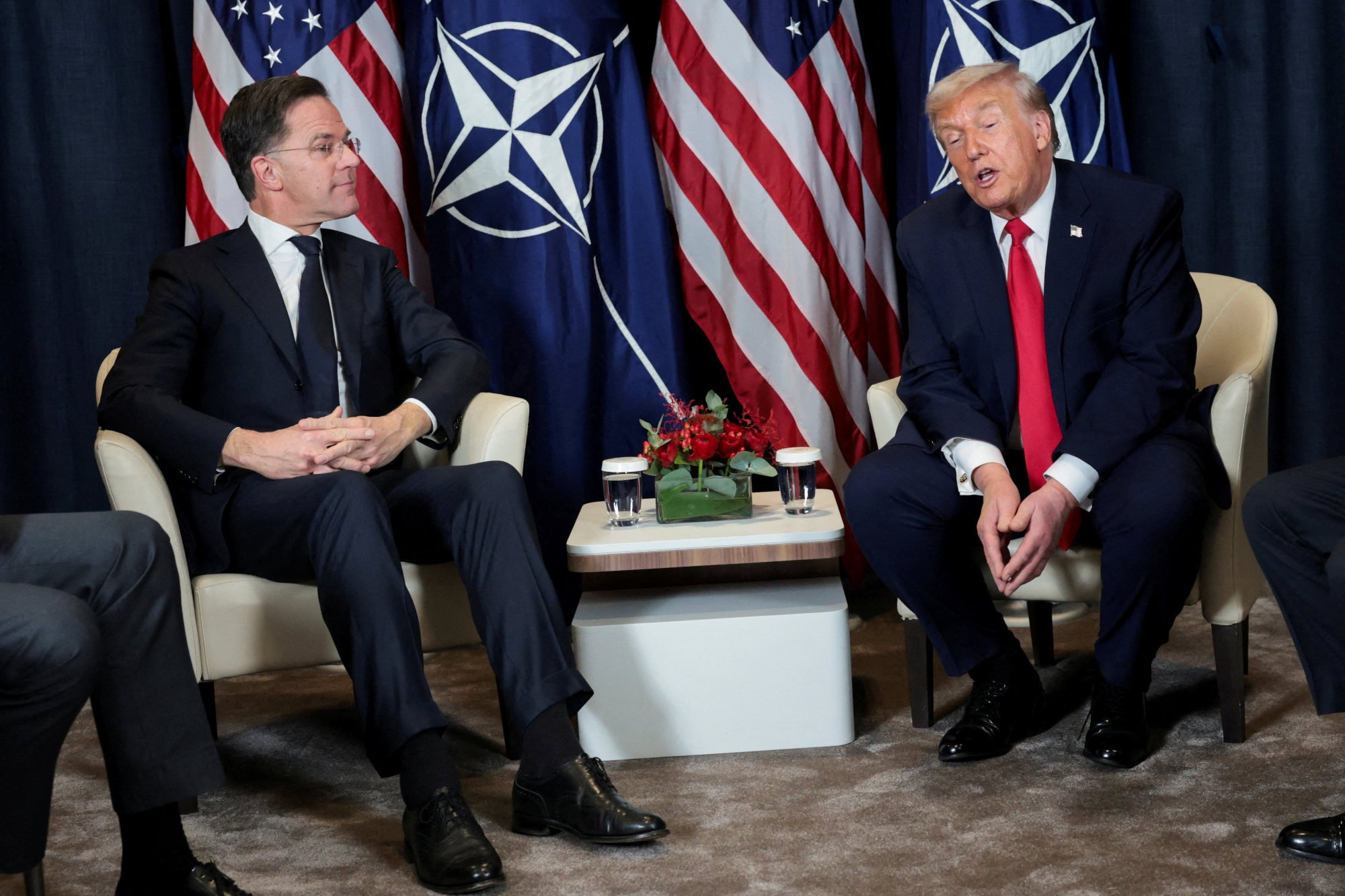
Nor was it just the meeting on the sidelines with Nato chief Mark Rutte, which produced a formula to defuse immediate tensions by designating US military bases on the island as sovereign territory and getting Trump to drop his related tariff threat.
Instead, the relief appeared to come from a different kind of release: the catharsis of saying the quiet part out loud.
Over the course of the week, a succession of European leaders took to the Davos stage to acknowledge publicly what had long been discussed in private, and which many other parts of the world had taken as a given for years: that the rules-based order on which modern Europe was built had gone.
In this vein, the Greenland episode crystallised another point long understood in much of the world, but which is only now dawning on Europe – that law no longer reliably constrains power.
“The calm and peace on the magic mountain in Davos is in stark contrast to a world whose old order is unravelling at breathtaking pace,” said German Chancellor Friedrich Merz.
“This new world of great powers is being built on power, strength and, when it comes to it, force. It’s not a cosy place.”
Belgian Prime Minister Bart de Wever went further still. “We are in a very bad position at the moment,” he said.
“We are dependent on the United States, so we chose to be lenient, but now so many red lines are being crossed ... being a happy vassal is one thing, being a miserable slave is something else.
“If you back down now, you’re going to lose your dignity.”
French President Emmanuel Macron warned that Europe, if it did not react quickly, would be “brutalised” and “vassalised” in this brave new world.
“We are witnessing a shift towards a world without rules, where international law is trampled underfoot, and where the only law that seems to matter is that of the strongest,” Macron said.
The “brutalisation” of Europe, it could be argued, began in earnest last year, where one humiliation seemed to beget the next, in a doom spiral that had European newspapers screaming of a “summer of surrender”.
Faced with Trump’s tariffs and constant threats to side with Russia, last July the European Union was forced into a slapdash deal in which it accepted 15 per cent tariffs – agreed at Trump’s golf course in Scotland – as it sought to bolster support for Ukraine.
This was on the heels of a Nato Summit in June, dominated by Rutte calling the US leader “Daddy”.
This was then followed by a fruitless EU-China summit in Beijing, where Chinese leaders did not budge on the bloc’s concerns, suggesting that a failure to punch back against the US was creating a credibility deficit.
Greenland, however, appears to have been the straw that broke the camel’s back.
Trump has long argued that the US needs the territory for security reasons, citing debunked claims of Chinese and Russian ships circling the island.
This year, his efforts to take over ratcheted up several notches.
After European countries sent small numbers of troops to Greenland, Trump promised tariffs in response. The EU then dusted off shelved retaliatory tariffs from last year and threats to retaliate in kind proliferated.
The spectre of the bloc’s fabled “trade bazooka” – which includes a raft of measures for blocking or restricting trade and investment on countries that exert undue pressure – was raised, as was the prospect of dumping US Treasuries.
Europe, it appeared, had been pushed too far and was jolted into action.
“Three of the five members of the P5 are trying to trample the global order, and China is the least offensive of them,” an EU official said, referring to the five permanent members of the UN Security Council.
“The trouble is we are so used to dealing with structure and logic. But here, there is none of that, so we are struggling with how best to respond. It’s not so much struggling with the end of the system, it’s more that we are the system.”
The official suggested the bloc might not have the same luxury of steamrollering the system, adding: “This is existential for us.”
Even if the Europeans are agreed that the old era is over, they are not quite ready to align on what comes next.
In Davos, leaders sensed that there was still an appetite for a world with rules and predictability, and attempted to present Europe as the fulcrum of this.
“Europe must be the antithesis to state-sponsored unfair trade practices, raw material protectionism, tech prohibition and arbitrary tariffs. Tariffs, again, have to be replaced by rules, and those rules need to be respected,” Merz said.
Macron said that if the bloc “passively accepts the law of the strongest, we will enter a world of vassalisation and bloc politics, where Europe would no longer be a subject of history but an object of it”.
As part of this push, the EU has been signing or trying to sign trade deals with Latin America, India, much of Southeast Asia and the Middle East.
But even in trade, the area where Europe once felt most confident, the contradictions are glaring.
In a sign that not everyone agrees that freewheeling commerce is the answer to Europe’s ills, the European Parliament voted to refer a deal with the South American Mercosur bloc to the courts.
This could add two years to the ratification of a deal that took 25 years to negotiate and hamstring efforts to wean the EU off Chinese critical minerals.
Another question mark over the bloc’s free-trading credentials came from the other side of Switzerland.
As Trump took the Davos stage to complain that globalisation had failed America, the EU was also signalling that it believed the rules must change at the World Trade Organization in Geneva.
On Wednesday, the European delegation circulated a paper calling for a change in the rules to make it easier to impose tariffs. Most-favoured nation status must be earned, not automatic, the paper suggested.
The move lays bare Europe’s identity crisis: it agrees that the system is broken, yet it cannot survive without it. It fears a world where might makes right, yet has no choice but to rearm at a breakneck pace to sustain itself.
Europe is caught between surviving in a carnivorous world and preserving the very foundations on which it is built.
Part of that balance, observers say, requires dropping the diplomatic pretence that once papered over deeper fractures.
“The illegal invasion of Iraq in 2003 greatly damaged that trust in the US. But in the end it was not a turning point for the world order as such, because the US pretended that its war precisely served to uphold the order – even though that was clearly untrue,” said Sven Biscop, a specialist in great power competition at the Egmont Institute in Brussels, drawing the contrast with Trump’s expressed motives for seizing Greenland.
Much of the world is already convinced of Europe’s hypocrisy after it failed to criticise Israel’s bombardment of Gaza with the same vigour that it did Russia’s invasion of Ukraine.
With this in mind, Europe must stop trying to convert others and present itself as a pragmatic player in a chaotic world, said Ivan Krastev, a political scientist from the Centre for Liberal Strategies in Sofia, Bulgaria.
“If before, Europe’s view of the world was very much based on the idea of how we’re going to transform the world, I do believe that now the aim is not to allow others to transform you. Europe for a long time was a missionary, probably now it will become a monastery,” Krastev said.
This sort of honesty won Canadian Prime Minister Mark Carney plaudits at Davos last week, after he said the idea of the international system was a “pleasant fiction” that suited the West.
“We knew the story of the international rules-based order was partially false. That the strongest would exempt themselves when convenient,” he said, calling for middle powers – of which Europe is surely one – to work together on areas of mutual interest.
“Middle powers must act together because if you are not at the table, you are on the menu. Great powers can afford to go it alone. They have the market size, the military capacity, the leverage to dictate terms. Middle powers do not.”
Carney’s speech went viral in Europe, toasted as a rallying call for those who did not want to be squeezed between the United States and China.
For some, in an era in which political leaders can appear either unhinged or robotic, it was refreshing to hear a path forward expressed in calm, literary words. Others suggested the words were nice but questioned whether it would translate into action.
“Let’s just hope it doesn’t become the rhetorical equivalent of the Draghi Report,” said one diplomat, citing the much-vaunted 2024 blueprint for European industrial salvation – formulated by former European Central Bank (ECB) president Mario Draghi – that has been barely implemented.
Carney’s speech came with a dark diagnosis but a cheerier prognosis than some in Europe have been able to muster in recent months.
“The powerful have their power. But we have something too – the capacity to stop pretending, to name reality, to build our strength at home, and to act together,” he said.
In their frantic pursuit of foreign trade deals and efforts to build industries and armies to break their dependencies on the world’s superpowers, Europeans appear to have heard this cry – but whether their managerial class will be able to deliver is an open question.
On the sidelines of the World Economic Forum, Christine Lagarde – another arch technocrat and ECB president – spoke to the zeitgeist by proclaiming “the biggest wake-up call we ever had”.
Her plan of action, however, may not inspire great confidence.
“Europe is going to do a big SWOT analysis and decide what do we need to do to be strong by ourselves,” she said. -- SOUTH CHINA MORNING POST