The new head of the International Bar Association (IBA) has said that the organisation will speak out if unjustified and illegal sanctions are imposed on legal professionals in Hong Kong.
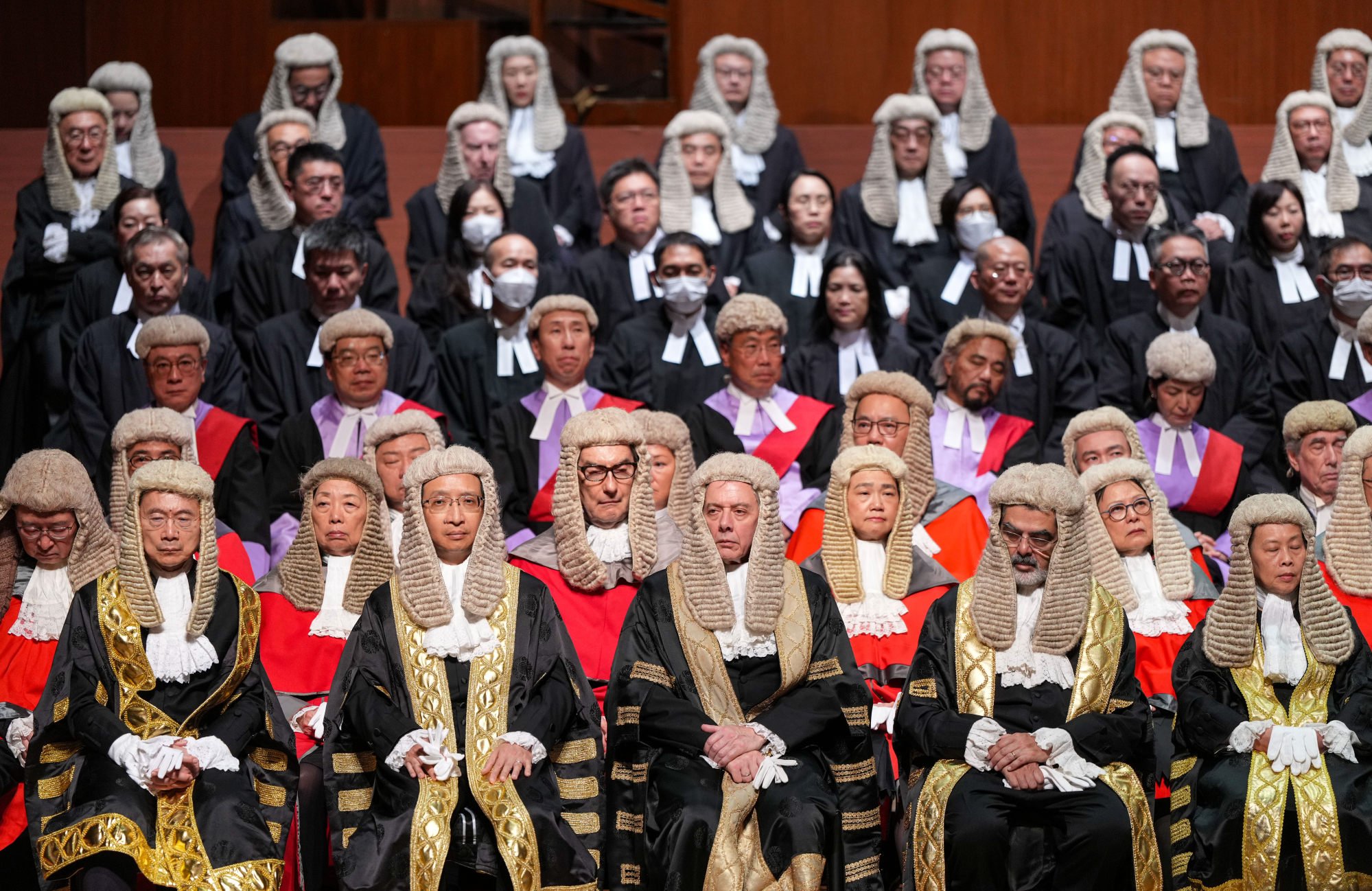
The remarks from IBA president Claudio Visco came during his visit to attend the ceremonial opening of the legal year on Monday, following calls from some US politicians to sanction Hong Kong judges and prosecutors involved in national security cases.
Visco said the IBA has consistently spoken out against violations of international law and that Hong Kong would not be excluded from its monitoring efforts.
“Whenever sanctions occurred, and [they] were not justified and there were clear violations of international law, we intervened,” he told the Post in an interview on Sunday.
He cited the IBA’s condemnation of threats made by the US President Donald Trump administration to sanction American law firms for not abiding by its policy as an example.
“So far, sanctions have not been an issue [for Hong Kong], but if they were, we would consider and evaluate to what extent we need to take a position,” Visco said.
Jose-Antonio Maurellet, chairman of the Hong Kong Bar Association, expressed a similar stance.
“You shouldn’t have a situation where people feel pressured when participating in the legal process as defence lawyers, prosecutors or judges. It’s just a form of illegitimate interference in the judicial process, and you should really let judges get on with applying the law to the facts,” he said.
In 2023 and 2024, the IBA’s Human Rights Institute expressed concerns over the rule of law in Hong Kong, following the government’s issuance of arrest warrants and bounties against eight overseas-based activists, and the enactment of the Safeguarding National Security Ordinance.
Last month, it also condemned the conviction of former media boss Jimmy Lai Chee-ying in a landmark national security case, calling the move “the final blow to Hong Kong’s democracy and rule of law” after “a dishonestly conducted and politically motivated trial”.
However, Visco said the institute had the freedom to take positions that may not necessarily reflect the official stance of the IBA.
“As the IBA, we want to be more practical and focused on doing things together,” he said. We of course listen to [various] points of view on any situation, but it’s important to see what happens in reality,” he said.
Asked about his views on the current status of the rule of law in Hong Kong, Visco said the recent criticism was “more of a perception locally”.
He explained that Hong Kong had a strong tradition of the rule of law, which remained the foundation of its legal system.
“What is important is that the court, when called to judge on a situation, applies the same principles that it uses in all other cases, and there are no different types of proceedings,” he said.
“We cannot get into the merits more than that, but we know that the rule of law would require process. If the process is respected, we have no objection.”
He added that while the city was undergoing a “complicated period of transition” following the enactment of the two pieces of national security legislation, the situation had been managed effectively.
“Most of the players have managed the situation in a constructive way, trying to find a balanced position and a reasonable compromise,” he said.
Looking ahead, Visco expressed a desire to collaborate with the Hong Kong Bar Association on topics such as artificial intelligence (AI), rule of law education and arbitration.
He emphasised the importance of participating in the AI debate to ensure preparedness for any scenario where it might jeopardise the rule of law or the judicial system.
“It’s very dangerous to use AI in judicial proceedings,” he warned. “You must create a sort of system which is capable of reacting immediately.” -- SOUTH CHINA MORNING POST