
Tiny carbon nanotubes with walls just one atom thick found on the far side of the moon have provided the first confirmed evidence that a material long thought to require sophisticated human engineering could also be produced naturally.
They were found in rocks collected by China’s 2024 Chang’e-6 mission, the first probe to land on the far side of the moon and bring samples back to Earth.
Using high-resolution electron microscopes, a team from Jilin University in northeastern China detected the straw-shaped, ultra-thin tubes in samples collected by the mission.
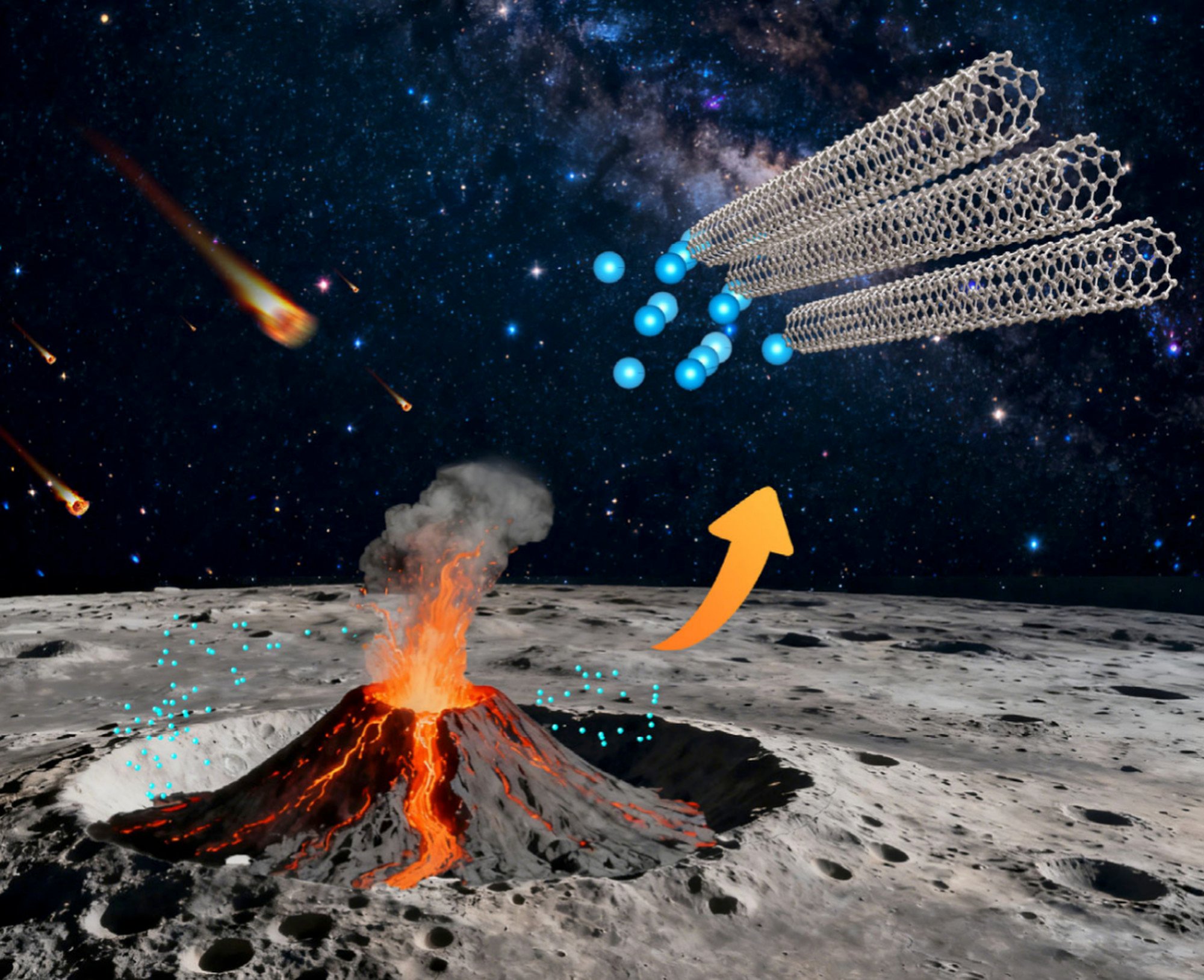
The researchers said the structures had probably formed under extreme conditions created jointly by micrometeorite impacts, solar wind exposure and ancient volcanic activity.
Although multilayered nanotubes that formed naturally have been found on Earth as a result of natural phenomena such as forest fires or ice cores, there had been a long debate about whether single-layer carbon nanotubes could form naturally.
Producing them in laboratories needed precisely controlled temperatures and catalysts, but the Chinese team’s findings, published online in the journal Nano Letters last month, have settled the debate.
Together with the team’s earlier discovery of graphene in samples taken from the near side of the moon during the previous Chang’e-5 mission, the discovery might inspire a “paradigm shift in carbon science”, the researchers wrote.
This, they added, could open up new pathways for developing advanced materials, from touchscreens to sensors and batteries.
Single-walled carbon nanotubes are hollow carbon tubes about a nanometre wide, formed by rolling a one-atom-thick layer of carbon into a seamless cylinder. Despite their tiny size, they are exceptionally strong, highly conductive and efficient at moving heat.
Carbon nanotubes were first reported in the early 1990s, when Japanese physicist Sumio Iijima spotted them by chance while studying carbon soot produced in high-temperature experiments.
Researchers later learned how to make multi-walled and single-walled carbon nanotubes, using heat and metal catalysts such as iron and nickel to shape the atoms.
Earth’s naturally occurring multilayered tubes – found in coal deposits, ice cores and the ash created by forest fires – are believed to have formed when carbon-rich material was exposed to intense heat and then cooled rapidly, allowing some atoms to rearrange themselves.
By contrast, there had been no widely accepted direct evidence that single-walled carbon nanotubes could form naturally.
For this study, the Chinese team used a combination of powerful microscopy and spectroscopy techniques to examine soil collected from the moon’s far side.
By scanning intact soil grains, they identified clear signals of graphitic carbon, most of them clustered near tiny impact scars left by micrometeorites.
In a separate step, the team examined finely scraped material from Chang’e-6 samples using higher-resolution electron microscopes.
It was in these ultra-small fragments that they detected single-walled carbon nanotubes, most of which they believe were formed a long time ago.
They said this happened when countless tiny meteorites slammed into the moon’s surface and generated brief bursts of extreme heat.
The carbon delivered by meteorites and the solar wind was released as gas, while iron particles in the lunar soil acted as catalysts.
As the material cooled rapidly, some carbon atoms reassembled into tiny tubes instead of forming flat carbon sheets or soot.
While the researchers did not specify how many carbon nanotubes were present in the samples, they said that understanding how lunar soil had been transformed under extreme conditions could help guide future efforts to process materials for space exploration.
“The detected carbon and the formation pathway elucidated a further in situ application of the lunar soil, laying the foundation for deep space exploration and lunar resource use,” they wrote. -- SOUTH CHINA MORNING POST