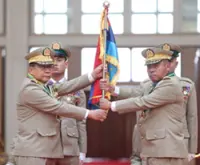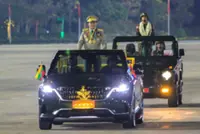
His name is not on the ballot, and his photographs don’t appear on campaign posters. But one man looms large over the general election underway in Myanmar: junta chief Min Aung Hlaing.
The 69-year-old general has ruled the impoverished South-East Asian nation since ousting Nobel laureate Aung San Suu Kyi’s elected government in a 2021 coup.
That sparked a civil war of unprecedented violence, which has displaced millions and left much of Myanmar’s borderlands in rebel hands.
The general said in a New Year address, as votes for the first phase of the three-stage election were being counted, that he intends to hand over “state responsibilities” to the next government.
Suu Kyi’s party, however, has been dissolved and other major opposition parties are not contesting the polls, which have been widely criticised as an exercise to keep the junta in power via proxies.
The UN and Western rights groups have said the elections are neither free nor fair.
Since the coup, he has only had limited diplomatic contact with many of Myanmar’s regional neighbours and has rarely spoken to non-state-controlled media.
The junta chief and acting president is a rigid military leader, but also a political creature with a fine-tuned sense for managing the country’s elites, according to three sources familiar with Min Aung Hlaing and two analysts of junta politics.
Those qualities, the people said, have helped him keep power through battlefield defeats that have dented the military’s prestige and hold over the country, exposing Min Aung Hlaing to criticism from supporters of the armed forces.
At least 16,600 civilians have died in conflict since the coup, according to the Armed Conflict Location & Event Data project.
Pulling back from absolute rule and sharing power through elections functions as “an elite management strategy, diffusing responsibility and preserving regime cohesion,” said Naing Min Khant, program associate at the Institute for Strategy and Policy – Myanmar, a think-tank in Thailand.
“He became the leader not only because of military ruthlessness but because of his subtle skills that help reduce all sorts of pressure around him,” said another source, a foreign former official.
“I think if another person was put in that position, there may have been even more pressure on them.”
Min Aung Hlaing has handed some generals lucrative positions atop military-linked businesses, even as he occasionally detained other senior officers, including court marshalling one likely successor. Such moves have helped control potential rivals, according to Naing Min Khant.
At the same time, Min Aung Hlaing has prioritised keeping important positions for loyalists, including some experienced at dealing with foreign leaders, two sources said.
Diplomatic backing from China, in particular, has bolstered the general’s position and supported the junta’s recent limited comeback on some frontlines, media reported in December.
Among the loyalists is retired military officer and former UN ambassador Than Swe, who serves as junta foreign minister, sources said. One of them added that the diplomat has been coaching Min Aung Hlaing as he emerges from diplomatic isolation.
After casting his vote inside the heavily-guarded capital of Naypyidaw on Dec 28, a smiling Min Aung Hlaing walked up to a gaggle of reporters, where he was asked if he planned to become president following the polls.
“I can’t simply say that I want to do this or that. I am not a leader of a political party,” he said.
However, the general has recently indicated he is considering appointing a successor as armed forces chief and will himself likely move into a fully political role, said a source.
“There will be a new government,” the source added. “He won’t be holding on to (absolute) power.” — Reuters