
SEOUL: Born into one of South Korea’s most powerful families, Lee Jee-ho, the son of Samsung Electronics Chair Lee Jae-yong, stepped into the spotlight in September last year for giving up his US citizenship to serve in the South Korean Navy.
As a dual national by birth, the 25-year-old could have legally avoided conscription, but his decision not to was widely praised as a rare display of civic duty.
More than two decades earlier, a Korean American K-pop star faced a similar choice and went the opposite direction. Despite having publicly pledged to serve, Steve Yoo, then widely known as Yoo Seung-jun, renounced his Korean citizenship in 2002 in favor of being a US citizen, exempting himself from military duty in Korea. The decision sparked public outrage and led the Justice Ministry to impose a permanent entry ban on him, which remains in effect to this day.
Together, the two cases underscore how military service remains a highly consequential decision for those who hold both Korean and foreign citizenship.
Those who surrender Korean nationality to avoid conscription are often met with resentment and seen as draft dodgers if they later return to live in South Korea and enjoy many of the same benefits of Koreans here, without having had shared the burden. They have been termed by some as “black-haired foreigners.”
Legal pathways for dual nationals
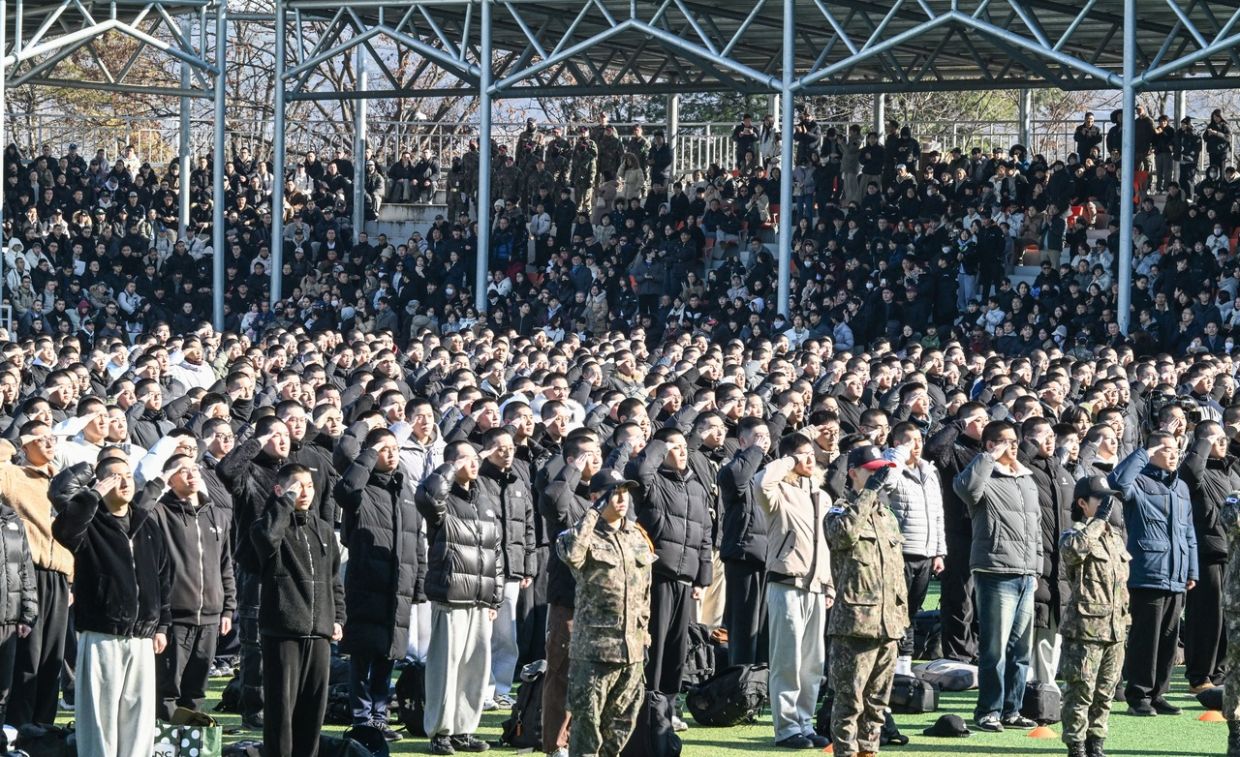
To be Korean carries a certain sense of responsibility. For young men, this means sacrificing at least 18 months of their youth to military service to defend the country amid its ongoing confrontation with North Korea, with whom the country technically remains at war.
South Korea mandates military service for all able-bodied men between the ages of 18 and 28, either in combat roles or through alternative service, unless they are granted exemptions for health or other clearly defined reasons. Draft evasion is a serious crime, with 61.2 percent of such cases resulting in a prison sentence or suspended prison term.
“Korean men born overseas with dual citizenship by birth must choose one nationality in the year they turn 18, such as US or South Korean citizenship. Opting for the other country’s citizenship means relinquishing both the rights and obligations of South Korean nationality,” a senior official at the Military Manpower Administration told The Korea Herald.
From 2021 through August 2025, 12,153 men of conscription age did just that, according to a report by Rep. Hwang Hee of the Democratic Party of Korea, which cited data from the MMA.
The official emphasized that by choosing not to serve, they are essentially opting to be regarded as foreigners in South Korea — and no longer considered Korean.
But Lee Kyung-woo, who is using a pseudonym, sees it differently.
Born in the US while his father was studying there, the 27-year-old renounced his Korean citizenship before turning 18. But he says it was not a break from his roots, it was a practical decision to avoid being drafted in Korea.
“I simply chose one of the two options I had, and there’s nothing wrong with that,” said Lee, who is now a graduate student in biology in the US. His family moved back to Korea shortly after his birth. He moved alone back to the US in eighth grade for his studies.
"I still feel more comfortable speaking Korean and when I'm around my Korean friends. I consider myself a Korean. It’s just my passport that’s different.”
Lee now travels to Seoul every few years to see his family on a C-3 visa, a short-term visit permit intended for temporary stays such as tourism. He hopes to return to Korea someday to be near his family and build his career here.
Similarly, a man identified by the surname Park, a 25-year-old master’s student in international relations in the US, renounced his Korean citizenship at 14, despite his family living in South Korea.
“I went to the United States to study abroad in elementary school and later obtained a green card and then applied for US citizenship,” he told The Korea Herald. “At times, I’m reminded that I’m no longer a Korean citizen when my name doesn’t appear on my parents’ resident registration record.”
When he renounced his Korean nationality, his name was removed from the family register in Korea.
Like Lee, Park visits his parents in Seoul on a C-3 visa during academic breaks. He says he plans to return to Korea in his 40s. He declined to provide more information, citing concerns over potential disadvantages.
Another man with the surname Jung, 30, a former Korean national who is now a US citizen, works at an artificial intelligence startup in Seoul on an F-4 visa. The F-4 is a long-term residency visa typically issued to overseas Koreans and descendants of Korean nationals.
Jung gave up his Korean citizenship before turning 18 after acquiring US citizenship, having moved to the United States in elementary school following his father’s overseas assignment.
After graduating from college and working in the US as an analyst, he returned to Korea in 2024. Jung declined to share further details for privacy reasons.
His visa status makes life in Korea much easier than is the case for Lee and Park.
The residency visa grants ethnic Koreans with foreign passports the right to live and work in Korea for extended periods, with the goal of encouraging investment, professional exchange and cultural ties.
It also allows holders to enjoy most of the same privileges as Korean citizens, including National Health Insurance benefits, the ability to open bank accounts and the option to obtain employment without employer sponsorship.
F-4 visa holders who have lived in South Korea for at least 10 years and paid into the National Pension Service can receive a monthly pension from the age of 65, with the amount determined by the length and how much they contributed. Like most noncitizens, they cannot vote.
However, an amendment to the Act on the Immigration and Legal Status of Overseas Koreans, which took effect on May 1, 2018, restricts men who renounced or lost South Korean citizenship without completing military service or receiving an exemption from obtaining an F-4 visa until age 40 — the age at which the military obligation effectively expires.
The revised law applies to individuals who first renounced or lost South Korean citizenship on or after its enforcement date. Those who gave up citizenship before the amendment took effect remain subject to the previous rules when applying for F-4 visa status.
Deeply rooted resentment
For many, “black-haired foreigners” remain a target of lasting resentment, particularly among those who have served.
A man surnamed Choi, 39, who served in Korea’s Air Force, stressed that conscription is “what all Korean men do.”
“I had a US green card and could have postponed service, but I enlisted during college because I wanted to live in Korea. If they didn’t serve, they don’t have the right to call themselves Korean,” he said.
The issue is frequently discussed in terms of fairness, yet beneath the surface lies a sense of relative deprivation that emerges whenever it is raised.
Hwang, a 51-year-old mother of a 20-year-old son who plans to enlist later this year, said, “For the rich, conscription has long been optional. They had the means to help their sons avoid it, while most families did not.”
This, she said, is why many Koreans like her do not see the dual nationality issue simply as a matter of personal choice, and why it often makes them angry.
Dual citizenship has long served as a legal pathway exploited by some of South Korea’s wealthy and politically connected families to shield their children from mandatory military service, typically through overseas births or long-term study abroad.
"Military service is a civic duty of South Korean citizens. Conscription, especially for men, and for women through their sons and brothers, is a responsibility felt by whole families," Seol Dong-hoon, a sociology professor at Jeonbuk National University, told The Korea Herald.
"That is why many Koreans see it as deeply unfair when some people avoid military service, and why it is understandable that there is strong public opposition to those who give up South Korean citizenship to sidestep conscription while still seeking to enjoy its benefits," Seol explained.
A 2021 Realmeter survey found that 65 percent of respondents opposed granting Steve Yoo entry — a figure largely unchanged from a decade earlier — citing concerns over relative deprivation among those who served. No more recent survey results are available.
From time to time, calls have resurfaced in political circles to shore up “loopholes” in the system that allow some people to avoid conscription. The 2018 change to the F-4 visa rules came amid such pressure.
In 2005, reflecting public uproar at the time, then-Rep. Hong Joon-pyo, a firebrand known for his sharp tongue, introduced legislation to penalize draft evasion by barring such individuals from employment in Korea and treating them as foreigners for benefits such as health insurance.
The measure ultimately stalled, as opponents warned it could infringe on the Constitution’s equality clause and undermine the nation’s global diaspora economically, professionally and culturally.
"Korean society is attentive to who benefits from what, often prompting strong reactions. Fairness is considered important, and when actions are perceived as unfair — such as dual nationals renouncing Korean citizenship to avoid conscription — it can lead to public anger," said Huh Chang-deog, a sociology professor at Yeungnam University.
"(But) would it help the country to treat dual nationals as 'draft dodgers' and prevent them from living, working or doing business in Korea? It's time for Koreans to think about that instead of hating them," Huh continued.
He referred to the Samsung scion’s recent enlistment as setting a good example of noblesse oblige, helping to rebalance public sentiment that has long been critical of rich families on the issue. - The Korea Herald/ANN