
A FEW years ago, Hu Anyan was speeding through the streets of Beijing on a three-wheel motorbike loaded with packages, one of millions of delivery drivers working for the country’s online retail giants.
The 46-year-old is now a best- selling author after recounting his experiences in his book I Deliver Parcels in Beijing.
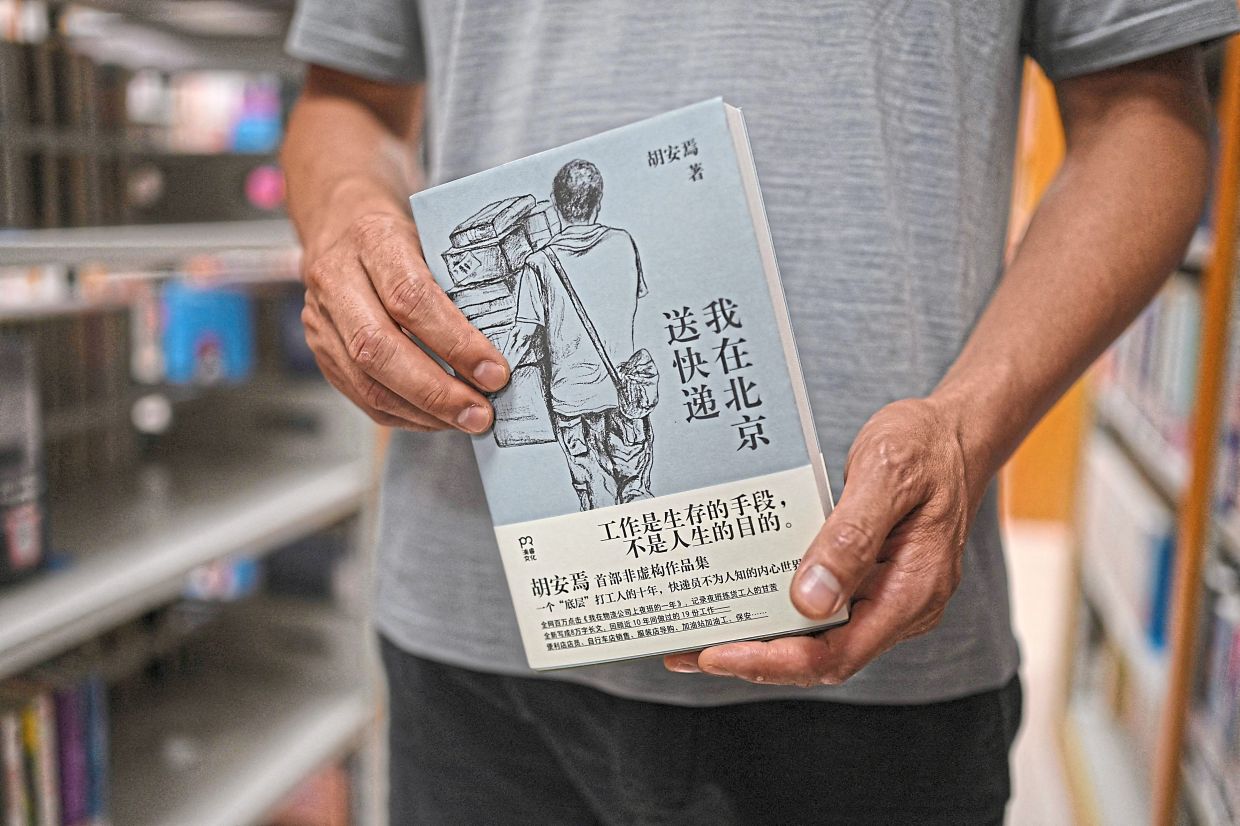
Around two million copies have been sold since its release in 2023 across more than 20 countries.
An English translation was released in October, with a French version due this month.
The simple autobiographical account gives a voice and face to the swarms of anonymous gig workers who weave through China’s bustling cities day and night to deliver online orders, which account for a third of retail sales.
But as a delivery driver, Hu said he “always believed (he) was trash”.
“It was through writing that I built recognition of my own worth,” he said near the flat he rents in Chengdu.
Hu’s story reflects China’s evolution.
His parents worked their entire lives in state-owned enterprises.
Hu entered a much more flexible job market in 1999 after a decade of reforms following the Cultural Revolution.
“Before, technical schools guaranteed a job after graduation, but that was no longer the case for my generation,” he said.
After a string of unstable jobs, Hu, like many, joined the gig economy in 2017.
He worked 12 hours a night in a huge parcel sorting centre in Guangdong, with a 30-minute break each shift and four days off per month.
“I was a walking corpse with blurred vision and a wavering consciousness,” said Hu, who would drink alcohol to sleep during the day.
Lacking humanity
But it was his account of working as a delivery driver in Beijing that moved readers.
At the time, Hu had no health insurance and no fixed salary.
He calculated that at two yuan (RM1.17) per delivery, he had to deliver a parcel every four minutes to earn a living.
If his pace slowed, he would receive a call from from a company employee.
“She would say: ‘You still have 60 parcels to deliver and you have 30 minutes left. What’s going on? Do you want to continue working here or not?’” he said.
“These rules lack humanity and rationality, and they oppress us every day.”
Laid off after his employer went bankrupt, Hu recounted his experience on social media platform Douban “without any particular goal”, while juggling odd jobs.
A young publisher encouraged him to turn his posts into a book.
Hu’s book passed the censors, with a few adaptations, sticking to social commentary and refraining from criticism.
But it has resonated like “very few other works” with a generation facing job insecurity and increasing competition in the labour market, said academic Huang Ke, who wrote a thesis on China’s delivery drivers.
How everyone survives
“The number of graduates is increasing, but job opportunities are not keeping pace,” he said.
Following the book’s release, one Douban user said he understood the irritability of some delivery drivers: “You can’t expect someone to be kind and gentle when they find themselves in an environment of insecurity and exploitation.”
Faced with growing social awareness, authorities have introduced measures to improve the lives of delivery drivers in recent years.
But most of China’s 80 million gig workers have “no real access to labour law protections because of their ambiguous employment status,” said Ou Lin, a law professor at Britain’s Lancaster University.
Now financially secure, Hu is inundated with requests for proofreading and advice from aspiring writers.
“If I hadn’t published this book, it’s quite possible that I would still be delivering orders today,” he said.
“That’s how everyone survives.”
Hu said he would be happy if his book helped improve the situation of delivery drivers, but “from a social movement perspective, literature is not very effective”.
He wants to believe that, at the very least, “customers now say thank you more” to delivery drivers. — AFP