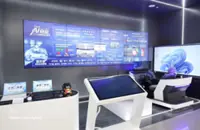
HONG KONG: Leading Chinese artificial intelligence startup Zhipu AI soared as it went public in Hong Kong on Thursday (Jan 8), a day before rival MiniMax also makes its market debut in a litmus test for the country's rapidly developing sector.
Shares in Zhipu AI, which runs the Z.ai tool, rose more than 12 percent on Thursday after its oversubscribed initial public offering raised HK$4.35 billion (US$558 million).
This week's flotations come before any IPO announcements from top US startups OpenAI, the maker of ChatGPT, and Anthropic, known for its Claude chatbot.
But analysts said profits were unlikely any time soon from either company -- the first two IPOs among China's so-called "six tigers", generative AI providers competing with tech giants such as Alibaba and ByteDance.
"Zhipu is honoured to stand at this historic juncture as a representative of China's large model sector," company chairman Liu Debing said at Thursday's listing ceremony.
Zhipu AI was founded in 2019 and is a major provider of large language model (LLM) services to businesses and government clients in the world's second-largest economy.
Proceeds from the IPO will go towards developing general-purpose large AI models, including key algorithms and system infrastructure, the firm said.
MiniMax, established in 2022, targets the consumer market, particularly outside China, with its generative AI tools for speech, music and video, as well as text.
"Once the market matures through full competition, more people will understand the capabilities, performance and pricing of these models reaching a state of equilibrium," Liu told Bloomberg Television Thursday.
He added that Zhipu AI has seen a trend of computing costs for AI development "gradually decreasing".
China tech analyst Poe Zhao, founder of the Hello China Tech newsletter, told AFP that the two IPOs "demonstrate both the revenue potential and the fundamental challenges facing this new generation of LLM companies".
"The high demand definitely reflects broader optimism about Chinese AI," he said.
An AI boom has helped push tech stocks to record highs in recent months, but they are also volatile as global investors watch intently for any signs of a bubble.
"Do I think there's a bubble? Yes. But I want to distinguish between 'bubble' and 'bubble risk'. These companies need capital intensity," Zhao said.
- Disney lawsuit -
The LLM market in China is estimated to grow to 101.1 billion yuan (US$14.5 billion) by 2030, according to consultancy Frost and Sullivan.
In January 2025, Chinese startup DeepSeek shook the tech world with a low-cost, high-performance reasoning model that upended assumptions of US dominance in the sensitive sector.
A year ago, Washington put Zhipu, backed by conglomerate Tencent, on its export control blacklist over national security concerns.
And Disney along with other US entertainment outfits including Universal is suing MiniMax for copyright infringement.
Zhao said he did not expect Zhipu or MiniMax to be profitable "any time soon".
"That depends on two industry-wide shifts: significantly lower computing costs and much larger AI demand to spread those costs across," he explained.
Beijing has reportedly been encouraging tech firms to use homegrown microchips owing to Washington's on-and-off restrictions on top-end Nvidia chips, used to train and run AI systems.
Investor faith in the potential of China's chip industry to challenge US powerhouse Nvidia last month sent shares in semiconductor companies Moore Threads and MetaX skyrocketing on their market debuts.
Earlier this month, Baidu, the operator of China's top search engine, said its AI chip unit Kunlunxin has filed a listing application in Hong Kong.
For chatbot providers, the picture is nuanced, said Shengyun Lu, founder of LSY Consulting.
"To run a foundational model company, it costs a lot and takes a lot of time," he cautioned.
"IPOs allow the companies to raise money for financing their future research activities, but on the other hand, the initial investors are seeking an exit." - AFP