
Scientists in China have discovered fossils of a new mammal-like reptile species in Gansu province – the first of its genus to be found in both South Africa and China.
The finding suggests that Late Permian (299 to 252 million years ago) tetrapods crossed the equator of the supercontinent Pangaea more often than expected, revealing an ecological corridor capable of supporting large animal migration.
The new species of dicynodont, an extinct clade of non-mammalian therapsids – a group that includes mammals, their ancestors and close relatives – was identified by researchers from the Chinese Academy of Sciences’ Institute of Vertebrate Palaeontology and Paleoanthropology (IVPP).
“A new dicynodont species, Dinanomodon guoi, is established based on a specimen collected in Gulang county, Gansu province, China,” the team said in a paper published in the peer-reviewed journal Cladistics on December 15.
“This discovery marks the first bidentalian genus shared between China and South Africa.”
Dicynodonts – considered a “cousin” to today’s mammals – were a herbivorous clade of mostly toothless animals that ranged in size from small burrowers to large grazers. Bidentalians are a specific group of dicynodonts.
One confirmed species of dicynodont was as large as an elephant and believed to have lived alongside large dinosaurs.
Some species of dicynodonts survived the Great Dying, a Permian-Triassic extinction event 252 million years ago, which wiped out around 90 per cent of marine life and 70 per cent of terrestrial life.
The supercontinent Pangaea reached its full assembly by the Early Permian, easing the dispersal of tetrapods or vertebrates with four limbs.
But fossil records show that after Pangaea broke up around 200 million years ago into the massive northern and southern supercontinents of Laurasia and Gondwana, there were few tetrapod groups shared between both.
Laurasia comprised modern-day North America, Europe and most of Asia, while Gondwana comprised South America, India, Australia, Antarctica and Africa.
“Dicynodonts, the most diverse Permian tetrapods, have been collected on all continents,” the team said.
“However, even in this versatile clade, there are very few records of shared genera between Laurasia and Gondwana. This indicates that some barriers to dispersal remained even on a contiguous land mass.”
Some scientists believe that the continental climate of Pangaea’s interior, which featured extensive deserts and high temperatures, limited tetrapod migration. However, a narrow tropical seasonal or ever-wet corridor may have existed across the equator.
In 2020, some Late Permian tetrapod fossils were found in China’s northwestern Gansu province, with more found in this region in the years since.
The Dinanomodon is a genus of Late Permian dicynodont, which had previously only been reported in the Karoo Basin of South Africa. It might have fed on higher-growing foliage and mostly had a pointed and hook-like snout.
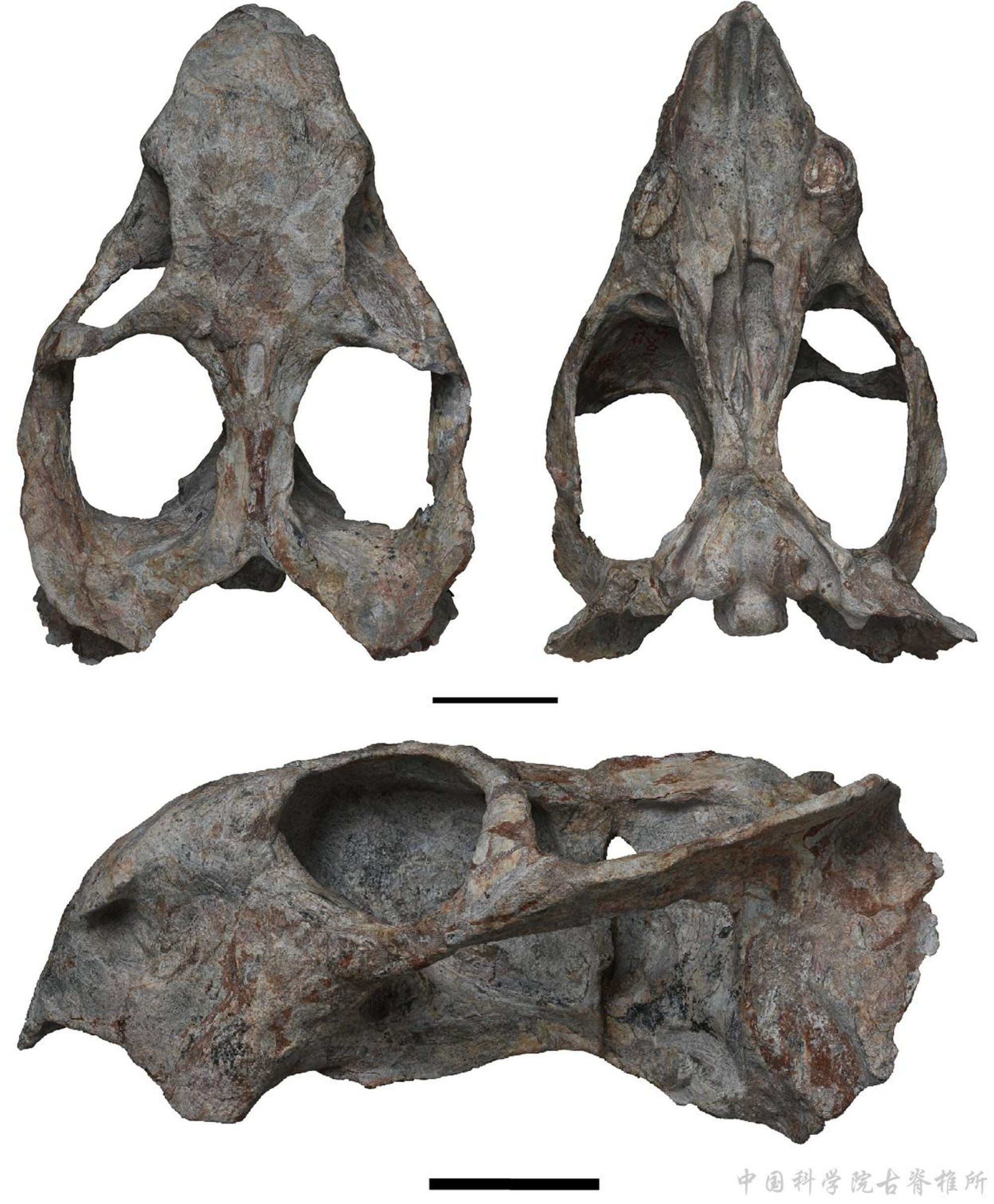
“Here we establish a new species of Dinanomodon based on a skull from the initial expedition, demonstrating that Dinanomodon exhibited a cross-equatorial distribution during the Lopingian,” the team said, referring to the last epoch of the Permian period.
They determined that this fossil in Gansu’s Gulang county – which would have been around 20,000km (12,400 miles) and three climatic zones away from the Karoo Basin in the Late Permian – was a new species, which they named Dinanomodon guoi.
The fossil bed it was found in corresponded to ones in the Karoo Basin, where the other species called Dinanomodon gilli was found, which constrains their age to between 255.2 and 252.21 million years ago.
The approximately one-metre-long (three-foot) species was named after Guo Wangang, a Gulang-born desertification control worker known for afforesting tens of thousands of acres of the Tengger Desert.
Their findings show that the cross-equatorial dispersal of tetrapods from the Lopingian was “more frequent than previously thought” and was possibly facilitated by an ecological corridor along the eastern margin of Pangaea.
“We emphasise the importance of precipitation, rather than temperature, as the major controlling factor of the cross-equatorial dispersal of tetrapods during the Permian,” the team said.
The discovery of an apex predator, the Moschowhaitsia lidaqingi, along with the new dicynodont species in the Sunan Formation in central Gansu province showed the region was likely to have had a “high ecosystem productivity” – plenty of resources to support a complex food web. -- SOUTH CHINA MORNING POST