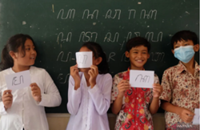
FILE PHOTO: Students collecting trays of food supplied by the Indonesian government at an elementary school in Banda Aceh. With a long-term target of reaching around 83 million people, the free meals programme has been allocated Rp 335 trillion this year, equivalent to 8.7 per cent of the total state budget. — AFP
JAKARTA: With a budget nearing one-tenth of this year’s state spending, President Prabowo Subianto’s flagship free nutritious meal programme faces mounting pressure to justify its cost, amid criticism over food safety incidents, weak oversight and competing policy priorities.
Launched on Jan. 6 last year to help address stunting, the programme initially operated just 190 kitchens, known as Nutrition Fulfillment Service Units (SPPG), serving around 570,000 children in selected cities.
In less than a year, it expanded to more than 17,000 kitchens nationwide, feeding nearly 50.4 million recipients including students, infants and pregnant women as of Dec. 15, backed by a Rp 71 trillion (US$4.25 billion) allocation, even though absorption was only 81 per cent until the end of the year.
Prabowo has repeatedly praised the breakneck pace of the rollout, which he said has drawn international plaudits, and is seeking to expand the programme further in 2026.
With a long-term target of reaching around 83 million people, the free meals programme has been allocated Rp 335 trillion this year, equivalent to 8.7 per cent of the total state budget.
To put it into perspective, the allocation is over 680 times larger than the National Disaster Mitigation Agency (BNPB)’s budget, the agency on the frontlines of disaster response, and more than twice as large as the traditionally well-funded Defence Ministry.
Misplaced priorities
Isnawati Hidayah, a researcher at the Centre of Economic and Law Studies (CELIOS), said the decision to push through such a massive budget reflected misplaced priorities, as other critical policies remain underfunded while the free meals programme has yet to show clear benefits in its first year.
Citing a CELIOS survey released on Dec. 15 involving more than 1,700 respondents, Isnawati said most parents felt the programme had failed to ease household expenses. The study also warned of unintended impacts, including rising food prices and income losses among micro food vendors.
“This is the danger of forcing through the free meals budget. If [even a portion] the 2026 allocation were redistributed, it could support many other urgent policies,” she said.
For instance, she added, reallocating Rp 60 trillion to the National Health Insurance Programme could cover annual premiums for roughly 126.8 million people, or 44 per cent of the country’s population.
Funding concerns are compounded by the programme’s heavy reliance on education funds. Ubaid Matraji of the Network for Education Watch Indonesia said around Rp 223 trillion of the programme’s total allocation comes from the education budget, at a time when many teachers still lack basic welfare.
Almost 30 per cent of the Rp 757.8 trillion (US$45.1 billion) education budget is dedicated solely to the free meals programme. By comparison, the Elementary and Secondary Education Ministry receives just seven percent of the total allocation, or Rp 55.4 trillion.
“This is deeply troubling because it is creating new inequalities within our education system. Free meals delivery drivers can earn around Rp 3 million a month, while some teachers with bachelor’s degrees earn barely a tenth of that,” Ubaid said.
Instead of offering free meals to all students, he urged the government to focus the programme on those most in need and redirect the remaining funds to the education sector, including to fulfill the Constitutional Court’s mandate to provide free schooling for all.
Food safety issues
The programme has also faced scrutiny over food safety following a series of mass food poisoning incidents believed to have affected around 12,000 students between August and October.
The incidents prompted calls for the programme’s suspension, but to no avail. Prabowo in September acknowledged shortcomings in implementation, but argued that poisoning cases represented only “0.00017 per cent” of recipients.
Nevertheless, the National Nutrition Agency (BGN) overseeing the programme tightened food safety protocols in October, including mandatory health certification for kitchens, later formalised through a presidential regulation issued in November.
BGN head Dadan Hindayana claimed the measures had reduced incidents from 85 in October to 40 in November and to four in the first two weeks of December. “We will work to ensure there are no further incidents next year, as the BGN has already carried out the food safety certification [process],” Dadan said.
Governance gaps
Centre for Indonesia Strategic Development Initiatives CEO Diah Saminarsih said the incidents highlighted deeper governance gaps that the recent presidential regulation has yet to fully address.
“We had hoped the regulation would set clear rules covering cooking schedules, staff supervision and food safety standards, for instance. But it still does not address these issues in sufficient detail,” Diah said.
Without firm standards, she warned that food safety could become a secondary concern, particularly as the programme’s large budget and planned expansion this year may attract new kitchen operators driven more by profit rather than by public service.
“If things remain unchanged, the risk of food poisoning incidents will inevitably increase. That is unfortunate, because with such a large budget and proper safety standards, the programme could genuinely help countless people,” she added.
Public nutritionist Tan Shot Yen cautioned that without serious governance reform, the free meals initiative risks becoming less a social welfare programme and more of a “pet project”, marked by weak oversight and a loss of control over its rapidly expanding network of kitchens.
“It is understandable that the public is angry. Their tax money is spent on a programme that lacks proper monitoring, supervision and evaluation, and fails to deliver nutritious meals, with children instead receiving ultra-processed, high-sugar foods,” Tan said.
She called for a comprehensive review of the programme, urging the government to prioritise underdeveloped regions and make participation optional rather than mandatory nationwide. - The Jakarta Post/ANN