
The court’s verdict in former Hong Kong media boss Jimmy Lai Chee-ying’s trial has shed light on the ways in which implicit acts and actions taken before the national security law came into effect may constitute criminal offences, legal experts have said.
Lai, 78, was found guilty on all three charges he faced under the Beijing-imposed national security law on Monday, marking the first time a court had ruled on the offence of conspiracy to collude with foreign forces.
The landmark verdict was closely watched around the world, with particular scrutiny on how the three judges hearing the case would rule given that many of the actions presented during the proceedings predated the implementation of the law in 2020.
In their ruling, the High Court justices emphasised that Lai’s actions before the enactment of the legislation were not the subject of any criminal charges but only served as background to those he faced.
The judges accepted the prosecution’s argument that a defendant could still be criminally liable even if the agreement in question was lawful when entered into but later became illegal due to a change in the law, provided the agreement remained in effect afterwards.
They also rejected the defence’s submission to discharge Lai from liability for any earlier agreements rendered criminal by the national security law.
The judges said Lai had sought to operate in a “grey area” after the promulgation of the law, adopting “an implicitly disguised and subtle approach”.
“However, in our judgment, [Lai’s] change of strategy was in form and not in substance,” they said.
Some international legal experts criticised the way the court handled the verdict, claiming it had blurred the principle of non-retroactivity.
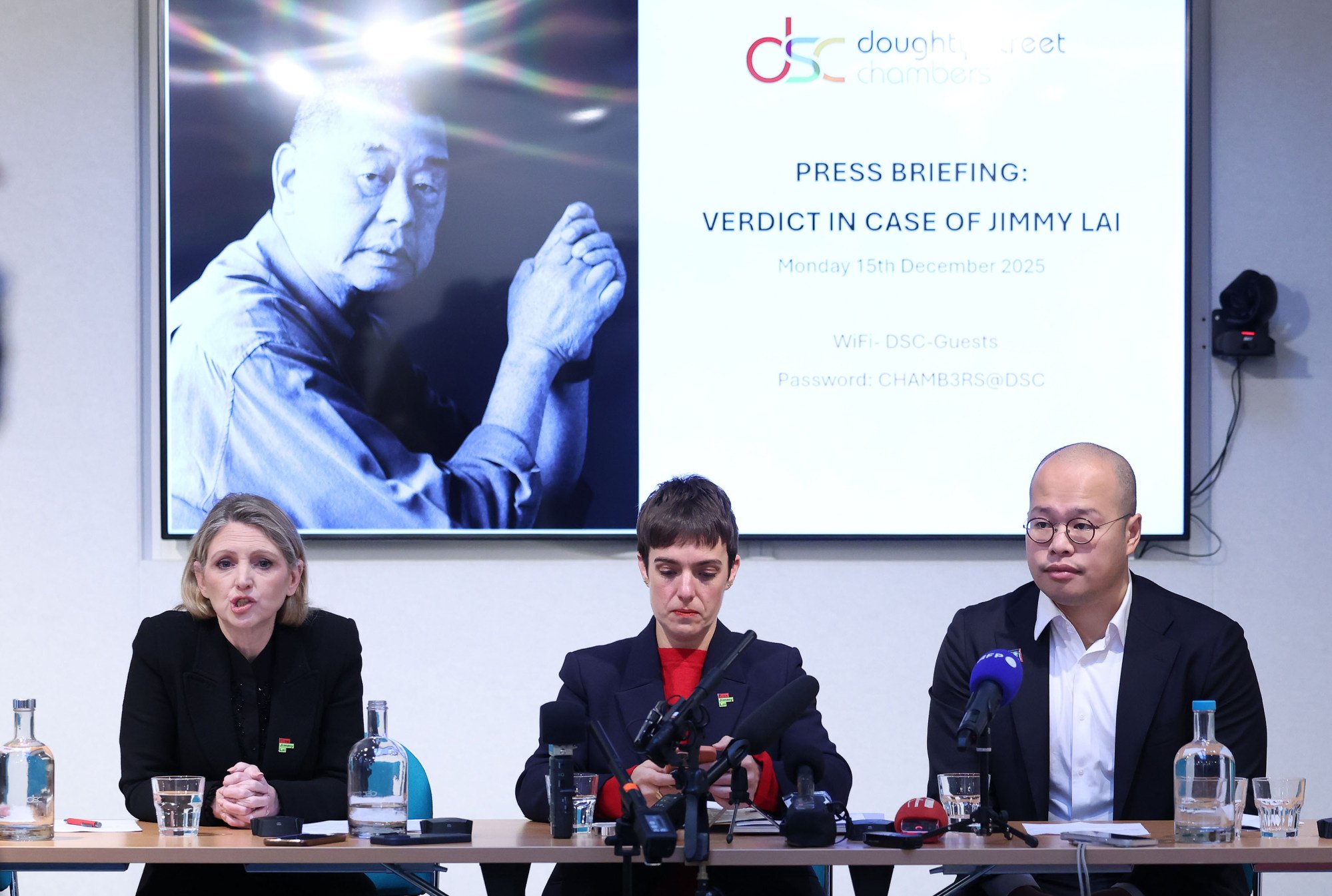
Caoilfhionn Gallagher, who leads a London-based international legal team representing Lai, said at a press briefing following the verdict that much of the evidence presented in the ruling had occurred before the implementation of the law in June 2020.
“What we have seen is a man being convicted of a crime that did not exist when he was supposed to have committed it, prosecuted under a law drawn up for that very purpose,” she said.
The concept of retrospective legislation, particularly over national security issues, is not uncommon internationally. It also occurs in the UK legal system, notably with the War Crimes Act 1991, a well-known example of retrospective legislation that was passed to address certain legal uncertainties.
Barrister Ronny Tong Ka-wah, a member of the government’s key decision-making Executive Council, said there was no issue with retroactivity in the way the judges ruled on Lai.
The court was simply explaining how an agreement made before the implementation of the security law could constitute a guilty offence if the person continued to engage in the agreement following its passage.
“A conspiracy is a continuing offence, so it doesn’t end,” he said.
Tong said the most important aspect of Monday’s verdict was that the court had ruled that conspiring to collude with foreign forces to impose sanctions could come in the form of explicit and implicit requests.
Among the evidence cited by the court as an “implicit request” for foreign sanctions were live chats hosted by Lai where he described China as an enemy of the Western world.
They also pointed to a text that Lai sent to American journalist Maria Bartiromo after appearing on Fox News in which he said: “We need all the help from America.”
Tong said that it had always been the case that the law considered the substance, not the form, when determining whether someone had committed a crime.
“The legal concept that you can do something wrong implicitly is always there,” Tong said. “The court is just borrowing a general principle in this situation.”
Professor Simon Young Ngai-man of the University of Hong Kong’s law department said that given Lai knew about the security legislation’s prohibitions, there were “real factual issues” of whether he had formed an agreement with others with criminal intent after the law’s enactment.
“However, it is fair game to look at all the evidence, including evidence of events taking place before June 30, 2020, [to] determine if in the post-NSL period he agreed with others with the relevant intent,” Young said.
He noted that the judges were mindful of the distinction of using pre-security law conduct as the basis to convict and were also “meticulous” in identifying actions after the law’s implementation which could infer the presence of the criminal conspiracy to collude.