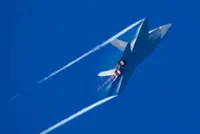
Beijing has lodged “counter-protests” against Japanese complaints over a weekend mid-air stand-off northeast of Taiwan near the Miyako Strait, accusing Tokyo of “purely ill-intentioned” rhetoric and “ulterior motives”.
“Japan is deliberately spreading and hyping up false information regarding military and security matters, thereby stoking tensions,” Chinese foreign ministry spokesman Guo Jiakun said on Monday.
“Such actions are entirely driven by ulterior motives,” he added.
On Sunday, the ministry said that the Japanese manoeuvres posed the “biggest” maritime and aerial security risks, while the Chinese defence ministry lashed out at alleged “malicious” monitoring.
The latest escalation underscores the deepening diplomatic rift between the two neighbours since Japanese Prime Minister Sanae Takaichi’s remarks on Taiwan in November.
According to Japan’s defence ministry, there were two separate instances of Chinese targeting of its F-15J jets by fire-control radar on Saturday, involving J-15 fighters launched from the PLA Navy’s Liaoning aircraft carrier.
The first incident happened between 4.32pm and 4.35pm local time over international airspace southeast of Okinawa’s main island, while the second occurred between 6.37pm and 7.08pm, it said.
Takaichi on Sunday characterised the incidents as “extremely regrettable” and said Tokyo would respond “calmly and resolutely”.
“We will closely monitor the movements of the Chinese military and take all possible measures to ensure our surveillance and monitoring activities,” she said.
Japanese Defence Minister Shinjiro Koizumi earlier in the day labelled the incidents as a “dangerous act” beyond the scope of safe flight operations, adding that Tokyo had formally protested to Beijing.
In a statement issued on Sunday night, the Chinese foreign ministry pushed back, saying that Japan’s fighter jets had taken frequent close-in reconnaissance and disrupted China’s normal military activities, saying the manoeuvres posed “the biggest maritime and air security risk”.
“China does not accept the so-called protest from the Japanese side and has rejected it on the spot and lodged counter-protests in Beijing and in Tokyo,” it said.
The ministry also accused Tokyo of “hyping up” the issue to “deliberately” make a false accusation against China, building up tension and misleading the international community.
“It is purely ill-intentioned. China firmly opposes it and strongly urges the Japanese side to immediately stop its dangerous moves of harassing China’s normal military exercises and training.”
Japan’s Chief Cabinet Secretary Minoru Kihara on Monday rejected Beijing’s claim that Japanese aircraft had seriously impeded the safe flight of Chinese planes, calling it “unfounded”.
“The [Japanese] government will continue to closely monitor the movements of the Chinese military in the sea and airspace surrounding Japan and will take all possible measures to ensure surveillance and monitoring activities in the sea and airspace surrounding Japan,” the Japanese government’s top spokesman said.
Kihara also said that it was “extremely important” for Tokyo and Beijing to ensure “timely” communication between their defence authorities to avoid unintended clashes.
In a separate statement on Sunday, China’s defence ministry also accused the Japanese side of “maliciously” following and harassing Chinese operations that were “in full compliance with international law and international practice”.
“They even falsely accused China’s normal operations. This is nothing but a trick of ‘a thief crying stop thief’ and making an unfounded countercharge,” ministry spokesman Zhang Xiaogang said in the statement.
“If Japan repeats its wrong path of militarism, it will surely fall into an irredeemable abyss,” he added.
On Sunday afternoon, Japanese foreign vice-minister Takehiro Funakoshi summoned Chinese ambassador Wu Jianghao over the mid-air encounter.
“Vice-minister Funakoshi lodged a strong protest that such dangerous acts are extremely regrettable and strongly urged the government of China to ensure that similar actions do not recur,” the Japanese foreign ministry said in a statement on Sunday.
For his part, Wu said that he issued a “stern representation and strong protest” to Funakoshi during the meeting.
He accused Japan of being “extremely irresponsible” in releasing information to the public that was “completely inconsistent with the facts”.
“China solemnly demands that Japan stops smearing and slandering, strictly rein in its frontline forces and prevent similar incidents from happening again,” Wu said in a social media post on Sunday.
During a joint press conference with Koizumi after scheduled talks in Tokyo on Sunday, Australian Defence Minister Richard Marles said his country was “deeply concerned by the actions of China in the last 24 hours”.
“We expect those interactions to be safe and professional,” Marles said, noting that Australia would “continue to work with Japan and to stand with Japan” in upholding the “rules-based order”.
He also said that Australia did “not want to see any change to the status quo across the Taiwan Strait”.
Marles noted that China was his country’s largest trading partner and said Canberra wanted to have “the most productive relationship we can have” with Beijing.
Koizumi reiterated that Japan would respond to Chinese actions in “a calm yet resolute manner”, while calling for Canberra to strengthen “collective deterrence” with Tokyo amid an “increasingly severe and complex” security environment.
China-Japan relations plunged into a deep freeze about a month ago, following Takaichi’s November 7 comment to parliament that a People’s Liberation Army attack on Taiwan could constitute a “survival-threatening situation” for Japan – a designation that could allow Tokyo to mobilise its military.
In an apparent bid to dial down tensions,Takaichi last Wednesday returned to Tokyo’s long-standing “strategic ambiguity” on the matter. Tokyo’s “fundamental position regarding Taiwan remains unchanged from that stated in the 1972 Japan–China Joint Communique”, she said.
Beijing dismissed those remarks as “prevarication”, warning that it “absolutely” did not accept Takaichi’s continued refusal to withdraw the comments she made early last month.
Beijing sees Taiwan as part of China to be reunited by force if necessary. Most countries, including the United States, its treaty ally Japan, as well as Australia, do not recognise Taiwan as an independent state. But Washington is opposed to any attempt to take the self-ruled island by force and is committed to supplying it with weapons. -- SOUTH CHINA MORNING POST