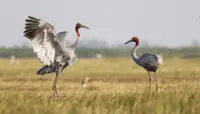
PHNOM PENH (Bernama): International conservationists are calling for a united initiative to safeguard the endangered population of sarus cranes - the tallest flying birds on the planet - which faces myriad threats to its survival.
From the wetlands and plains of Cambodia to Myanmar’s Ayeyarwady coastal region and the rugged terrains of Nepal’s Lumbini, the birthplace of Buddha, the cranes are fighting for survival against human-induced risks.
Poisoning, power cable electrocution, egg poaching, unfriendly farmers, wetland degradation and climate change are among the perils to their survival in South-East and South Asia, the primary hotspots for their breeding.
Cambodia’s General Directorate of Natural Protected Areas Director-General Srey Sunleang said protecting the sarus crane is not only about conserving a species, but also about safeguarding wetlands and forest landscapes that sustain communities.
"In the Lower Mekong Basin, sarus cranes display a unique behavioural pattern that distinguishes them from all other populations. Conserving this species requires strong national and regional collaboration,” said Sunleang.
The cranes are adorned with stunning features, including a distinctive red patch on their necks that contrasts with their soft, greyish plumage, and they stand on pink legs.
These birds can grow up to 1.8 metres tall and weigh about 12 kilogramme.
During their courtship, pairs dance in the fields and their bugling calls are unique.
Beyond their aesthetic appeal, cranes play a crucial role in maintaining the health of the agricultural ecosystems and the vitality of wetlands.
At a two-day Sarus Crane Symposium in Phnom Penh last week, experts - including rangers, conservationists, ornithologists and policymakers - debated ways to protect this species as their numbers have declined significantly over the years.
The International Union for Conservation of Nature has listed the cranes as "vulnerable”, with a declining population. Around the globe, only 15,000 - 17,500 mature individuals exist.
The Eastern Sarus Crane (antigone antigone sharpii) is found in Cambodia, Vietnam and Myanmar.
Nepal’s Tribhuvan University Zoologist Dikpal Krishna Karmacharya said many grassroots activities are being carried out to educate the public on the importance of the birds.
"We are creating a lot of awareness campaigns by engaging youths in schools and among farmers. We also include the religious element of Buddhism to make villagers understand the importance of sarus cranes.
"We are concerned about adult mortality due to electrocution and collision fatalities of about six to eight individuals per year,” Dikpal told Bernama.
There were 47 deaths between 2010 and 2023 due to electrocution and collision with wires in Nepal, he said.
In the Ayeyarwady River Delta, Myanmar’s famous rice bowl, sarus cranes have made rice fields and wetlands their cosy habitat for nesting.
But climate change has become their newest enemy, threatening to impair their population growth.
"Climate change is a critical threat to the cranes, and due to the high mortality of the adult population, numbers are declining.
"Their reproduction is affected, their nests are destroyed by floods, and food scarcity is among the major impacts. Now there are about 400 cranes in six townships that we are monitoring,” International Crane Foundation of Myanmar biologist Dr Myo Sansar Winn told Bernama on the sidelines of the forum.
Recent census results for 2024-2025 recorded a slight recovery, with 214 individuals observed across Cambodia and Vietnam.
Sunleang said cranes around the world are some of the most extraordinary birds and hold deep cultural significance.
"Their long lifespans, strong pair bonds and shared dependence on wetlands all contribute to the special connection that exists between people and cranes.
"The sarus crane is likewise a highly symbolic species across its range,” said Sunleang. -- Bernama