SINGAPORE (The Straits Times/ANN): Till the final days before separation, founding prime minister Lee Kuan Yew was ambivalent about Singapore leaving Malaysia.
Senior Minister Lee Hsien Loong recounted how the Lee family were on holiday in Cameron Highlands on Aug 3, 1965, when his father received a call from Dr Goh Keng Swee, the principal negotiator on the Singapore side.
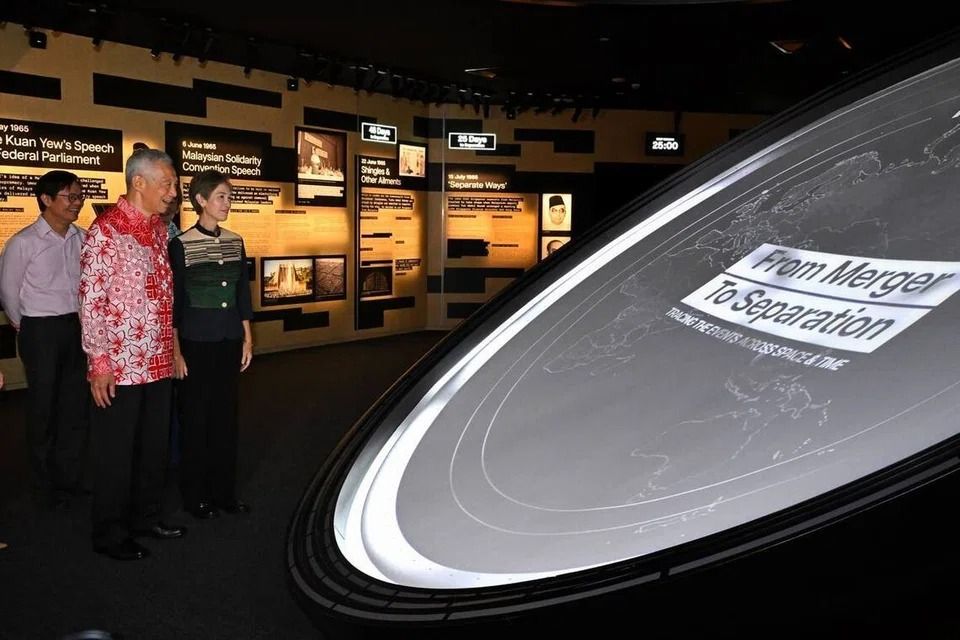
“I was in the room at Cluny Lodge when my father took a call that afternoon and I heard him tell Dr Goh in Mandarin: ‘This is a huge decision; let me think about it.’,” SM Lee said on Dec 7 at the launch of the Albatross File book and exhibition at the National Library in Victoria Street.
“I didn’t know then what it was about, but it became plain soon enough,” said SM Lee, who became emotional and held back tears as he related this memory.
While Mr Lee had brought enormous political pressure to bear on the federal government in the preceding months, which forced the hand of then Malaysian Prime Minister Tunku Abdul Rahman on what to do with Singapore, Separation was not the outcome he preferred, said SM Lee.
“His aim was to strengthen Singapore’s position politically, so as to compel the federal government to grant Singapore greater autonomy... Separation was to be an option only if Singapore could not get such a rearrangement.”
Yet, within a few years, all of Singapore’s founding leaders – including the senior Lee and those who had signed the agreement reluctantly – concluded that Separation was the best thing that ever happened to Singapore, said SM Lee.
Dr Goh, who was finance minister at the time, had named the file Albatross after the large seabird as he felt Malaysia had become an albatross around Singapore’s neck.
After the PAP won all three Malay-majority seats in the general election held days after Merger in 1963, “ultras” (radicals) in UMNO succeeded in sowing deep distrust between the Malays and Chinese in Singapore. This culminated in race riots in July and September 1964.
Lee Kuan Yew decided on a political counter-offensive, which included a crucial speech he gave in fluent Malay in the Malaysian Parliament on May 27, 1965, and another speech at the Malaysian Solidarity Convention on June 6. The convention, initiated by PAP leaders, was a united front of non-communal political parties across Malaysia.
Those were tense days – Lee Kuan Yew knew his strategy put him at grave peril, and he was aware that the federal authorities were considering arresting him, said SM Lee, recounting a conversation the two had during that period.
“I was 13 years old then. One day, on the Istana golf course, he told me that if anything were to happen to him, I should look after my mother and younger siblings,” he said.
Lee Kuan Yew found out only decades later, when he was preparing his memoirs, that contrary to his instructions, Dr Goh had never tried for the looser federation he had preferred, and from the start sought a clean break from Malaysia.
He was so astonished at this discovery that he made a note of the exact time, date and place when he first learnt this in August 1994. He wrote that in the margin of the transcript of Dr Goh’s oral history, next to the passage where Dr Goh confirmed that it was he – and not Malaysian Deputy Prime Minister Abdul Razak – who wanted Singapore’s “hiving off”.
“The senior Lee told some of the ministers about this, and his great surprise at what had really happened – he also spoke to me about it,” said SM Lee.
The page with Lee Kuan Yew’s handwritten note is one of the key items in the exhibition.
SM Lee said the Cabinet papers, records of conversations with Malaysian leaders and British and Australian diplomats, and Dr Goh’s handwritten notes inside Albatross gave a dramatic, blow-by-blow account of how Singapore came to separate from Malaysia.
When he was prime minister, SM Lee said he decided that the file should be declassified and published, together with relevant extracts from the oral histories of key participants in Separation, to put on record a full documented account of this seminal event in Singapore’s independence journey.
“The reader will not only understand the actions and events that led to Separation, but also feel the emotions and passions of our founding leaders,” he added. “It is a history well worth publishing.”
There are two enduring lessons for Singapore from its two years in Malaysia, said SM Lee.
The first is that trust in government – in the political leadership, in particular – is founded on the people knowing their leaders will always have their backs.
Singaporeans saw Lee Kuan Yew stand up to the ultras and knew he could not be cowed. A week before Dr Goh’s first meeting with Tun Razak, other PAP ministers such as Dr Toh Chin Chye and Dr Goh held a press conference to declare that they would not quietly acquiesce if Lee Kuan Yew was detained, noted SM Lee.
The Republic’s founding leaders therefore won the right to govern because Singaporeans were convinced that Lee Kuan Yew and his team could not be intimidated into compromising Singapore’s interest, he added.
“His successors have not forgotten this lesson – no Singapore PM has ever allowed any force or power, whether foreign or domestic, to intimidate us into compromising our national interest or sovereignty,” said SM Lee.
The other lesson is to never take Singapore’s racial and religious harmony for granted.
In his oral history, Lee Kuan Yew said one of his most vivid memories from those two years was how easy it was to arouse communal passions and undo years of work trying to bring the races together.
Even in HDB estates, where the norm is for Singaporeans of different races to live together, Mr Lee said he never allowed himself to forget how fragile interracial harmony and trust is.
“It can be snapped, broken, smashed – the dynamics of communal politics or communal politicking will override reason and logic.”
SM Lee said: “We separated from Malaysia because of racial and religious politics. We will not allow race or religion to break up Singapore.”
The launch was attended by an audience that included Ong Pang Boon, one of the 10 ministers who signed the Separation Agreement.
Also present were Ng Kah Ting – he and Ong are the two surviving members of Singapore’s first Parliament that sat in December 1965 – and Lai Tha Chai, one of the nine candidates the PAP fielded in the 1964 Malaysian General Election.
Joining them were family members of first-generation leaders, including the daughters of former law minister E.W. Barker – who drafted the Separation Agreement – and the daughter of Mr Othman Wok, who was also part of Mr Lee’s Cabinet during that period.
Other political figures who attended the launch included former president Halimah Yacob, Emeritus Senior Minister Goh Chok Tong and former senior minister Teo Chee Hean.
Minister for Digital Development and Information Josephine Teo said at the event that the team behind the exhibition had strived to make the story “almost touchable”, stitching together oral history interviews to tell it first-hand from the people directly involved.
Visitors can experience the founding leaders’ anxiety and anguish, but also their clarity of purpose and conviction, Mrs Teo added.
“Our hope is that they will feel history as the key personalities did, the dynamics of the times, the tensions of the negotiations, the weight on their shoulders in those months before Aug 9, 1965,” she said.
In his speech, SM Lee said many Singaporeans today look at Separation as a distant memory, and wonder why the founding leaders were so conflicted about leaving Malaysia.
“Isn’t it obvious that what happened was inevitable and right? Why the tears?” he asked.
But at that time, when the issue was live and the stakes were huge, it was far from obvious that Singapore should be independent, said SM Lee.
He noted that Lee KUan Yew had once said he was glad he did not have to live through once more the 23 months from Merger to Separation, as he was not sure Singapore would be so lucky as to emerge intact again from “those terrifying times”.
SM Lee urged Singaporeans to experience the book and exhibition, and see how Singapore came to be a sovereign, democratic and independent nation.
“They will realise it was hardly foreordained. It was − and still is – a miracle.” -- The Straits Times/Asia News Network