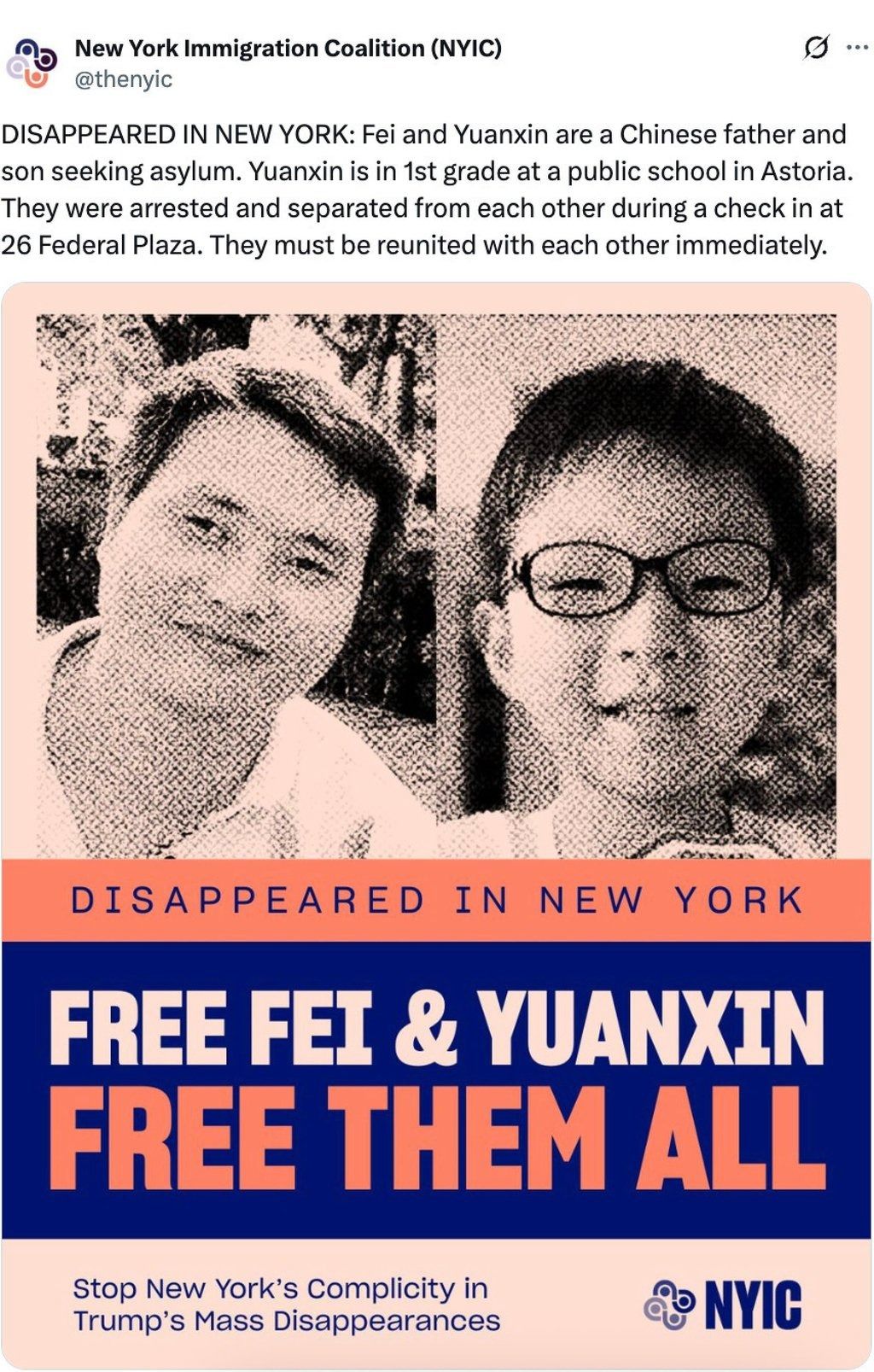
WASHINGTON: More than a week after US immigration authorities separated six-year-old Yuanxin from his father during a routine check-in with ICE in New York, it has been confirmed that the child has been placed in the custody of the US Office of Refugee Resettlement. However, his location still remains unknown.
The ORR, a federal agency within the US Department of Health and Human Services, is almost always the agency that takes custody of immigrant children classified as unaccompanied or separated minors after their initial detention by the US Department of Homeland Security (DHS).
The agency has confirmed that the immigrant minor from China was in its custody but refused to reveal where the boy was being held.
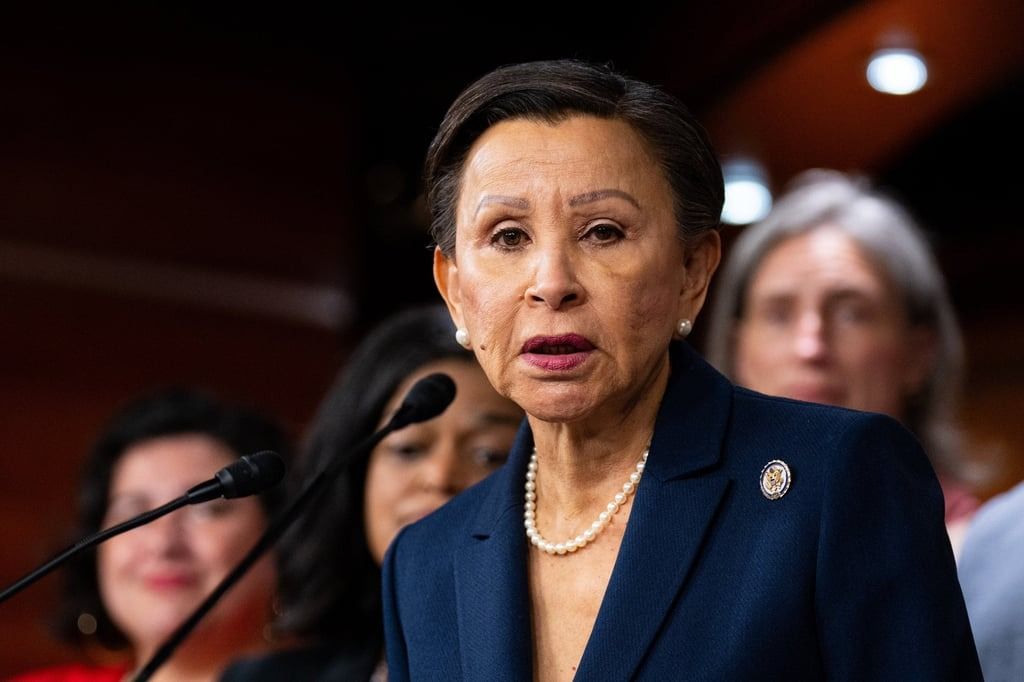
The office of Nydia Velazquez, a Democratic congresswoman from New York who has been involved in locating Yuanxin, said in a statement to the South China Morning Post that her team has been working to gather details from the relevant federal agencies.
“We have confirmed that he is in the custody of the Office of Refugee Resettlement. We are continuing to gather more information and are focused on ensuring the well-being and reunification of the family,” the statement said.
Yuanxin and his father, Fei Zheng, were detained on November 26 at the immigration office in Manhattan.
This is the third time the duo has been held by US Immigration and Customs Enforcement since they attempted to cross the border seeking asylum in April. However, this is the first time they have been separated.
The Post was able to locate Zheng in ICE’s online detainee locator as being held at the Orange County Correctional Facility in Goshen, New York.
Yuanxin could not be found in the system. The boy’s mother is believed to be in China and he does not have any other family members in the US, according to an activist who worked with the family.
Jennie Spector, a volunteer and community activist who spoke to Zheng in prison last week, told the Post that she first met Yuanxin and his father in July during a weekly food distribution in Brooklyn, New York, and since then has been involved in supporting them.
She had helped coordinate two volunteers to accompany Zheng and Yuanxin for their routine check-ins, typically required once a year or every few months. They were told to return for another check-in on November 26.
Because only the immigrants themselves – not even their lawyers – are allowed inside ICE offices during check-ins, the volunteers waited outside. But the father and son never emerged. Zheng appeared in the ICE database the next day, but there was still no information about Yuanxin.
Speaking about her meeting with Zheng, Spector described him as “very good at protecting his son”, and that he was “extremely worried, very upset about his son”.
She added that he was unclear why he and his son were arrested when they had remained compliant with the authorities’ instructions, including his last check-in.
DHS has attributed the incident to Zheng’s “disruptive” and “aggressive” behaviour and his refusal to board a plane despite receiving a removal notice as a family unit. The department said that ICE does not separate families, but that children of arrested parents are placed in “safe custody”.
Spector rejected the DHS claim, saying that the father and son were detained at an ICE office and held separately, with Zheng being transferred shortly after to a correctional facility in upstate New York.
“There was no plane involved. But they’re trying to make him look like the bad guy, like he wasn’t compliant. So this is what he deserves, right? Which is ridiculous”, she said, adding that “children should be with their parents”.
Spector said that Yuanxin and Zheng were released from detention in October together to be on a one-year parole in the US and while asylum seekers on parole, they were asked to check in again in November, when they were detained again.
“He’s complied with everything that they have said... like he’s going to these check-ins, knowing the danger he’s putting himself in,” she said.
Spector said the Senate Minority Leader Chuck Schumer’s office has also got involved in helping her find Yuanxin, but the US authorities have refused to share the child’s whereabouts with the most senior Democratic leader in the upper chamber of the US legislature. Schumer’s office did not reply to a request for comment.
“We know that he’s in ORR custody... but yes, they won’t tell anyone exactly where he is, and I’m being told that the father has been told, but I can’t confirm that,” she said.
A recent report by ProPublica, a US-based non-profit news organisation, found that since the start of this year, about 600 immigrant children have been placed in government shelters by ICE – the highest number recorded in a decade.
Describing Yuanxin’s detention as a “kidnapping”, Spector noted the mental toll such a situation can have on a minor.
“It’s totally traumatising,” she said, adding that a child could have several questions: “‘Will I ever see my parent again? Who is my, like, my protector, my primary caretaker? You know, the person who I trust.’
“It’s something that’s going to be a trauma for them for the rest of their lives,” she said.
Spector said that neither Zheng nor Yuanxin speak English fluently and could be facing difficulties due to that. The boy had only been enrolled in an elementary school about a month ago.
“I never heard him speak English, so he probably was just learning English... but that’s not his primary language. So, yeah, that’s the other thing is, like he’s around only English speakers and not fully able to communicate.”
ORR did not respond to a query from the Post about how many Chinese-language interpreters were available at its facilities.
Chinese embassy spokesman Liuy Pengyu in a statement to the Post did not directly comment on Yuanxin’s case, but said that “as a principle, the Chinese government has always attached great importance to safeguarding the legitimate rights and interests of Chinese citizens overseas and protecting their safety”.
Last month, the brother of a Chinese immigrant who died in ICE custody in August filed a lawsuit against the US government, demanding answers and accountability for his sibling’s death.
According to the complaint filed in the Southern District of New York, 32-year-old Chaofeng Ge was found hanging by his neck in a shower stall “with his hands and legs tied behind his back” at the Moshannon Valley Processing Centre (MVPC) in Pennsylvania.
In the filing, his brother, Yanfeng Ge, alleged Chaofeng was isolated because no one at the facility spoke Chinese and staff made no effort to communicate with him.
A report published in July by the Asian-American Studies Centre at the University of California Los Angeles (UCLA) found that Asian immigrant arrests nearly tripled from less than 700 in 2024 to almost 2,000 between February and May 2025.
Arrests in the first week of June were almost nine times higher than in the same week the previous year. The proportion of detainees who were convicted criminals fell from nearly half in the first three months of 2025 to less than a third in early June.
Among those arrested, nearly a third were from China, more than a quarter from India and almost a sixth from Vietnam, the UCLA study found.
The number of deaths in ICE detention has also risen. There have been at least 20 deaths in ICE custody in 2025, the deadliest year since 2004. - South China Morning Post