




Hong Kong’s worst blaze in seven decades has exposed an ugly open secret of a murky and rapacious building renovation business that is plagued by bid-rigging and skyrocketing costs even as it staves off feeble official efforts to tackle collusive conduct.
Experts and former insiders offered this grim assessment, pointing to the city as a gold mine for such syndicates given its ageing stock of high-rise properties ripe for renovation.
They made a collective call for an overhaul of the industry as the government announced on Tuesday an independent committee to investigate the cause of the deadly fire at Wang Fuk Court in Tai Po – which has claimed 156 lives so far – and to review systemic problems, including alleged bid-rigging.
Like many older buildings, the impetus to renovate at Wang Fuk Court came from an official edict. The estate was served a statutory order under a mandatory building inspection scheme in 2016. Each year, authorities require around 600 properties aged at least 30 years to hire a professional consultant to inspect the buildings and contractors to complete necessary repairs.
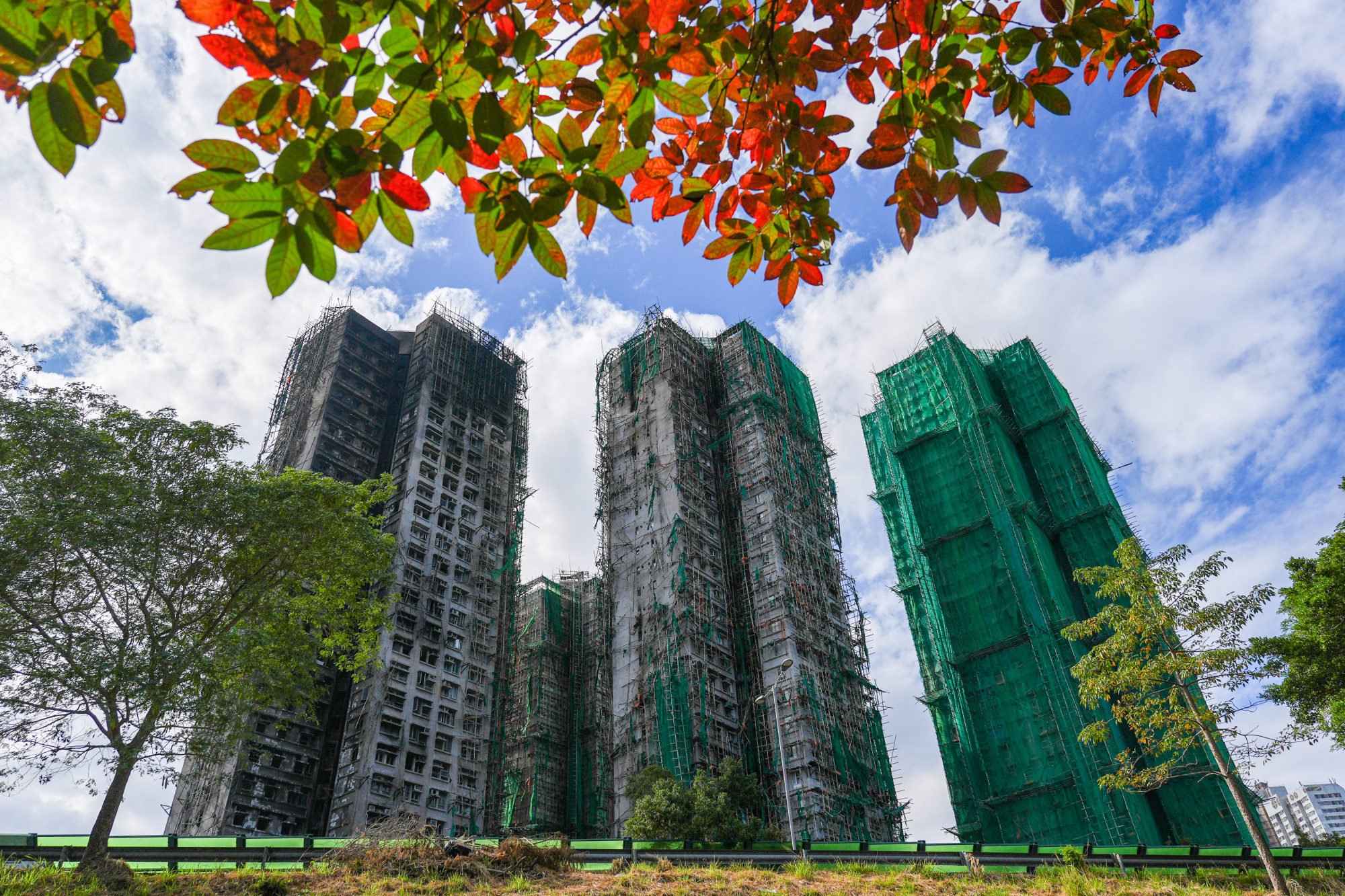
Internal documents reveal the renovation budget of Wang Fuk Court ballooned from a preliminary tender analysis of HK$152 million (US$19.5 million) in September 2023 to a final HK$336 million last year, after the estate adopted the most expensive option.
The renovation included the complete removal and repaving of external wall mosaics rather than patch repairs, alongside millions in added costs for drainage and fire safety upgrades.
Skyrocketing renovation costs have become commonplace in Hong Kong. A notable case was a HK$260 million project in Sha Tin’s Garden Vista in 2016, where the owners were to pay HK$200,000 to HK$300,000 each on average.
A subcontractor was sentenced to 35 months in jail after he turned himself in for conspiring with six others, including the chairman of the estate’s incorporated owners, representatives from management firms and consultants, which eventually led to HK$45 million being paid to some of them.
According to Chiu Yan-loy, founder of the Property Owners’ Anti Bid-Rigging Alliance, a common malpractice in maintenance involves a consultant company securing a contract at a low price and then working with a related contractor to win the renovation project at a price significantly higher than the actual cost.
Chiu, who has helped with numerous private maintenance projects in the past two decades, said high renovation costs tended to include extra unnecessary work and using costly techniques, from which the syndicate could make a profit by using low-cost materials.
He added that property management companies and the owners’ corporations often had a role to play in such a collusive set-up, as they were responsible for communicating with the consultants and contractors.
Chiu noted that the statutory Urban Renewal Authority (URA) launched the “Smart Tender” services in 2016 to combat bid-rigging, but its advisory and facilitative role posed limitations.
The URA service provides guidelines on organising maintenance works, technical advice and cost estimates offered by an independent third-party adviser and an electronic tendering platform.
“The fatal flaw is that, no matter how fair the process is, final approval must come from the general meeting of the owners’ corporation. If it is manipulated – for example, by using proxy votes to control the majority – the deal can be sealed simply by buying off enough votes,” Chiu said.
‘It has become a structural problem. Bad money drives out good. It is about how to restore public confidence so that proper companies can return to the market.”
Ricky Wong, chief executive at King Value Realty Investment Consultant, said the city’s ageing housing stock was a gold mine unscrupulous contractors could easily exploit.
As of the end of 2022, about 9,600 private buildings, at least one-fifth of the stock, were at least 50 years old.
“With so many buildings in Hong Kong now reaching 40 to 50 years of age, they have to undertake major renovation,” Wong said.
“Many contractors view this market as a huge piece of ‘fat pork’, extremely lucrative meat. They are desperate to get a slice of the work. Profits can be huge.”
Despite efforts to anonymise tenders, Wong pointed to a tactic to manipulate the outcome.
“They may set up multiple different companies to bid for the same project in a bid-rigging way, but several companies may have the same group of bosses,” he said.
Wong added that while malpractice had persisted for “10 to 20 years”, it was only the scale of the recent tragedy that finally forced the public to “wake up” to the reality of the risks involved.
Chau Lin-kin, chairman of the Hong Kong Renovation Practitioners Union, said the industry was rife with contractors using predatory pricing to “plant a flag” and seize business.
“They bid cheap, then add costs here and there,” Chau said.
Chau warned that the obsession with the “lowest bid wins” mentality in property management tenders had created a race to the bottom that compromised safety and quality.
“Everyone is fighting to be the cheapest, to the point where the whole market is rotten,” he said. “If a job costs HK$10,000 to do properly including labour and overheads, and someone takes it for HK$8,500, how do they do it? It’s either [substandard] materials or cutting corners.”
Chau urged the government to step up regulation and public education to help owners identify red flags in pricing.
“If the market rate is HK$8 to HK$10 ... and someone bids way below or way above ... there’s a problem,” Chau said.
Veteran surveyor Vincent Ho Kui-yip, president of the Hong Kong Institute of Building Safety, said the city lacked a mechanism to crush the syndicates linked by vested interests.
“It takes both an inside job and outside help to succeed ... Syndicates dominate the market, while proper consultants also worry about entering the market as they are excluded and cannot fight for a reasonable consultation fee,” he said.
“Even if they can get it, they can hardly proceed if the owners are part of the syndicate.
“The key is to break the chain of interest.”
Just how exactly the collusive practices could be stamped out would require both greater deterrence measures of higher penalties of fines and jail time and a regulatory overhaul that needed greater and closer government supervision, experts said.
Ho suggested, for example, that the government could establish a statutory body to manage not just citywide mandatory inspections but also the scope and progress of maintenance projects, based on owners’ endorsement, as many lacked the professional knowledge and some could even be part of a syndicate.
He also said the body could tender renovation projects only to a list of endorsed consultants and contractors, requiring the industry to meet certain performance standards and that they had to be reviewed and assessed regularly.
He added that the body could also provide data on maintenance costs for public reference.
“It is time for a review. This tragedy is a wake-up call,” he said. -- SOUTH CHINA MORNING POST


