

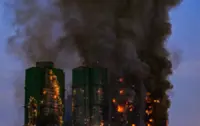
The massive fire that engulfed the Wang Fuk Court residential estate in Hong Kong on Wednesday has prompted discussions about the potential for new firefighting technologies to improve rescues.
The fire spread rapidly across seven adjoining residential blocks covered in bamboo scaffolding. Residential high-rises are closely clustered in the densely populated city.
Since 2000, mainland China has built almost 1,600 skyscrapers – 60 per cent of the global total – eclipsing the early 20th century high-rise boom in the United States.
To address firefighting challenges in dense urban landscapes, researchers and firefighters in mainland China have been developing and adopting new technologies designed to withstand high temperatures, locate fires and reach upper floors.
Still, fire safety engineers and combustion scientists stressed that prevention was crucial, noting that the Hong Kong fire exceeded the scope of both human intervention and existing technology.
They also pointed to the physical limitations of using large fire trucks in the city’s cramped streets.
“What I want to emphasise is there is no technique in the world that can fight the high-rise building fire,” said Huang Xinyan, an associate professor at Hong Kong Polytechnic University (PolyU) and deputy director of its Research Centre for Smart Urban Resilience and Firefighting.
Huang said building facade fires over the past two decades had not been extinguished through firefighting operations but had ceased only when the fuel was depleted.
“I think it is time to stop criticising the firefighting strategy. Because essentially, it is beyond human power, beyond our current technology,” he said, adding that it might be more important to focus on how the fire started and why it spread so fast.
Asif Usmani, chair professor of building sciences and fire safety engineering at PolyU, said that in congested areas with high population density and high-rise buildings, firefighting presented a challenge because responders had difficulty getting access to the fire, and equipment used from the outside could only reach so far.
Usmani noted that the buildings that caught fire in Hong Kong were under renovation and used bamboo scaffolding and other materials with the potential to burn and spread fire upwards.
Over the past six years, Usmani and fellow researchers at PolyU and other institutions have been conducting a research project called SureFire to try to address challenges associated with dense urban firefighting.
In major cities across mainland China, including Shenzhen in Guangdong province and Chengdu in Sichuan province, hi-tech equipment designed to combat fires in high-rise buildings is being tested.
This includes the use of drones that carry fire extinguishing agents, robots and thermal imaging devices for search and rescue, and tall firefighting ladders capable of reaching higher floors.
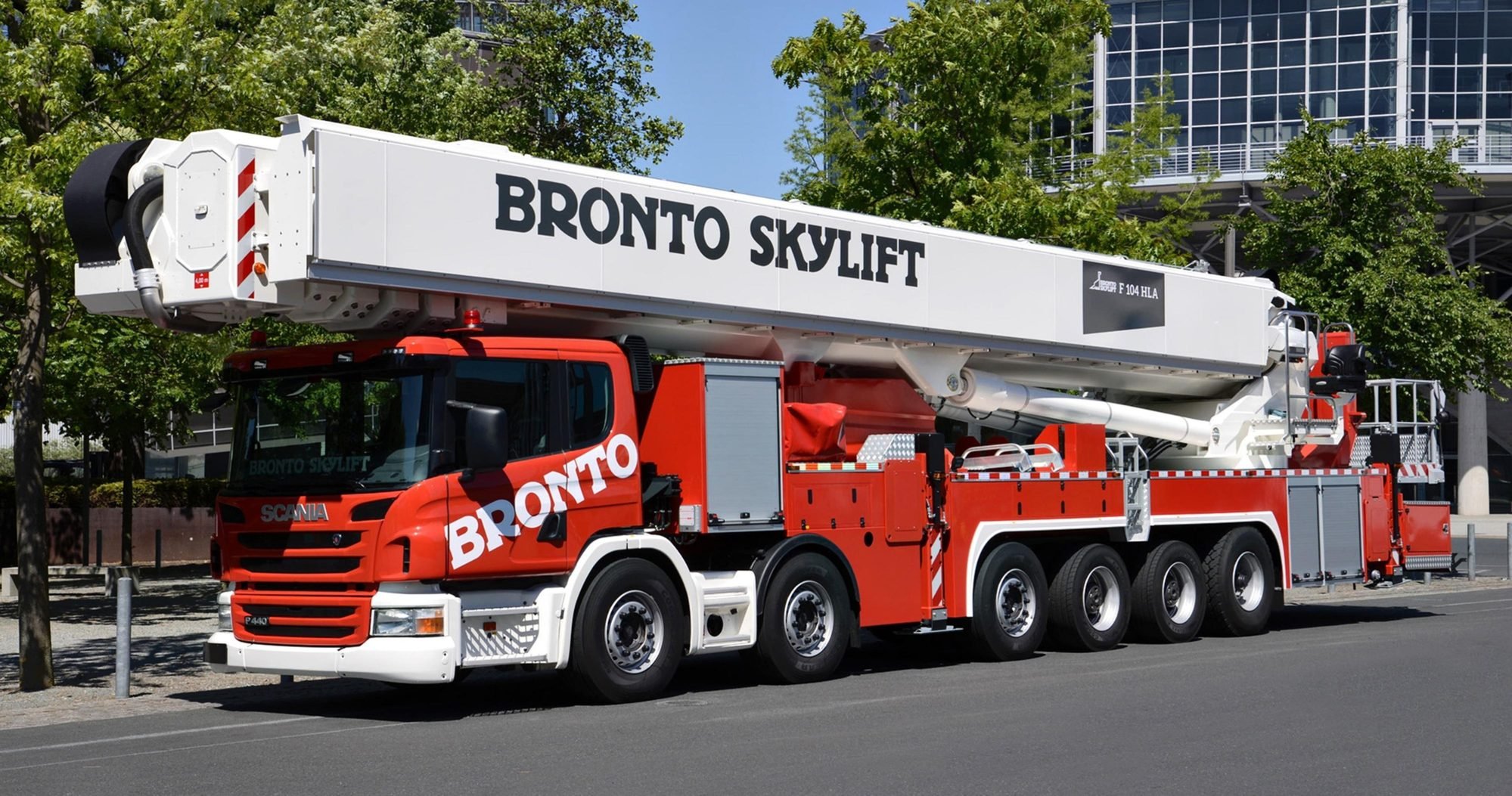
Ladder trucks reaching up to 101 metres (331 feet) or 33 storeys, designed by Finland-based Bronto Skylift, have been deployed in several cities, including Shenzhen, which neighbours Hong Kong.
The trucks can spray water at a rate of 3,800 litres (1,004 gallons) per minute, according to Hongkong Skytech International Trade, a distributor of the trucks in mainland China.
In December, the trucks were deployed in Shenzhen to put out a fire that started on the 28th floor and spread to nearby floors.
Fire engineering expert Luo Mingchun, an adjunct associate professor at PolyU, said fire engine ladders in Hong Kong reached less than 60 metres, making fighting fires in high-rises from the outside “difficult, if not impossible”.
Luo pointed to space limitations in cities such as Hong Kong, where the streets were very narrow.
“It’s just impossible to fight in this kind of fire. So the most important thing is to manage how to avoid this extreme case,” he said.
Other major cities that have deployed the Bronto Skylift trucks include Toronto, which acquired a 70-metre model in 2022, according to CTV News.
In Shenzhen, firefighters also deployed tethered drones in a fire drill, state news agency Xinhua reported in June.
“Made of carbon fibre and packing a 350kg (772lbs) payload, these drones can shoot foam or water up to 30 metres. They can operate at over 200 metres and run continuously with a tethered power and fluid supply,” the report said.
In 2020, the Guangzhou-based autonomous aerial vehicle company EHang launched the 216F, a version of its flagship pilotless aircraft designed especially for high-rise firefighting.
With a maximum altitude of 600 metres, it can carry up to 150 litres of firefighting foam and six fire extinguisher bombs during a single trip and targets fires using a camera and laser aiming device, according to EHang.
Jiang Liming, an associate professor in the PolyU department of building environment and energy engineering, said his team had been involved in developing unmanned aerial vehicle-based fighting solutions that could be used to deliver water to higher floors.
“But again, currently these solutions are not mature. You cannot directly deploy these UAVs to the fire scene. We have to put more effort into the development.”
Researchers are developing technologies to support firefighting efforts in other scenarios, including robots for warehouses and factories. However, these robots cannot be used in high-rises because they cannot climb the stairs.
Under the SureFire project, Usmani said they had been trying to develop a way to predict how a fire would develop and forecast imminent risks to help warn firefighters.
The team has been working with the Hong Kong Fire Service Department at its fire test facility to develop this technology, and they hope they can translate their research into real-world practice.
“I think technology is ultimately the answer, but I think we are at the moment still not really using all of these potential technologies that could be used,” Usmani said, adding this would require the government’s will to ensure they were installed.
Anwar Orabi, a lecturer in fire safety engineering at the University of Queensland in Australia, who conducted research at PolyU as a postdoctoral fellow, said prevention was still the most effective solution and warned about “pure marketing fluff” in firefighting.
He said firefighters who used these technologies daily could draw from their experience to tell which ones were truly effective.
“There are many technologies emerging nowadays attempting to fight battery fires, for example, but you hardly see many of them adopted by firefighters because many times they actually cause more harm than they mitigate,” he said.
“If you were to ask a firefighter, you will likely find that the best and most effective technology is a water hose.”
Huang noted that Hong Kong was doing very well in fire safety compared with the rest of the world, and a case like the Wang Fuk Court fire was an “exceptional” one.
He said that if the government chose to demolish the Wang Fuk Court buildings and build anew, they could install the latest smart firefighting technology, including sensors and even a digital twin system to monitor the building.
“Then any kind of fire risk will be identified very quickly, and also the firefighters outside will have more information about the fire inside the building so they can be more prepared,” he said. -- SOUTH CHINA MORNING POST


