Excessive heat and raging flames that engulfed a Tai Po estate in one of Hong Kong’s deadliest fires posed the biggest challenges for firefighters, experts have said, as they dismissed suggestions that height limitations of aerial ladders had added to the blaze’s severity.
They were responding to widespread online speculation that the severity of the highest No 5 fire alarm blaze stemmed from limitations in the Fire Services Department’s ladder apparatus and a reluctance to ask for help from mainland China, which had equipment that could reach higher floors.
At least 83 people, including a firefighter, were killed after the ferocious blaze ravaged seven of the eight 31-storey blocks of Wang Fuk Court in Tai Po on Wednesday. The fire had yet to be completely put out by Thursday evening.
“The length of the fire ladder was not the determining factor,” William Ip, safety supervisor of OHMS Limited, said.
The fire service installation contractor said water jets projected from aerial ladder platforms in Hong Kong could typically reach an effective extinguishing height of up to about 30 storeys.
But he said the water could only help cool the temperature and would not extinguish the fire entirely.
He said the spread of the fire from outside the buildings to the flats, which was rare, also posed challenges for firefighters.
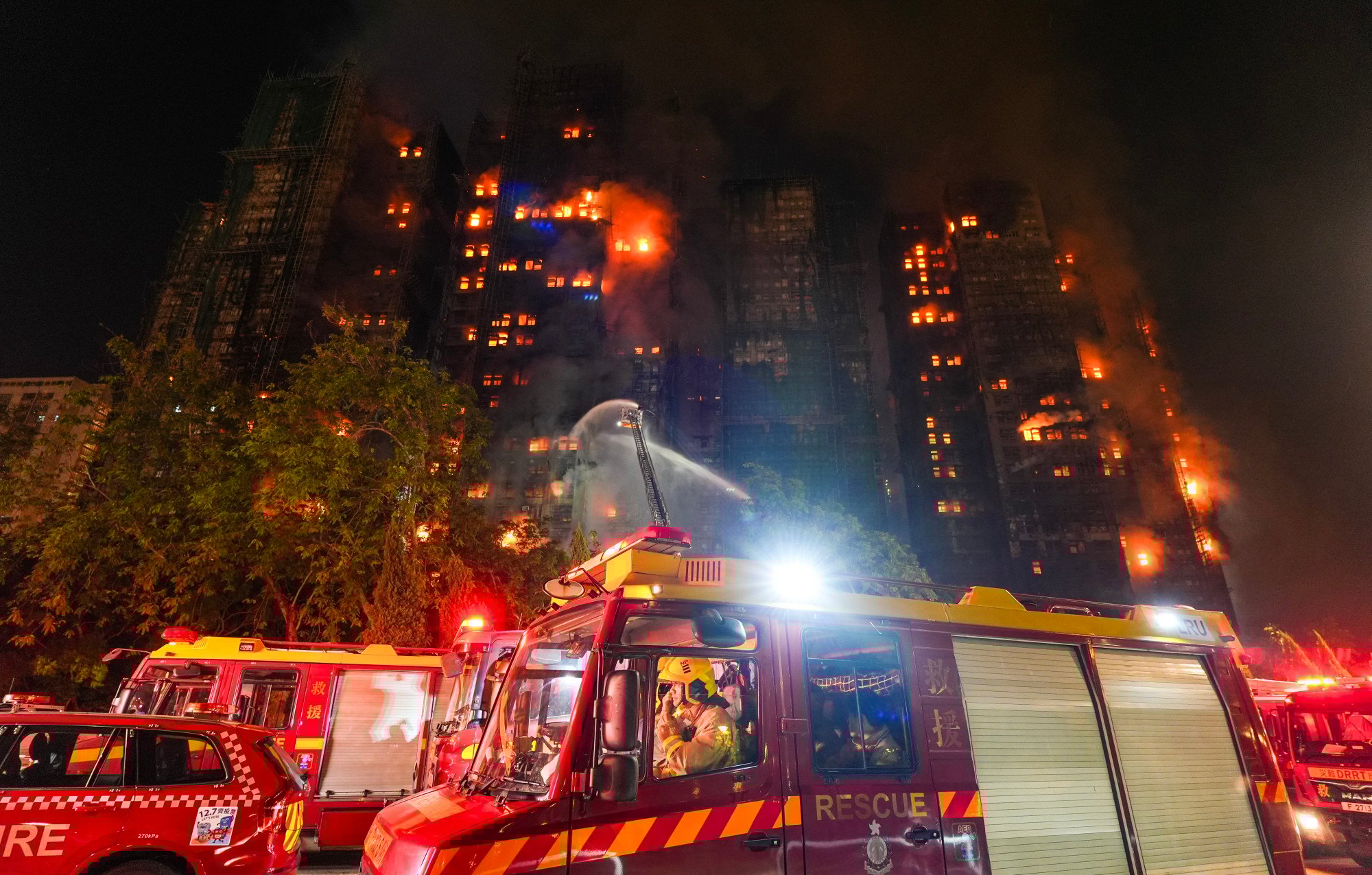
Given the dry weather and the high temperatures emanating from the buildings, it was difficult for fire engines to park very close to the blocks that were ablaze.
According to the Fire Services Department’s website, it is equipped with different platforms including aerial ladders providing working heights of 42 metres and 56 metres.
The Post has learned that while aerial ladders used on the mainland can reach 100 metres, they would still be unable to reach the top floors of skyscrapers.
Anthony Lam Chun-man, a fire safety specialist and an ex-director of the department, said that the height limitation of the aerial ladders was determined by various factors, including whether the road structure could support the vehicle’s weight.
He said a longer ladder might not necessarily be better, as the length must be assessed against the width of the road.
The longer ladders were heavier, and the road’s bearing capacity was a critical consideration, he said.
He stressed that all firefighters at the scene “must have tried their best”, and used their professional judgment based on the situation at hand to save lives.
While some residents also questioned why helicopters and water bombs were not deployed, another expert said they could not help in this case.
Gary Au Gar-hoe, a spokesman for the fire division of the Hong Kong Institution of Engineers said that water bombs were not effective in putting out fires in buildings.
“Throwing water bombs – or firefighters spraying water jets – with furniture burning inside, would make it difficult [to bring the blaze under control],” he said.
As flames were still raging inside flats by Wednesday evening, he said it would be extremely difficult for firefighters to enter the building and withstand intense temperatures that could go up to 800 to 1,000 degrees Celsius.
He added that firefighters could only direct water jets at the buildings to reduce temperatures, while waiting for the fire to finish burning through flammable objects inside.
Past chairman of the structural division of the Hong Kong Institution of Engineers Chan Sai-cheong said that a thorough inspection was necessary to determine the full extent of the buildings’ damage, but stressed that they had no immediate risk of collapse.
He added that temperatures of around 500 degrees would typically begin to affect a building’s structure, and those reaching 1,000 degrees would have a serious structural impact.
“However, given it has burned across such an extensive area and for such a long duration, it must have affected the building,” he said, predicting that residents would not be able to return home for a few months.
He said that because the fire spread upwards, the underside of the floor slabs on every storey would have received the most heat, and he anticipated that the damage to those areas would be serious. -- SOUTH CHINA MORNING POST