




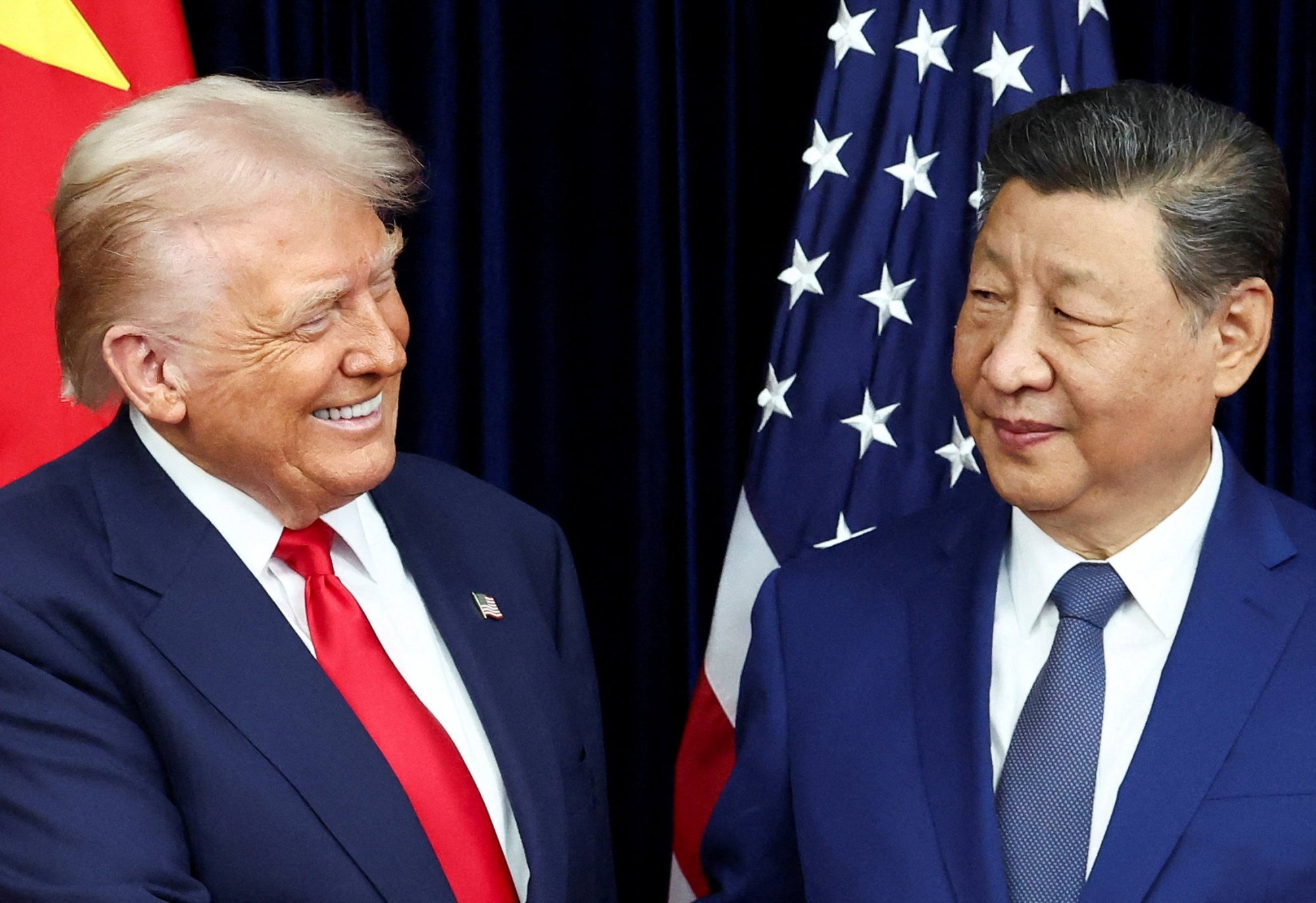
When US President Donald Trump was about to begin his closely watched summit with his Chinese counterpart Xi Jinping last month, he wrote a social media post that revived a decades-old concept about the dynamics between the two countries and their role in global affairs.
“The G2 will be convening shortly,” he wrote – in all caps – ahead of the talks.
The term “G2”, or Group of Two, emerged in the 2000s as a proposal for Washington and Beijing to work together to address global challenges. Over time, it has evolved to broadly refer to the US and China as leading powers sharing the world stage.
Trump’s remarks, which hinted at a global duopoly between the US and China, have worried some US allies. But how does it sit with the Chinese leadership?
Beijing is likely to have taken some pride in being treated by Washington as an equal, but its leaders would not be particularly pleased about being referred to as the G2, according to observers.
They said this categorisation would not be ideal for Beijing as the term had a “hegemonic” undertone that could harm China’s efforts with the developing world and bring it added responsibilities it might not be too eager to shoulder. Trump’s words, they suggested, should be treated as no more than political rhetoric or flattery ahead of trade talks.
As Da Wei, director of Tsinghua University’s Centre for International Security and Strategy, put it: “China is not enthusiastic about the ‘G2’ concept and term.”
“In the past, China wasn’t keen on it ... I think this attitude has not changed,” he said.
First floated by American economist C. Fred Bergsten in 2005, the G2 concept envisioned the US and China jointly tackling global issues ranging from economic stability to climate change.
It gained some momentum in the wake of the 2008 financial crisis, when China – the fastest-growing developing economy – emerged as a key player in supporting the global economic recovery.
While the concept was discussed during Barack Obama’s first term as US president as a framework for the US and China to come together to shape a new global order, it was never adopted as official policy.
It was never embraced by Beijing either. Former premier Wen Jiabao rejected the concept in 2009, making clear to Obama that while Beijing and Washington could play a role in setting up a new global order and promote world peace and stability, “global issues should be decided by all nations in the world rather than one or two countries”.
In another occasion that year, Wen said: “Some say that world affairs will be managed solely by China and the US. I think that view is baseless and wrong.”
“Multipolarisation and multilateralism represent the larger trend and the will of the people,” he said, according to Chinese state news agency Xinhua. “China stands ready to develop friendly relations and cooperation with all countries and it will never seek hegemony.”
About 16 years later, Beijing’s position has not changed. Asked about Trump’s G2 comment, China’s foreign ministry last month said China and the US could shoulder their responsibilities as major powers while stressing that Beijing would “forever stand together with fellow developing countries”.
Dominic Chiu, senior analyst at Eurasia Group, said the Chinese leadership certainly wanted to be treated by the US as an equal power. Privately, this meant that Chinese leaders probably welcomed Trump’s G2 remark as a tacit acknowledgement of equal status, even if it was for the purposes of the trade negotiations.
Xi and Trump met last month on the sidelines of a multilateral forum in South Korea – the first in-person summit since Trump’s return to power – resulting in the two sides agreeing to dial down tensions and yielding breakthroughs in areas including soybean purchases and fentanyl-related tariffs.
But Chiu suggested Beijing’s reaction to the G2 comments might appear “lukewarm” because of its “public disavowal of international hegemony”.
“The phrasing could be interpreted by some third countries as a global duopoly, which Beijing is eager to avoid for diplomatic reasons,” he said.
“Trump’s use of ‘G2’ signals the priority he places on managing US-China relations and may also serve as flattery ahead of talks, much like his many references to a personal friendship with Xi. Beijing likely does not interpret this as a call for a true G2 framework.”
Da said China had not been keen on the G2 concept when it gained popularity during the first Obama administration – and that position remained.
“G2 suggests that China and the US, as two major powers, are playing a decisive role in international affairs. This doesn’t align with China’s long-term diplomatic philosophy and tradition,” he said.
“It has a strong hegemonic undertone, a sense that major powers are determining global affairs, so China is unwilling to accept such a term.”
While China would agree to play a significant role in global affairs with the US as a leading power, Beijing did not necessarily prefer to use the G2 term, as it had a connotation of the two countries “dominating” the global order, Da said.
He added that China wanted to become a major power and had been shouldering greater responsibility, including its contributions to the United Nations and global peacekeeping operations, but “if being a global leader means taking on a role like the one US had in the past, China probably has no appetite for that”.
“China’s diplomatic goal has never been to become a country like the US, a leader or a hegemon, however you want to call it,” Da said.
Joining a G2 grouping with the US could also hurt China’s interests when it comes to building deeper ties with the developing world. China has in recent years sought to frame itself as a champion and leader of the Global South, advocating a greater voice for developing economies.
Da said major developing countries such as India and Brazil would be unwilling to accept the G2 concept as the grouping tacitly suggested the US and China dominate global affairs. And that could sour Beijing’s ties with developing economies.
“I think there’s no need to take Trump’s statement too seriously,” he said. “I think his core meaning is that China and the United States should play leadership roles in global affairs.”
Yu Jie, senior research fellow on China at British think tank Chatham House, said Trump’s G2 remark should be treated “as a matter of rhetoric rather than a substantive policy pushed by the Trump administration and by Beijing”.
The cautious Chinese response indicated that Beijing did not want to become a world leader in the way the US had conducted its diplomacy, she said.
“It will only bring additional responsibilities and inevitably draw China into conflicts which it does not want to get involved in,” she said.
“We are not exactly moving towards a duopoly; instead, we are moving into a low-intensity competition temporarily between the world’s two largest economies.”
“The first time I heard about ‘G2’ being used as an analogy for describing the current state of affairs between Washington and Beijing, I was, like many, surprised,” said Zha Daojiong, professor at Peking University’s school of international studies.
But he noted that Trump had not offered a definition of the term, suggesting that Trump “might as well be saying something aspirational” about the future state of affairs between the US and China.
“It might as well have resulted from just an impromptu choice ... by its sender to express his sentiments at that moment,” Zha said. -- SOUTH CHINA MORNING POST



