




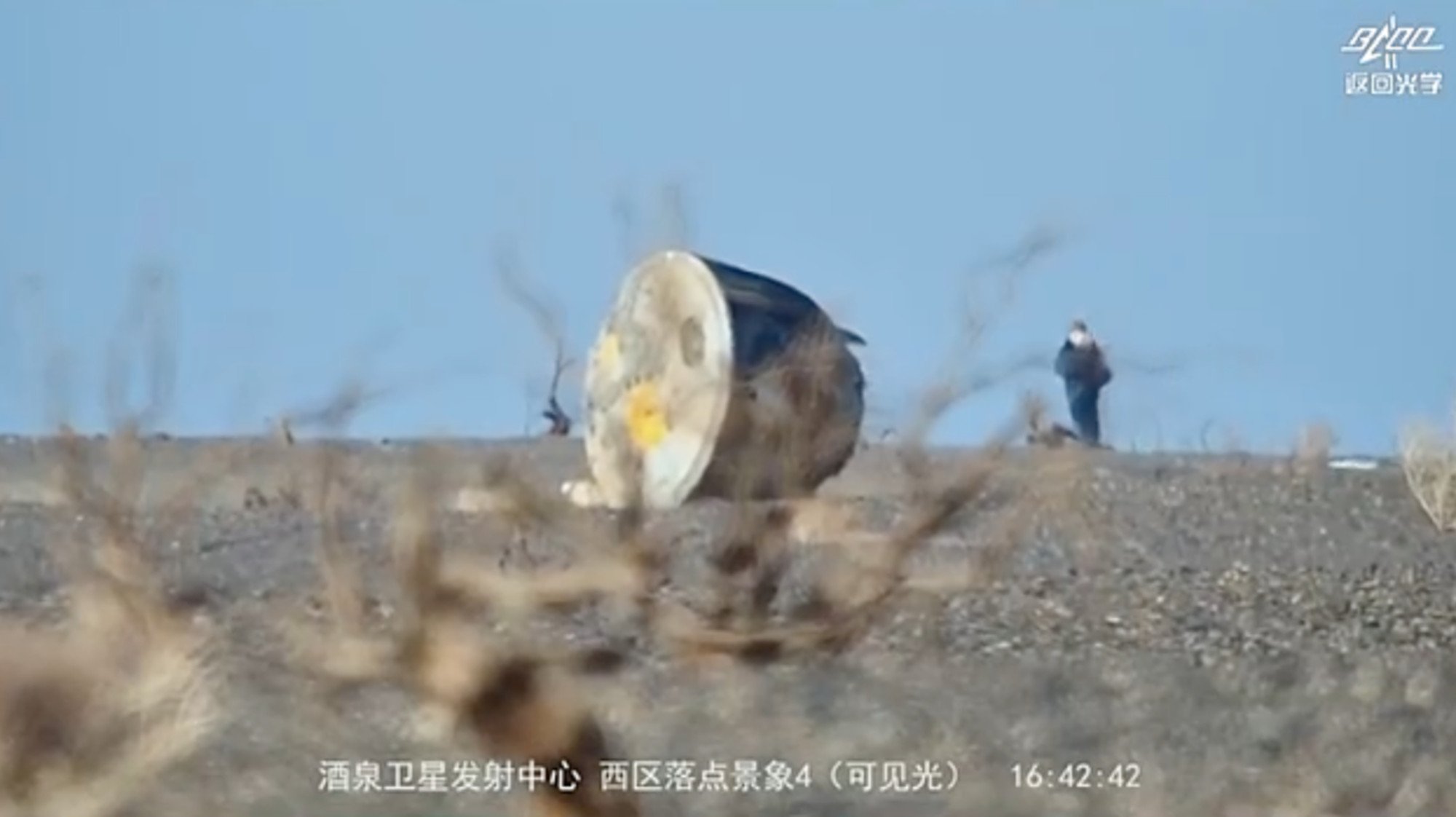
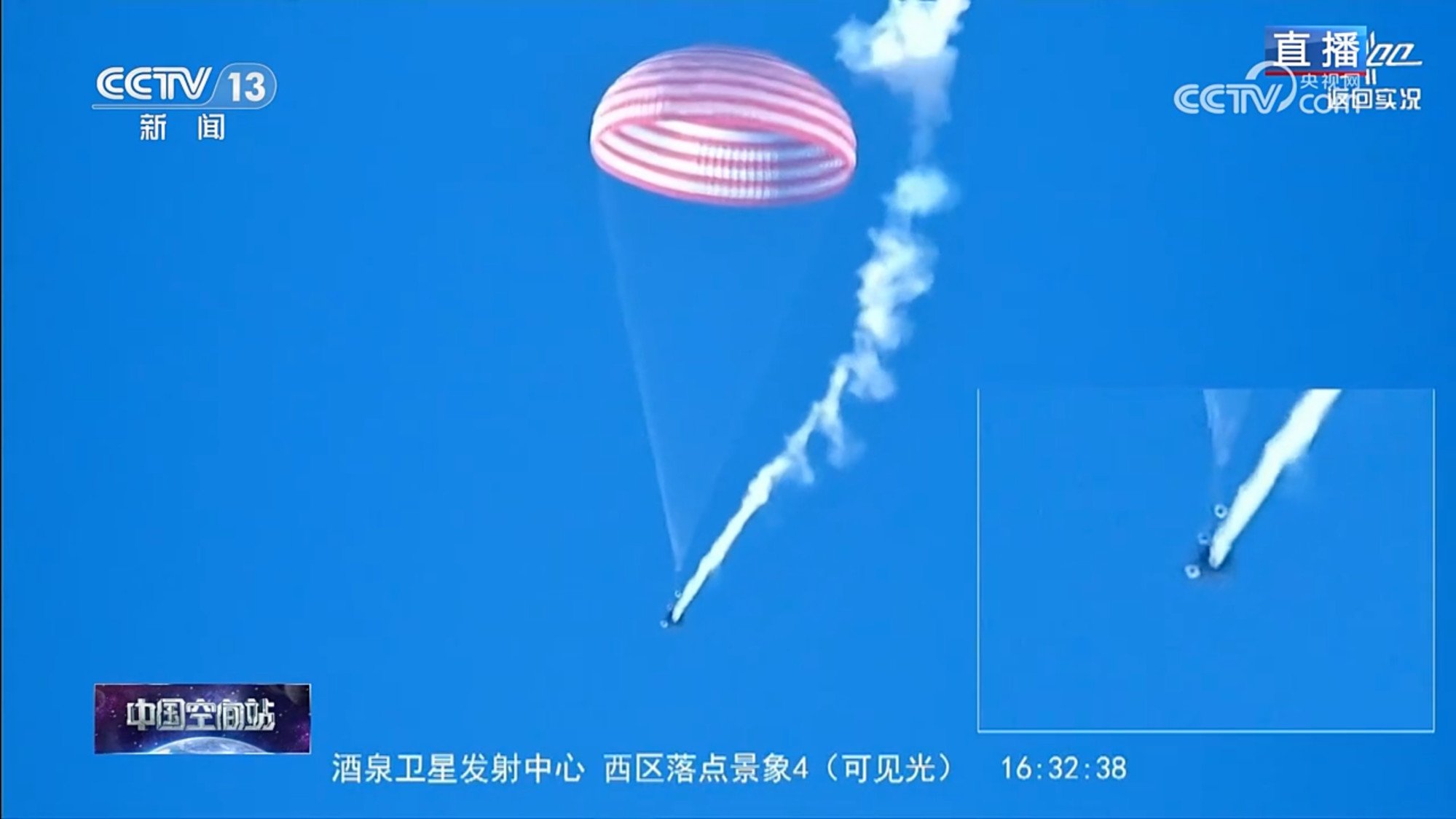
Three astronauts whose return to Earth from China’s Tiangong space station was delayed last week after a suspected debris strike touched down on Friday at the Dongfeng landing site in the Inner Mongolia autonomous region.
The Shenzhou-20 crew arrived on board the new Shenzhou-21 crew’s spacecraft, landing at 4.40pm, according to the China Manned Space Agency (CMSA).
Ground search and rescue crew located the landing site shortly after the capsule touched down and confirmed the three crew members – Chen Dong, Wang Jie and Chen Zhongrui – were in good physical condition.
“The three astronauts of Shenzhou-20 stayed in orbit for 204 days, breaking the longest stay in orbit for a single Chinese astronaut crew,” CMSA said on Friday.
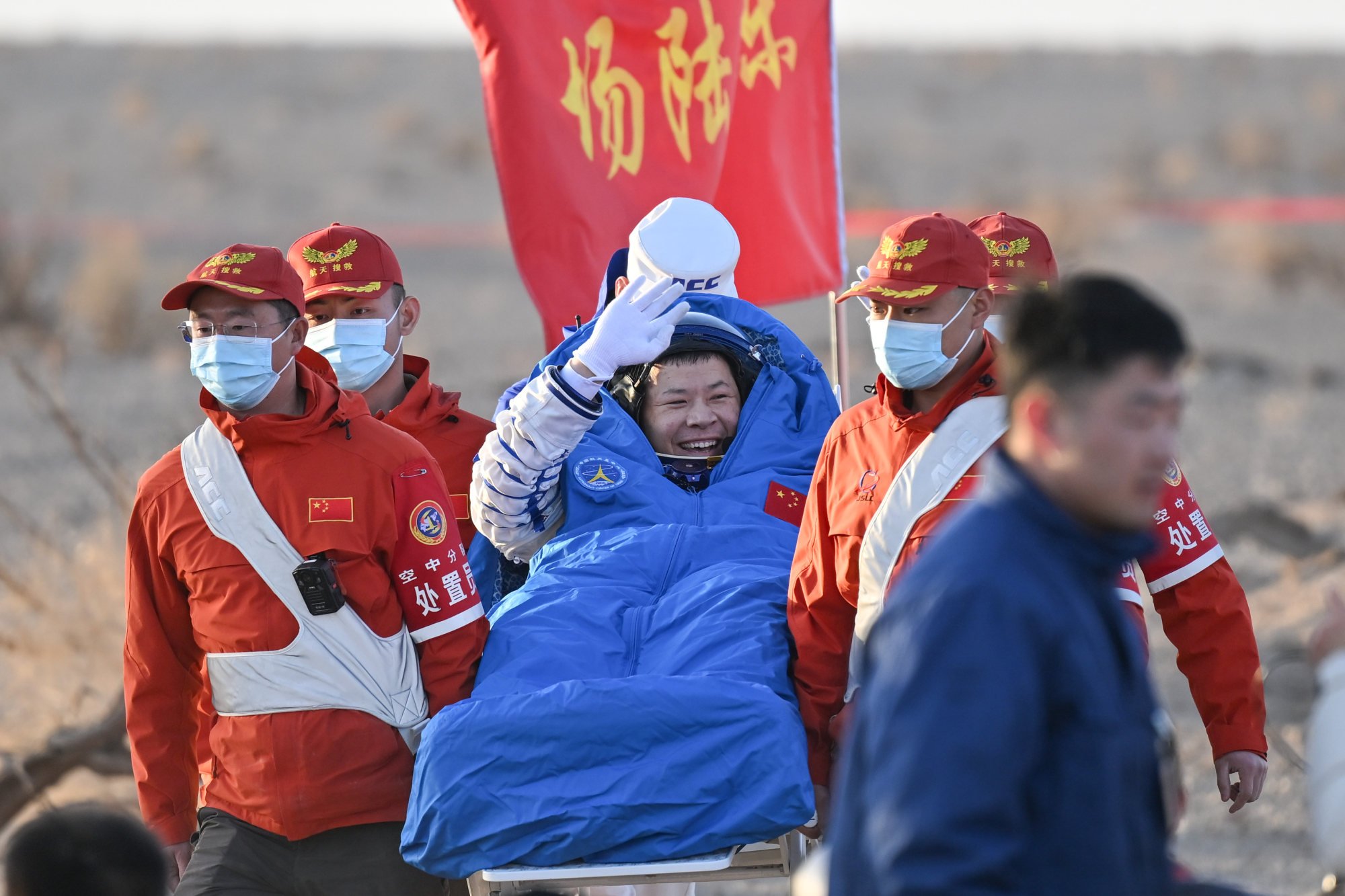
“I think this mission was a valuable experience, a test, and I’m very proud,” Chen Dong, commander of the Shenzhou-20 crew, told state broadcaster CCTV after exiting the re-entry capsule.
“We successfully completed the mission. China’s space programme withstood the test, and the entire project delivered an outstanding result.”
Earlier on Friday, state news agency Xinhua reported that the spacecraft had successfully separated from the Tiangong space station and was on its way back to Earth.
The report said the crew were unable to return on their own spacecraft after tiny cracks were found in the porthole of the Shenzhou-20’s return capsule – damage that was likely to have been caused by the debris impact.
That meant it could not make a safe crewed return to Earth, and the spacecraft will remain in orbit where it will be used for research.
Ahead of Friday’s launch, the CMSA said all three astronauts were in good health, and preparations were under way at the landing site for their return.
The new astronauts from the Shenzhou-21, who arrived on November 1, were originally set to make their trip back to Earth next year aboard their own spacecraft. The CMSA said a new spacecraft – the Shenzhou-22 – would soon be sent to the Tiangong.
The three returning astronauts, who have been in orbit since April, had been scheduled to return aboard their own spacecraft on November 5 after completing a handover to the relief crew, who arrived at the space station days before to begin their six-month mission.
On the day the Shenzhou-20 crew were due to make their return, the CMSA said it had been postponed following a suspected impact by small space debris.
The agency said the debris was believed to have struck the spacecraft and that it was conducting an impact analysis and risk assessment.
The CMSA on Tuesday said emergency response plans and measures had been activated after the crew’s return was postponed.
According to Chinese space authorities, an emergency rescue system is in place for such incidents, with a backup spacecraft on standby for rapid deployment if necessary.
On Tuesday, the South China Morning Post reported that the Shenzhou-22 – which was originally built for the next crew rotation – was being prepared for launch at the Jiuquan Satellite Launch Centre in the Gobi Desert.
The CMSA on Friday said the Shenzhou-22 spacecraft would be prepared to launch at an appropriate time in the future.
In April, the return of the Shenzhou-19 crew was delayed by a day because of bad weather at the planned landing site, forcing the ground crew to switch to a new site.
During their time aboard the Tiangong space station, the Shenzhou-20 crew conducted science experiments and several extravehicular activities, including tasks such as installing debris protection shields.
Chen Dong, the commander of the Shenzhou-20 crew, holds the record for the longest time spent in space by a Chinese astronaut after accumulating more than 400 days in orbit on board the Shenzhou-11, Shenzhou-14 and Shenzhou-20 missions. -- SOUTH CHINA MORNING POST


