
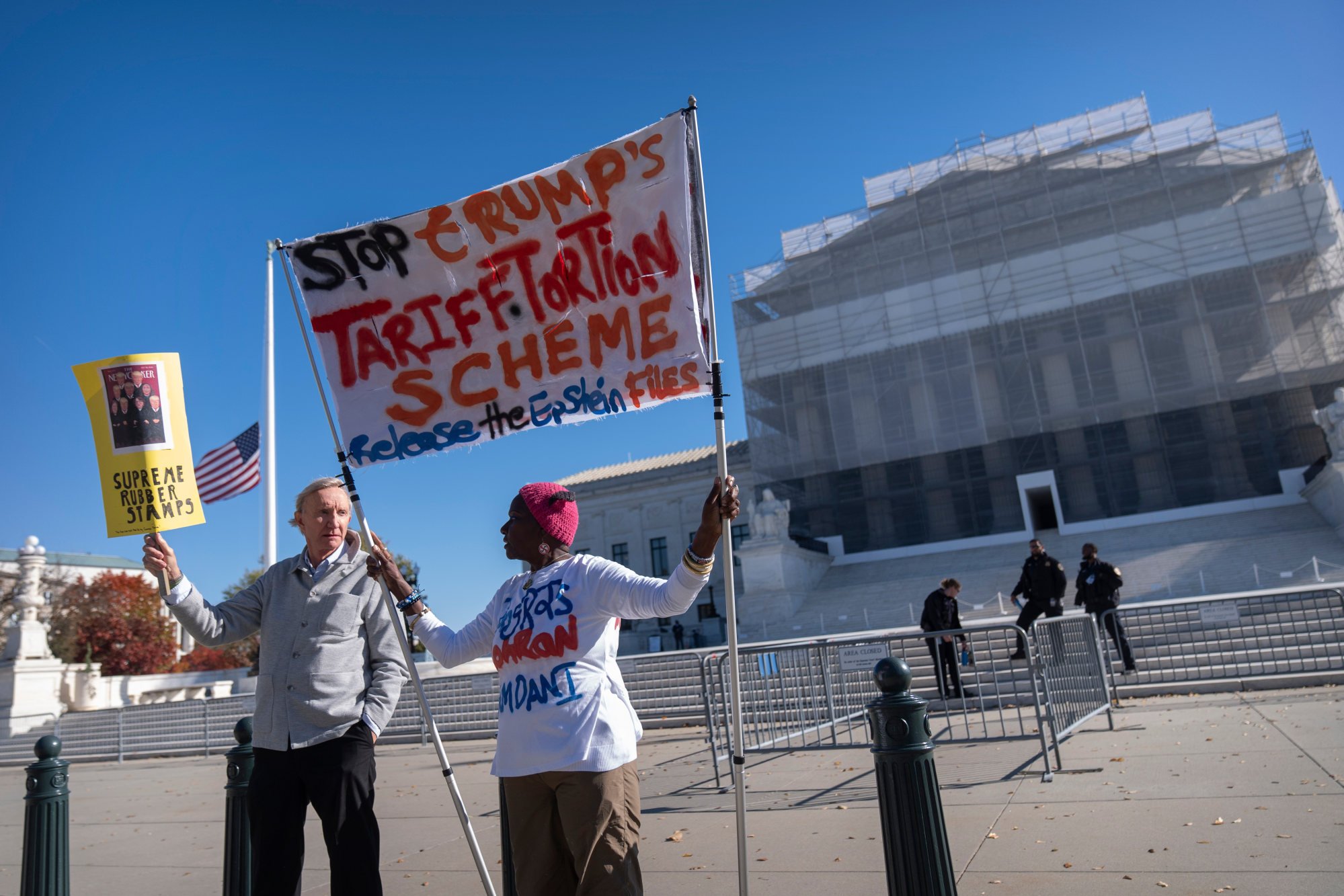
In a packed marble courtroom, the US Supreme Court on Wednesday heard oral arguments on what could be the most consequential trade ruling in a generation, grilling President Donald Trump’s administration over whether a 48-year-old emergency law effectively gave the White House virtually unlimited power over trade.
At stake: US$90 billion already paid by American importers, trade deals with partners across the globe, billions more to come, and the delicate balance of power between Pennsylvania Avenue and Capitol Hill.
The next step in the highly consequential case before the highest US court is a private conference that will see the justices take a preliminary vote on the outcome. It is not clear when the court will announce its final decision.
Analysts said that Associate Justice Neil Gorsuch and Associate Justice Amy Coney Barrett, both conservative Trump appointees, appeared to be the swing votes on the conservative-majority court.
Gorsuch in particular seemed concerned about granting limitless power to presidents.
The first half of the oral arguments crackled with tension as justices signalled deep scepticism that the International Emergency Economic Powers Act (IEEPA) was ever intended to serve as an all-purpose trade weapon. IEEPA has been used dozens of times by presidents since it was passed in 1977, generally for more conventional emergencies such as the 1970s Iran hostage crisis.
Trump is the first president to use it to justify imposing expansive tariffs, which challengers argue is unconstitutional. Chief Justice John Roberts, a conservative member of the court, appeared to cast doubt when he noted that it had never been used before to justify tariffs.
All three major US markets closed higher with the S&P 500 up 0.4 per cent, the Nasdaq Composite climbing 0.7 per cent and the Dow Jones Industrial Average gaining some 225 points.
The two and a half hour hearing ran well beyond its scheduled 80 minutes.
The justices appeared to agree that the “major questions doctrine”, which requires Congress to grant clear and explicit authority for sweeping executive actions, could apply in this case.
Some judges appear sceptical of government’s argument
Both conservative and liberal justices pressed Trump’s solicitor general, Jonathan Sauer, on why the administration maintains that tariffs are not taxes, and why it is not Americans who ultimately pay them.
Sauer argued that the issue concerns not Congress’s “power to tax” but rather the president’s authority to “regulate” foreign commerce.
“The fact that they raise revenue is only incidental,” he said of the tariffs, while stressing that “major questions doctrine” was a “poor fit” for the case.
On the key issue of whether the president has sweeping authority to employ tariffs that generate revenue, the constitutional purview of Congress, Sauer argued that tariffs amount to “regulations” and that tariffs are actually most effective if they never generate revenue.
Citing last week’s trade deal with China, he said Trump’s threatened tariffs produced an agreement on rare earth minerals, which clearly has a critical national security component.
“And it got China, for the very first time, to change its policy with respect to fentanyl precursors, which is a crucial piece of that,” Sauer argued.
“Those tariffs, if no one ever collects them, but the threat of imposing those tariffs, gets China and our other parties across the world to change their behaviour in a way that addresses that, then that’s the most effective use of the policy.”
Associate Justice Sonia Sotomayor noted that the IEEPA does not explicitly contain the word “tariffs” or grant clear authority for broad economic action.
“And you want to say tariffs are not taxes, but that’s exactly what they are,” the liberal justice said.
Barrett asked Sauer why “every country” needed to be tariffed.
Sauer responded that “lack of reciprocity, this asymmetric treatment of our trade with respect to foreign countries” justified Trump’s actions.
Roberts also sounded sceptical, saying that imposing taxes “has always been a core power of Congress”, adding that the major questions doctrine might be applicable: “The statute doesn’t use the word tariff.”
However, later in the arguments, he said that Trump’s tariff policy touches directly on “the president’s foreign affairs power”.
An extended exchange between Gorsuch and Sauer centred on whether Congress can reclaim tariff powers once delegated to the president.
“The president’s a one-way ratchet toward the gradual but continual accretion of power,” Gorsuch said.
Neal Katyal, a partner at New York-based law firm Milbank LLP representing a group of small businesses, argued it was “simply implausible” that Congress had handed the president the power to tear up the “entire tariff architecture”.
Katyal, who served in the Obama administration, warned that if the government wins the case, in practice Congress “will never get this power back” since presidents seek to expand power and would veto attempts to get it back.
He noted that while Congress has delegated certain powers in the past, it has done so “explicitly”, adding that the IEEPA “looks nothing like those laws”.
Associate Justice Clarence Thomas, a conservative who did not speak much, asked whether the president could wield tariffs as leverage to pressure a foreign government – perhaps China – to return an American who was taken hostage.
Katyal replied no: “Tariffs are different because they’re revenue raising,” explaining that tariffs function as taxes since their main purpose is to generate income for the government.
He pointed to the example of Switzerland, which faces a 39 per cent tariff despite running a trade deficit with the US. “That is just not something any president has ever had the power to do in our history,” he added.
Trump’s global tariffs are projected to bring in US$4 trillion over the next decade. The duties, his team argues, have pushed countries to the negotiating table and spurred companies to move more manufacturing back home.
Barrett expressed concern that refunding the collected tariffs would be a “complete mess” if the government lost its case. Katyal agreed: “We don’t deny that it’s difficult.”
Benjamin Gutman, solicitor general for Oregon, representing a dozen US states against tariffs, noted a distinction between tariffs and taxes. “To be blunt about it, one of them, there’s something in it for the government, and one of them there isn’t.”
Associate Justice Brett Kavanaugh, a Trump appointee, cited tariffs on India as an example where tariffs sought to change a foreign country’s behaviour. Trump has imposed 50 per cent tariffs on New Delhi, including 25 per cent aimed at forcing India to stop buying Russian oil.
Sotomayor cited Brazil as an example, noting that the US president imposed 50 per cent tariffs after that country’s supreme court allowed the prosecution of a former leader for “criminal activity”. She said such action had nothing to do with regulating foreign commerce, showing how broadly the law was being applied. “Those may be good policies,” she said, “but does it require more than just the word ‘regulate’?”
Analysts noted the court’s scepticism of Trump’s broad application of the law. “The odds of a full administration victory are likely lower now,” said Eurasia Group in a research report, citing a drop by prediction markets to a 30 per cent chance of Trump prevailing fully, down from its 40 per cent earlier. “This move is, in our view, reasonable,” it added.
The conservative Cato Institute added that Trump’s interpretation stretches “beyond recognition” the IEEPA’s language. “Most justices appeared attentive to the risks of deferring to a president’s interpretation of an ambiguous statute and the executive branch ‘discovering’ new powers in old statutes,” said Cato legal fellow Brent Skorup.
White House warns of ‘catastrophic consequences’ from Supreme Court case.
The hearing took place on the first anniversary of the November 5 election victory that returned Trump to the White House, adding political significance to a case that could redefine presidential authority over global trade.
According to the White House, Trump considered attending Wednesday’s oral arguments in person, which would have made him the first, but opted instead to travel to Miami with US Treasury Secretary Scott Bessent representing him instead.
Trump has long defended tariffs as a tool to cut government debt, punish rivals like China, revive US manufacturing and even nudge warring nations towards peace.
For someone who has been accused of changing his mind like a weathervane, his deep belief in tariffs stretches back decades.
Why is the Trump tariff case before the Supreme Court?
The tariff dispute was sparked by two lawsuits filed by seven small businesses and 12 US states, led by Oregon.
The coalition, including Arizona, Colorado, Connecticut, Delaware, Illinois, Maine, Minnesota, Nevada, New Mexico, New York and Vermont, challenges Trump’s authority to impose tariffs on all imported goods using emergency powers.
The petitioners argued that the “America first” president overstepped when he imposed sweeping “reciprocal tariffs” in April.
Lower courts largely ruled against Trump. In August, a seven-justice majority of the US Court of Appeals for the Federal Circuit found that the tariffs exceed IEEPA’s emergency powers.
In May, the International Trade Court in New York struck down his Liberation Day and fentanyl-related tariffs directed at China and Canada.
Administration officials have said they remain optimistic the Supreme Court will do the “right thing”, but added that it is “always preparing for Plan B”. -- SOUTH CHINA MORNING POST