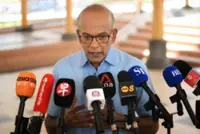
SINGAPORE (The Straits Times/ANN): Leader of the Opposition Pritam Singh returned to court on Nov 4 to appeal against the conviction and sentence meted out to him in February for lying to a parliamentary committee.
The case, the first prosecution of its kind under the Parliament (Privileges, Immunities and Powers) Act, saw defence counsel Andre Jumabhoy argue that the case boiled down to which witnesses were believed by the trial judge, Deputy Principal District Judge Luke Tan.
Mr Jumabhoy said he hoped to persuade High Court Justice Steven Chong that the trial judge had “ignored crucial pieces of evidence” in convicting Singh of two charges.
The charges were that Singh had wilfully lied to the Committee of Privileges (COP) about how he dealt with then Workers’ Party MP Raeesah Khan’s untruth to Parliament in meetings with her on Aug 8 and Oct 3, 2021.
Justice Chong said the appeal turns on two key statements Singh had made. The first was him telling Ms Khan to take her lie “to the grave” at the Aug 8 meeting, and the second was Singh telling her at the Oct 3 meeting that he would not judge her.
Here are the key points from the morning’s proceedings:
1. Defence reiterates inconsistencies in Raeesah Khan’s testimony
Mr Jumabhoy cast doubts on the veracity of Ms Khan’s account of the Aug 8, 2021, meeting between herself and WP leaders Singh, Sylvia Lim and Faisal Manap – the meeting at which it was allegedly agreed that Ms Khan would take her lie “to the grave”.
The lawyer said Ms Khan had given three different accounts of the meeting before the COP and at Singh’s trial, including one instance when there was no suggestion that Singh had asked her to take the lie to the grave.
“Everyone can see that there are differences, and to pretend that there’s no difference does a disservice,” Mr Jumabhoy said.
He argued that Singh, on the other hand, was consistent with what was said during the meeting at his house on Aug 8, 2021 – which was that at some point Ms Khan “would need to clarify the lie”.
Justice Chong replied that Ms Khan might not have used the phrase consistently in the three versions, but that does not mean it was not said.
The defence cannot ignore the text message that Ms Khan sent to her then aides Loh Pei Ying and Yudhishthra Nathan immediately after the Aug 8, 2021, meeting. The message stated that WP leaders had agreed the best course of action was to take the information to the grave.
Mr Jumabhoy also noted the defence had attempted to impeach Ms Khan’s credibility during the earlier trial, in relation to a separate set of inconsistencies as to why she lied again on Oct 4, 2021.
Judge Tan had ruled that Ms Khan’s credit was not impeached.
2. Meaning of ‘I will not judge you’
Justice Chong and Mr Jumabhoy also had an exchange about the context in which Singh said the words “I will not judge you” to Ms Khan.
This related to the second charge against Singh: that he had falsely testified to the COP that when he spoke to Ms Khan on Oct 3, 2021, he had wanted to convey to her that she had to come clean about her lie if it came up in Parliament the next day.
At his trial, Singh had acknowledged that he had said “I will not judge you”, but disputed the context in which the phrase was used.
This conversation took place at Ms Khan’s house, with no one else within earshot.
The judge noted that after Ms Khan repeated her lie in Parliament on Oct 4, 2021, Singh had told Ms Khan: “Look at the choice you made.”
Justice Chong asked Mr Jumabhoy how he would explain Singh’s use of the word “choice”. “He said ‘look at the choice you made’, not ‘the mess you made’,” the judge noted.
Mr Jumabhoy replied that Singh was expressing his frustration at Ms Khan for repeating the lie. “He (Singh) was frustrated because it was inconsistent with what he told her on Oct 3,” said Mr Jumabhoy.
The expression “I will not judge you” takes into account “responsibility”, Mr Jumabhoy added.
In return, Justice Chong said the expression is not uncommon, and is typically used when someone is doing something not quite right.
“It will be odd to say ‘I will not judge you’ when the context is that the person is going to do the right thing. That is how I would objectively judge those words,” said the judge.
To this, Mr Jumabhoy replied: “It’s not quite as clear-cut as Your Honour made it seem. It could be either way.”
3. Defence takes aim at credibility of aides
Mr Jumabhoy also attempted to characterise Ms Khan and her aides as inconsistent witnesses, and recounted their actions.
He also questioned whether Ms Khan was telling the truth in a key piece of evidence – the “take it to the grave” text message that she sent to the two WP aides, Ms Loh and Mr Nathan – immediately after her meeting with WP leaders on Aug 8, 2021.
It was “interesting” that the trio had a Zoom meeting on Aug 7, a day before Ms Khan’s meeting with Singh, said Mr Jumabhoy.
He also questioned why the “take it to the grave” element was missing from another text exchange on the matter between Ms Khan and Ms Loh two days later.
Through a series of messages exchanged between Ms Khan and the aides in early October 2021, Mr Jumabhoy argued that they were nudging her to operate in a grey area about her lie.
“The flavour that the messages give is that they weren’t keen for Ms Khan to tell the truth, and they were advising her on various ways to avoid confessing that she’d lied,” he said.
The defence lawyer also recounted that Mr Nathan had given untrue reasons for certain redactions to WhatsApp messages provided to the COP.
“They were redacted because they were telling her to continue to lie, not to come clean,” he said.
4. Singh’s lack of action during ‘critical’ 8-week period
Justice Chong asked the defence to explain why Singh appeared to be “doing nothing” about the lie between Aug 8, 2021, and Oct 3, 2021.
He said that if Singh’s position was that Ms Khan had to come clean at some point, steps would have been taken during this “critical” eight week period.
Ms Khan had confessed her lie to the party’s leaders at a meeting at Singh’s house on Aug 8. On Oct 3, the day before a Parliament sitting, Singh and his wife had visited Ms Khan at her home.
The judge questioned if this behaviour is consistent with someone who wanted the truth to be clarified, or someone who was prepared to let the lie be buried.
Mr Jumabhoy said that Singh described Ms Khan’s lie as an “earth-shattering discovery” that “involved an incident of significant personal detriment (and to the party)”.
Singh had wanted to give Ms Khan time to settle herself before going to Parliament. The WP leader was also focused on the Foreign Interference (Countermeasures) Act, which was slated for debate on Oct 4, 2021, and which the WP had a lot of interest in, Mr Jumabhoy said.
He added that Ms Khan had shingles in September, and Singh had been dealing with other issues during that period, including personal matters pertaining to his children.
The trial judge did not mention these other things that were going on, said the defence lawyer.
“(Singh’s) inaction is partly explained, as I have submitted there were a number of issues he was dealing with at that time,” said Mr Jumabhoy. Not dealing with the lie was never meant to be a permanent position, he added. - The Straits Times/ANN