




A long-awaited trade deal between India and the United States may be facing political delays, despite broad agreement that would cut the steep 50 per cent duties imposed on New Delhi by US President Donald Trump to about 15-16 per cent, according to two people familiar with the talks.
The sources, who declined to be identified given sensitive negotiations, said that while Washington is eager to conclude the deal quickly to appease US farmers caught in the crossfire with trade frictions with Beijing in advance of the 2026 US midterm elections, New Delhi has been cautious about making any announcement before the November elections in Bihar – a key state that produces both corn and soybeans – fearing potential political backlash.
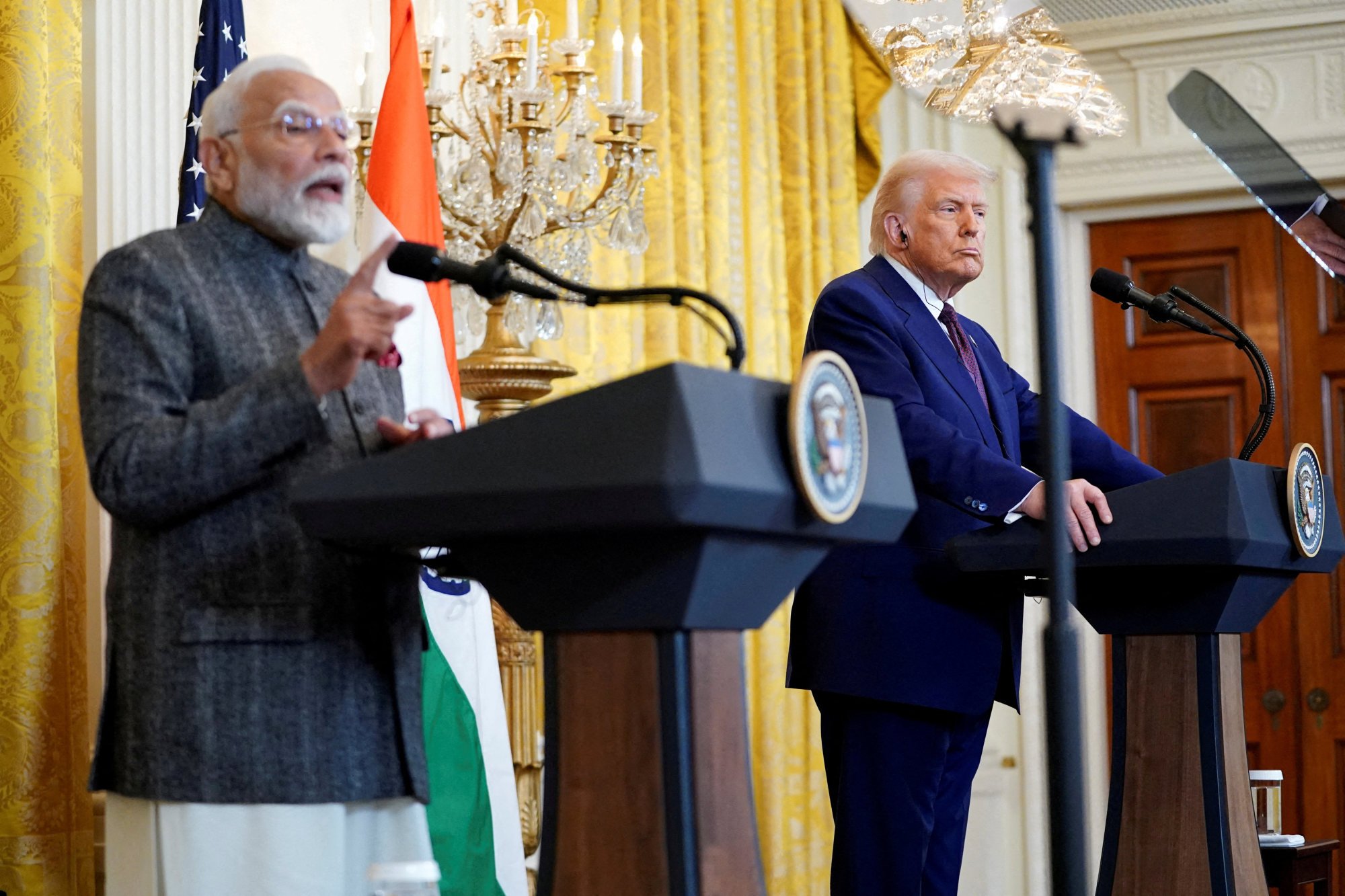
The two sides had aimed to announce a first phase of the trade agreement during a possible meeting between Trump and Prime Minister Narendra Modi on the sidelines of the Association of Southeast Asian Nations summit in Malaysia from October 26–28.
However, with the Indian state election approaching in mid-November, Modi is only expected to attend virtually, with the delegation led instead by Indian Foreign Minister Subrahmanyam Jaishankar.
One person familiar with the situation said both sides were also mindful that announcing a sharp tariff cut for India could offend Asean host Malaysia, which after months of negotiations with Washington only secured a reduction to 19 per cent.
Indian Commerce Minister Piyush Goyal on Thursday said that “progress” was being made with the US and that a “fair and equitable” deal will be sealed in the “near future”.
Why talks with India are a test for Trump’s trade ties
The talks mark a critical test for the Trump administration’s effort to rebuild trade ties with a key Indo-Pacific partner while also advancing its broader strategy to gain leverage in negotiations with China and pressure Russia to halt its assault on Ukraine.
A potential tariff cut, coupled with India’s increased purchases of US energy and farm goods, could reset one of Washington’s most important but often fraught economic relationships, though domestic politics in both countries continue to complicate the timing and scope of any agreement.
Purchases of US energy and agricultural products, including soybeans and corn, are being discussed as key elements of the deal, several sources said.
As US soybean farmers have not received any orders from China – their largest customer, accounting for around 40 per cent of their sales – Trump has been pressing other countries to open their markets to American products in order to counter Beijing’s muscular move.
Rick Rossow, chair in US-India policy studies at the Centre for Strategic and International Studies, a Washington think tank, said that if Modi does not attend the Asean summit, “which now seems to be the case – I do not expect an agreement to be finalised”.
“I suspect that, if the two sides have finalised key elements, they will seize another moment, such as a potential visit to India by President Trump,” he added.
Rossow cited “few long-term India hands in the Trump administration”, noting that “understanding India’s real ‘redlines’ in areas like agricultural market access requires direct engagement from officials that can influence the president’s thinking”.
Will a US-India trade deal be announced at Asean?
According to Michael Kugelman, a specialist on South Asia and US policy in the region, though it seems unlikely that a trade deal would be announced at Asean, from Trump’s perspective “when the deal is concluded, he will want it to be announced quickly, without regard for domestic politics in India”.
Adding that the two countries are “almost there”, he contended that the Indian side will be pushing back against “impatience” from the US side to announce it when it’s ready to go.
India – one of the countries hit with the highest Trump-era tariffs – has shown willingness to increase its imports of US soybeans and corn in exchange for lower duties on its own exports. On top of the 25 per cent so-called reciprocal tariffs, Trump imposed an additional 25 per cent secondary duty on India for continuing to buy Russian oil despite his warnings to stop.
On Wednesday, Trump told reporters that India was in the process of weaning itself off Russian energy imports and “by the end of the year, they’ll be down to almost nothing”.
During a Diwali celebration at the White House on Tuesday, Trump said that New Delhi had promised to halt purchases of Russian energy.
However, when Trump quoted Modi last week as promising to end Russian oil imports, the Indian side denied that any such conversation had taken place.
In recent months, Indian officials have sought to convince Washington that the country would gradually reduce its reliance on Russian oil, citing the need to meet the energy demands of its massive population.
In the first nine months of this year, India imported about 1.7 million barrels per day of Russian seaborne crude.
In 2024, India imported around 1.7 million barrels per day of Russian crude.
How have trade negotiations between Trump and Modi gone?
With Modi and Trump enjoying a certain personal rapport, expectations were high that India would be among the first countries to sign a comprehensive trade deal.
But negotiations have been rocky, with Washington demanding greater access to India’s agricultural market. Bilateral trade talks resumed in September after a deadlock in July, and an Indian delegation was in Washington last week to continue discussions.
Compared to 3 per cent in the US, more than 40 per cent of India still engages in agriculture for their livelihoods.
Mukesh Aghi, president of the US-India Strategic Partnership Forum, a think tank in Washington, contended that Modi will put in place “guardrails” to ensure that the farming community “doesn’t face the brunt of increased American exports”.
“Election sensitivities and the farmer voter base and anticipated backlash could be political headwinds,” he noted, stressing that India realises that concessions are needed to get a deal that is acceptable to Trump and his team.
Wendy Cutler, a former US trade negotiator, said that it was “encouraging” to hear that the two sides were inching closer to an agreement but noted that Trump’s sharp attacks against India in recent times could have long-term effects on the ties.
“A lowering of tariff rates could help to put the US-India relationship back on track, but developments over the past couple of months will undoubtedly have a more lasting impact on bilateral relations,” she contended.
Rossow pointed out that Trump had a “good history of working with India, even if the last few months have been difficult”.
“The promise of economic collaboration with India and the complementarity of views on core security issues provides greater magnetism and trust between our two nations. China does not enjoy these natural advantages,” he said.
But Kugelman noted that “the US has squandered a lot of trust in New Delhi in recent months” and concluding a trade deal, “even a modest one, even a first phase one, would deliver a much needed confidence building measure”.
Aghi of the USISPF said that the US is “cognisant that tougher trade measures on allies and partners would only push them closer to China’s orbit, which isn’t a win-win for anyone”. -- SOUTH CHINA MORNING POST


