




China’s commerce minister has accepted an “urgent” invitation to Brussels, the EU’s trade chief Maros Sefcovic said on Tuesday, as the bloc looks to unpick Beijing’s restrictions on rare earth mineral exports and defuse a row over Dutch-based chipmaker Nexperia.
The EU is seeking China to relax export licensing requirements for rare earth elements and magnets, which are crucial to manufacturing hi-tech goods, from fighter jets to electric vehicles, and which were broadened earlier this month.
It is also hoping to avoid a major fallout over Nexperia, after Dutch authorities effectively took control of the company from its Chinese owners last week, citing threats to the supply of semiconductors and, by extension, national security.
Sefcovic, who described the restrictions as “unjustified and harmful”, said he spoke for “almost two hours” with Commerce Minister Wang Wentao earlier on Tuesday, during which the Chinese official agreed to talks in the Belgian capital.
“At the conclusion of this discussion, I invited the Chinese authorities to come to Brussels in the coming days to find urgent solutions. Minister Wang Wentao has accepted this invitation,” Sefcovic told reporters in Strasbourg.
On Nexperia, Sefcovic said he had spoken to Dutch authorities before his video call with Wang, and was “reassured by the intention expressed by both sides to de-escalate the situation and work towards a practical agreement that will restore supply chains, provide much-needed certainty and prevent production halts around the globe”.
Court documents last week showed that The Hague had come under duress from Washington to oust the Chinese owners of Nexperia.
Government sources insist, however, that Wingtech, the parent company, planned to move the chipmaking facilities to China. In return, Beijing slapped its own export controls on Nexperia, cutting it off from its suppliers and buyers in the country.
The Dutch economic minister Vincent Karremans spoke with Wang on Tuesday, too, with a short statement saying that they “discussed further steps toward reaching a solution that serves the interests of Nexperia, the European economy, and the Chinese economy”.
Beijing introduced export licensing requirements for rare earths, a market in which it dominates the global supply, in April.
While it was seen as a response to US President Donald Trump’s trade war tariffs, soon after, European firms began complaining that their license applications were being refused or gummed up in the system, with some being forced to pause production as they waited for the minerals to arrive.
Two weeks ago, the commerce ministry dramatically broadened the scope of the restrictions to include rare earth processing equipment and to cover goods made overseas which contained traces of Chinese-processed minerals.
Before the controls were upgraded, Sefcovic said, the EU had sent Beijing “eight lists of priority applications”, containing “around 2,000” individual applications.
“Despite the reassurances from Chinese authorities to fast track these priority applications, according to our assessment, only a little bit more than half of them have been properly addressed,” the Slovakian official said, adding that he would resend them to Wang’s office following their conversation.
Beijing’s readout, meanwhile, made clear that it sees the controls as “a normal step in improving its export control system in accordance with laws and regulations”.
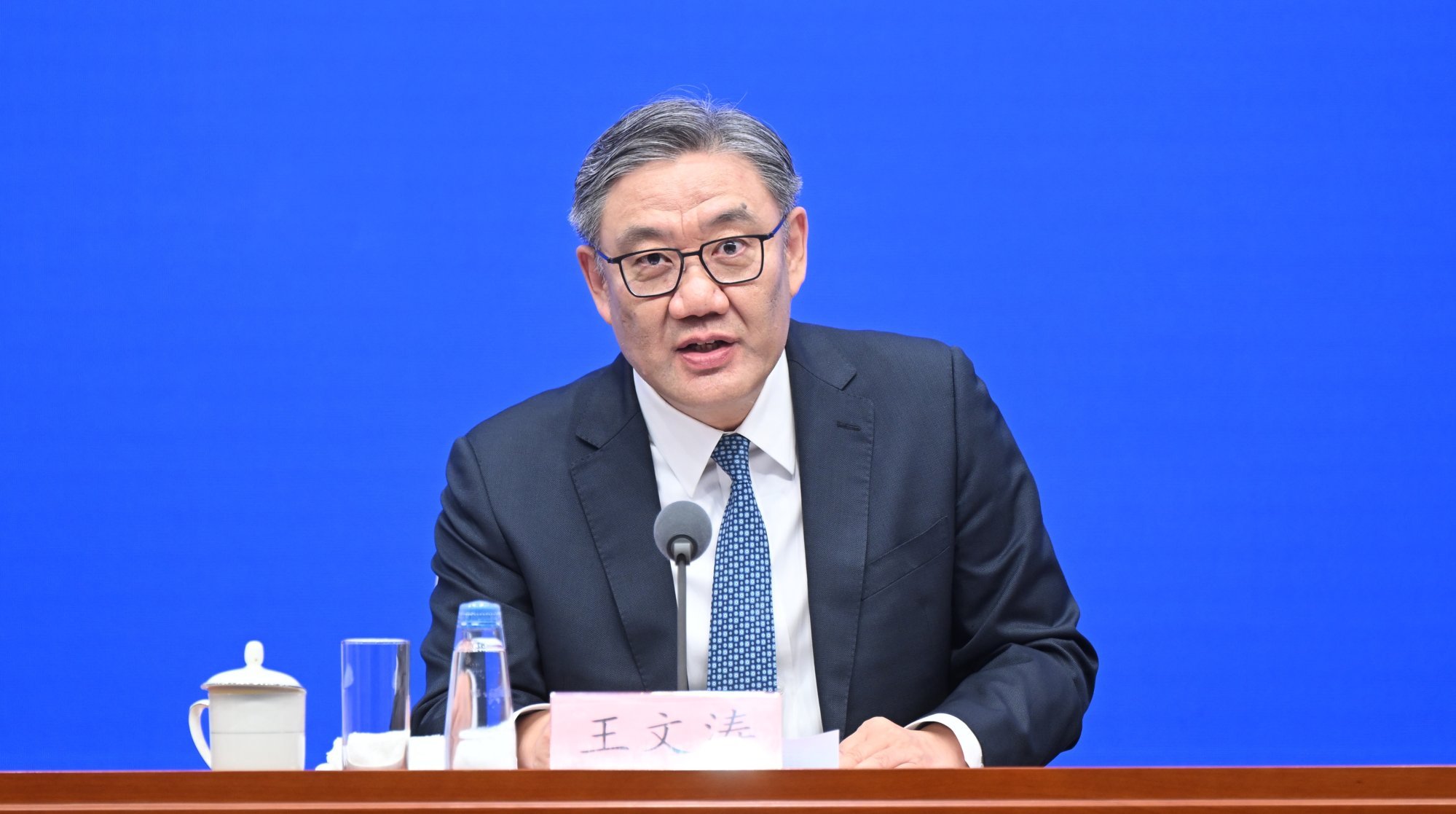
Wang told Sefcovic that China remains committed to safeguarding the stability of the global supply chains and Beijing has “consistently provided facilitation in the approval process for EU companies,” according to the Chinese statement published after the call on Tuesday.
On Nexperia, Wang slammed the Dutch government for its “generalisation of the concept of ‘national security’” and hoped the EU could “play an important constructive role”.
On Monday, Mofcom held a meeting with foreign business leaders to explain its recent policies, including the strict rare earth export control measures that have caused concerns among foreign companies.
Vice-commerce minister Ling Ji, chairing the briefing, said China’s implementation of export controls aims to “safeguard world peace and regional stability and fulfil non-proliferation obligations, while also approving legitimate trade activities in accordance with the law to maintain the stability of global industrial and supply chains,” according to a statement published by Mofcom on Tuesday.
Foreign companies attending the meeting praised the Chinese government’s continued commitment to opening up and pragmatic efforts to stabilise foreign investment despite increasing challenges on global trade and investment, the statement said.
In Europe, however, the controls could not be viewed more differently. They have helped sour an already ailing trading relationship and led to a clamour of officials calling for tougher action against Beijing.
Announcing the European Commission’s work programme for 2026 on Tuesday, its president, Ursula von der Leyen said that “we must double down on reducing our dependencies”.
“Just last week, the association of our aerospace and defence industries issued a stark warning, a new wave of Chinese export controls could disrupt production and increase costs. I take this warning very seriously,” von der Leyen said.
The work programme contains several policy proposals that would affect China, including a regulation to “address the negative trade-related effects of global overcapacity in the steel market”, an upgrade to the EU’s investment screening mechanism, and the establishment of a critical raw materials centre.
With the trade issues piling up, criticism of China is now coming from quarters that previously promoted cooperation.
“When it comes to China, let me only say one thing: China needs Europe more than Europe needs China,” said Joachim Nagel, Germany’s top central banker, at a financial event in Washington over the weekend.
“We are a strong economy. We are 450 million people ... so we should play the European card in a more offensive way,” said the Bundesbank chief, according to a Reuters report. - SOUTH CHINA MORNING POST


