The removal from the sea of a wrecked cargo plane that veered off a runway at Hong Kong airport and killed two security workers in a vehicle will take at least two days, with investigations into the crash expected to last up to a year, aviation experts have said.
Louis Szeto Ka-sing, a specialist in vessel design and maintenance, said on Friday that the first step in salvaging the cargo plane was to determine whether the two halves of the aircraft remained partially connected underwater.
He said authorities were likely to send divers to conduct a risk assessment of the wreckage.
“Taking photos and videos underwater can record any damage or wear and tear,” Szeto, a former chairman of the Hong Kong Institution of Engineers’ mechanical, marine, naval architecture and chemical division, told a radio programme.
“It helps the crew know how to secure the slings and where to place them. If the secured position is too close to a fracture point, they need to work more cautiously to avoid damage.”
He added that it was crucial to determine if the plane’s fuel was completely depleted, as leaks could occur and pollute the environment.
On Monday, Emirates flight 9788 from Dubai, operated by Turkish cargo charter carrier ACT Airlines, swerved off the north runway while landing and struck a security patrol vehicle, killing two airport employees.
Two salvage vessels, Nan Tian Xiang and Nan Tian Peng, arrived in the waters near Hong Kong airport from Guangzhou on Thursday, along with an 80-member crew, to help clear the wreckage.
According to checks by the Post, the crew salvaged a piece, which was likely to be one of the aircraft’s engines, at around 10am on Friday.
The Airport Authority earlier said it had closed the north runway since 8am on Thursday due to the salvage operation, which was expected to “last for a few days”.
Szeto said factors such as tidal movements and monsoon winds could affect the operation.
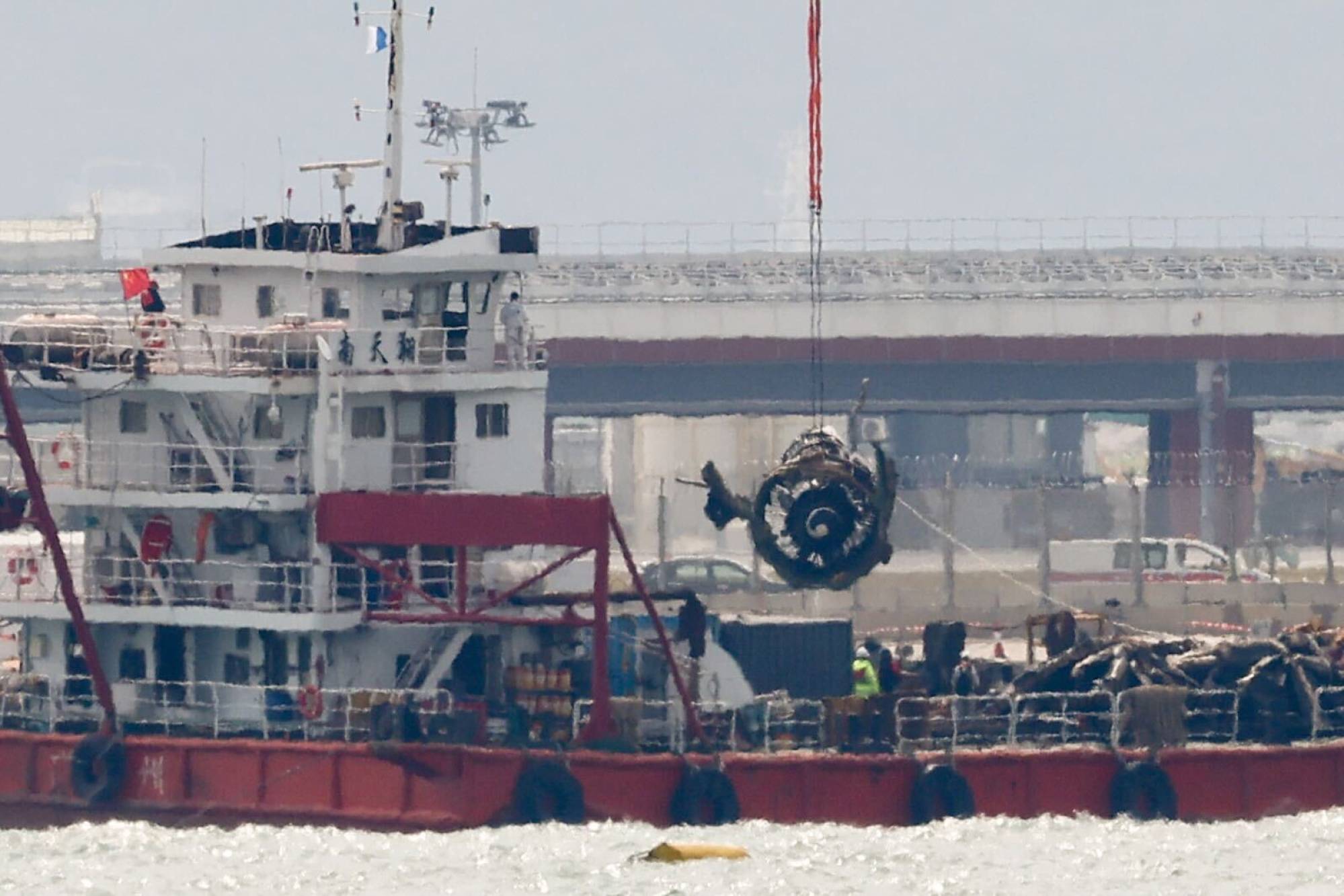
The salvage vessels, which operate near the shore, must avoid low tides and check the wind warnings before lifting the aircraft, as strong winds could affect the stability of large-scale lifting operations, Szeto said.
“I think they need at least two days to finalise the position to secure the slings. Even so, the aircraft might not be ready to be hoisted immediately as they wait for another high tide,” he said.
“It’s not something that can be done within an hour.”
He added that while cranes using a hydraulic system were slower, they offered higher safety and flotation devices that could be used to raise the aircraft’s tail gently.
“The wings contain fuel pipes, so extreme care must be taken during the lift to avoid bending and damage,” he said.
Warren Chim Wing-nin, deputy chairman of the Hong Kong Institution of Engineers’ aircraft division, told the same show that aircraft were typically equipped with two black boxes – the cockpit voice recorder (CVR) and the flight data recorder (FDR).
“The FDR provides data such as the aircraft’s speed, angle, deceleration upon landing, and whether it bounced, while the CVR records conversations within the cockpit,” he said.
Chim also said the investigation was being conducted according to International Civil Aviation Organization (ICAO) standards, which require collecting the qualifications and testimonies of the flight crew, runway markings, maintenance records, communication logs and weather data.
“A preliminary report must be submitted within 30 days after the accident, and the final report is typically required within one year after the accident occurs,” he said.
ICAO standards also required local aviation authorities to invite the country of design and the country of manufacture of the aircraft involved to take part in the investigation, he added.
“However, it is still premature to determine the cause of the accident.”
A source earlier said that Hong Kong police had questioned the aircraft’s four Turkish crew members on Thursday.
The Post also learned that the force was conducting its own investigation so the Coroner’s Court could decide whether an inquest was needed.
Fay Siu Sin-man, chief executive of the Association for the Rights of Industrial Accident Victims, said she had accompanied the families of the two victims to meet senior management of ACT Airlines on Friday morning.
She said the company had expressed its sympathy to the families, adding that it would provide all the help they needed and a bereavement payment. However, the exact amount had yet to be arranged.
She revealed that the company had said crew members would cooperate with the investigation and they would stay in Hong Kong for the time being.
The company was also willing to meet the victims’ families when the investigation report had been issued, Siu said.
“The families felt the sincerity of the company as representatives have personally come to Hong Kong, but the families really hope the government and the relevant departments can speed up their investigation work, so they can know the truth behind what happened,” she said.
Siu said that family members had not heard from Emirates. -- SOUTH CHINA MORNING POST