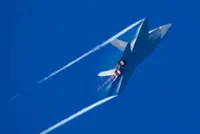
China has developed a flexible, durable aircraft coating that absorbs radar waves, potentially closing a critical technological gap and redefining the future of aerial stealth.
A study published on October 14 in Advanced Materials details a scalable, flexible and ultra-thin (0.1 mm) metasurface capable of withstanding temperatures up to 1,000 degrees Celsius (1,832 degrees Fahrenheit).
The material features tunable impedance, making it suitable for aerospace electromagnetic wave absorption.
It shows balance between performance, durability and manufacturability, and could have potential applications in fighter aircraft, according to the paper.
The research was led by Cui Guang and Liu Zhongfan from Peking University, along with Wang Huihui from Peking University of Technology and Li Maoyuan from Harbin Engineering University.
Liu’s team had previously discovered that chemical vapour deposition could be used for large-scale graphene production.
Building on this, the team deposited graphene directly onto a silica fabric substrate, forming a graphene@silica fibre membrane (G@SFM). The resulting material resembles a soft cloth but combines lightweight properties, flexibility and resistance to extreme heat.
However, the material’s uniform surface was initially ineffective at dissipating electromagnetic waves. To address this, the team applied a subtractive laser patterning technique, creating a metasurface with tunable surface impedance that enabled effective electromagnetic wave absorption.
The final material exhibits an ultra-thin profile (~0.1 mm), low surface density, excellent flexibility and tunable sheet resistance ranging from 50 to 5,000 ohms per square.
It is also stable, maintaining consistent wave-absorbing performance after exposure to 600 degrees Celsius in air for five minutes and long-term heating at 1,000 degrees in a vacuum. Under high-speed airflow of 200 metres per second, the material experienced less than 1 per cent loss, with the metasurface pattern and sheet resistance remaining intact.
These properties make the material particularly suitable for the thermal conditions encountered by high-speed aircraft.
“Integrating this metasurface directly into an aircraft’s thermal insulation layer can reduce radar reflection to -42 [decibels] without adding significant weight or altering the aircraft’s structure,” according to the researchers.
They said the material “not only offers structural and thermal stability for aerospace use but also holds potential for broader applications, including satellite payload protection, stealth surfaces for defence platforms and electromagnetic shielding for high-temperature electronics in extreme industrial or space environments”.
The laser patterning strategy can also be extended to millimetre-wave and terahertz frequencies, supporting next-generation wireless communications, space-based sensing and adaptive stealth systems.
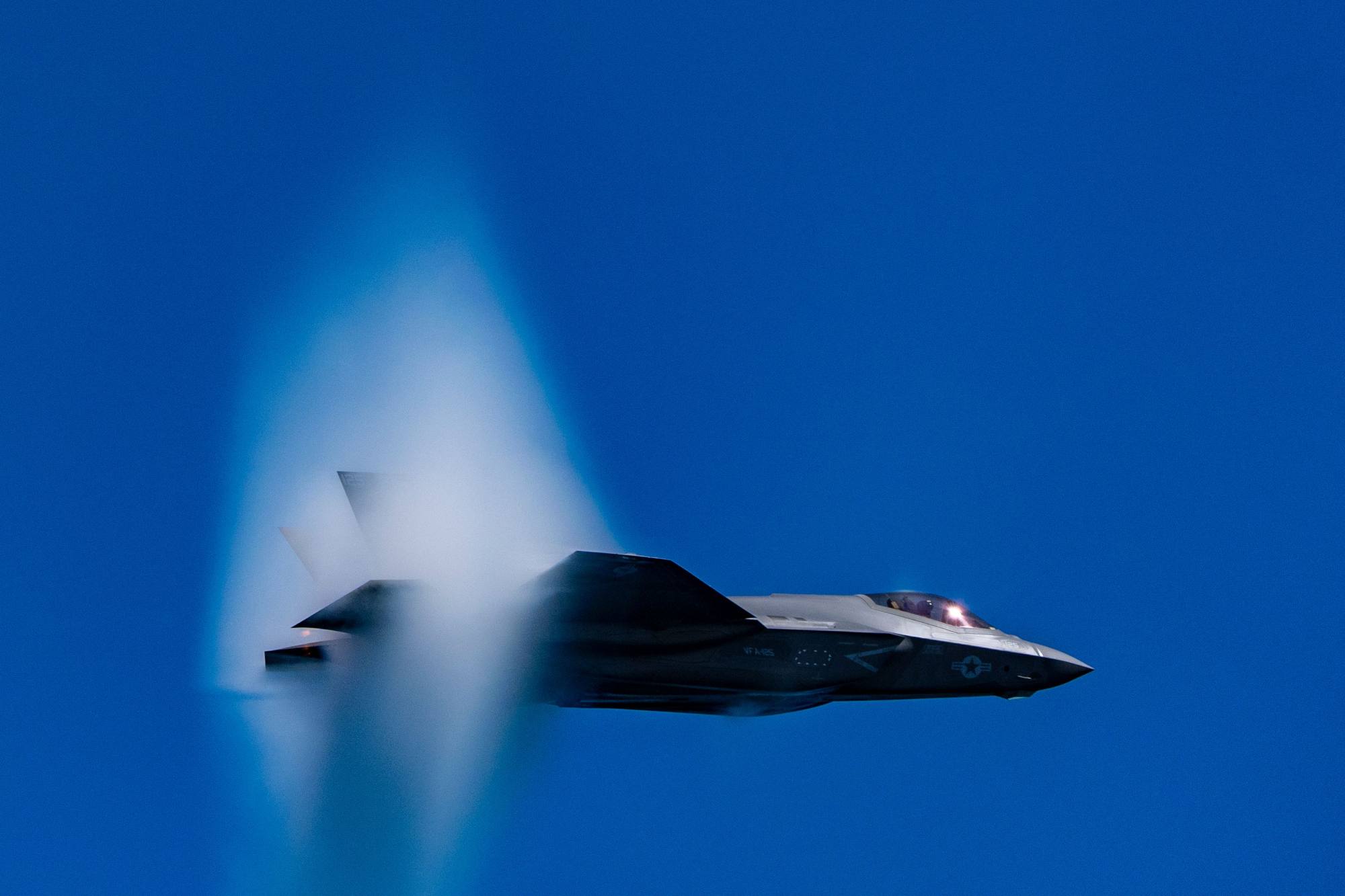
This breakthrough stands in stark contrast to known challenges faced by United States stealth aircraft. During the 2025 Changchun Airshow, spectators observed maintenance personnel wiping the surface of a J-20 fighter with a dust-free cloth – suggesting the aircraft’s radar-absorbing coating is both weather resistant and easy to maintain.
Meanwhile, the maintenance of US stealth fighters remains a major concern. The F-22, the world’s first fifth-generation fighter, uses an iron-based radar-absorbent coating that, while effective, is fragile and prone to peeling because of airflow erosion or rust. It is widely reported that F-22s must be housed in specialised hangars with controlled temperature and humidity.
In July, photos of a rusty F-35C aboard the USS Carl Vinson went viral online. One possible cause is the iron content in the F-35’s stealth coating, which is vulnerable to oxidation in the aircraft carrier’s high-salinity, high-humidity environment. Once the coating is damaged, corrosive salt spray can penetrate, accelerating internal rust and creating a vicious cycle.
A US Department of Defence report noted that the F-35A incurred operating costs of US$28,500 per flight hour, second only to the F-22A’s US$33,500.
China’s research in next-generation stealth materials continues to advance across multiple fronts.
In June, a team led by Gui Xuchun at Sun Yat-sen University developed an MXene film just 2.25 micrometres thick.
It achieved an electromagnetic shielding effectiveness of 45 decibels in the gigahertz frequency band and 59 decibels in the terahertz band, while also exhibiting an extremely low infrared emissivity of 0.1 – close to that of aluminium – enabling excellent infrared stealth capability. - SOUTH CHINA MORNING POST