
The fervour for giant pandas and their cubs in Hong Kong brought in more visitors and revenue to Ocean Park, their home, but other expenses ate into its financial health and worsened its deficit last year.
The theme park’s deficit widened to HK$274.7 million (US$31.8 million) in the 12 months to June 30 from HK$71.6 million in the same period a year earlier, due to higher expenses such as depreciation, at HK$414 million, according to a document it submitted to the Legislative Council on Wednesday.
The deficit also included losses from the park’s Water World attraction.
However, the theme park in Wong Chuk Hang reported a surplus from operations of HK$42.4 million in its 2024-25 financial year compared with a HK$17.2 million deficit in the same period a year earlier, its management said.
It attracted 10 per cent more visitors year on year, reaching 3.46 million in 2024-25, while revenue grew by 9 per cent to HK$1.28 billion.
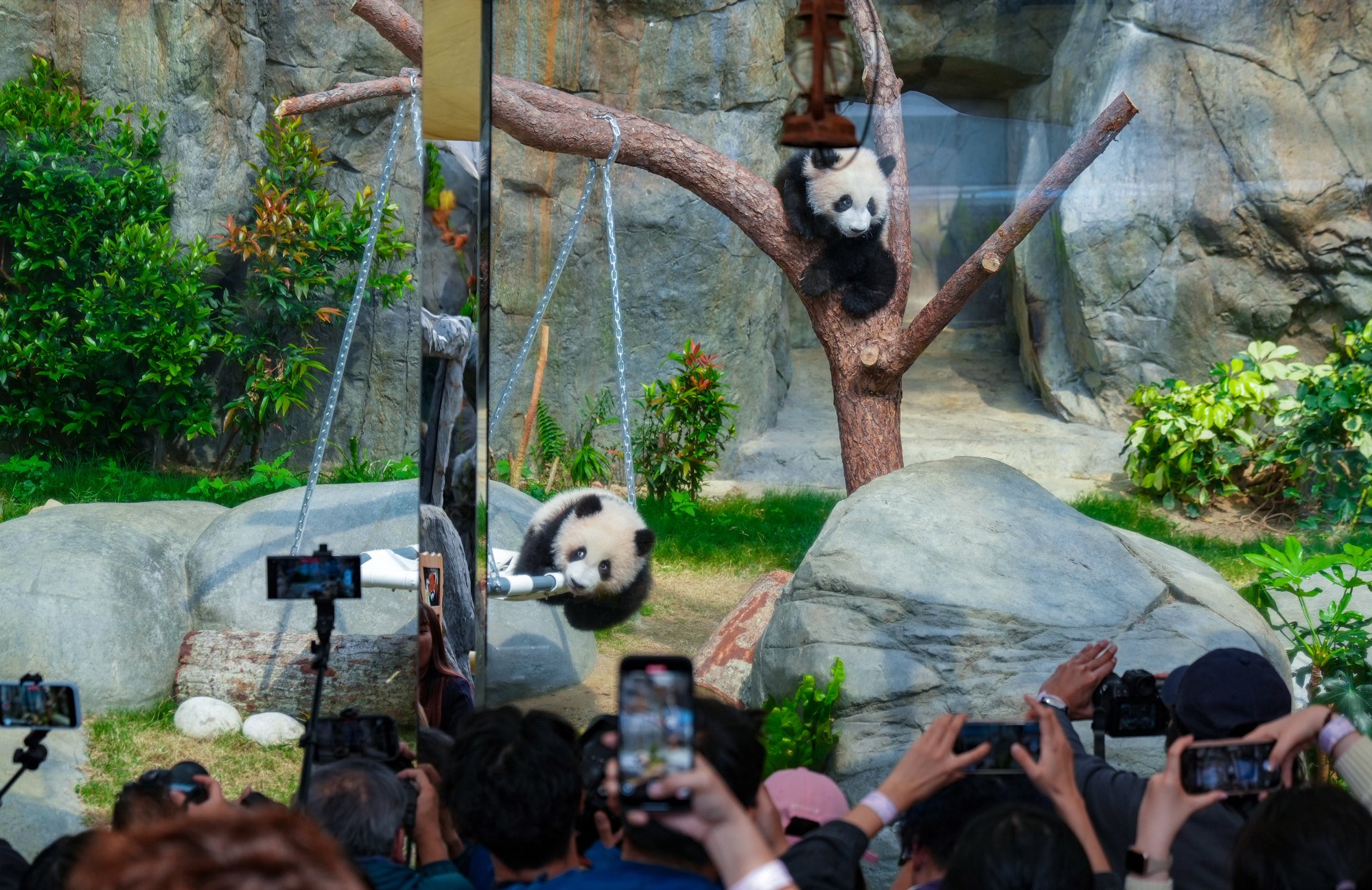
Park chairman Paulo Pong Kin-yee said the giant panda cubs, Jia Jia and her brother De De, and their mother Ying Ying and father Le Le, as well as a pair that Beijing gifted to the city – male An An and female Ke Ke – had thrust the park into the international spotlight.
“The giant pandas have drawn quite a lot of visitors to see them, buy products and lift Ocean Park’s exposure,” he said. “We need to keep the heat on the giant pandas while pressing ahead with celebrations for the 50th anniversary of the park in 2027.”
Locals accounted for most of Ocean Park's visitors last year, with numbers rising by 9 per cent year on year to 2.21 million, or almost two-thirds of the total.
The remaining visitors came from other places, including mainland China, the United States, Australia and India, with the level seeing an increase of 12 per cent to 1.25 million.
Visitors from the mainland still made up more than 65 per cent of the total non-local visitors.
In terms of revenue, in-park spending performed the best, growing by 35 per cent to HK$110.6 million, while merchandising income jumped by 20 per cent to HK$172.5 million in 2024-25 from 2023-24.
Pong said the park had leveraged bear-related intellectual property called “Panda Friends” by collaborating with 24 brands or companies to produce merchandise.
“We will push ahead with more collaborations because those products are not only sold in the park, but also in the outlets of companies that collaborated with us,” he said.
The park also secured 49 per cent more donations last year from private sector players, such as banks and insurance companies, to support its operations, reaching HK$52.2 million.
Water World continued to lose money last year, recording a deficit of HK$148.3 million from operations, although losses were reduced by 19.5 per cent compared with 2023-24.
Pong said the management had gone all out to improve the performance of the attraction, including cutting costs.
“When we talked to interested parties about partnerships to run the water park, they balked at the large scale and high operating costs,” he said. “Even boiling a kettle of water is expensive.”
Pong said the management had found the “best performing” season for the attraction was in winter, when it temporarily closed for business and operating costs were minimal.
Water World is closed in winter because there are not enough visitors. Pong said the previous management’s expectation was that expats would go there in winter, but many of them had left during the Covid-19 pandemic and had not yet returned.
He added that the migration of some middle-class families had also affected the footfall of the water park, while locals were not interested in it during cold weather. These were unforeseen when the previous management planned the attraction more than a decade ago.
Ocean Park chief executive Ivan Wong Chi-fai said the management had explored the possibility of revising Water World’s business model to minimise its losses, changing its use for other purposes, and synergies with a government plan to build a marina nearby.
Asked about the fate of the water park, Pong said: “It will take some time to turn it around, but we are trying every possible means.”
Kevin Tsui, co-founder and director of economic research with the Pagoda Institute think tank, said the management had been transparent about the attraction’s woes, but it was a financial burden for Ocean Park.
“The future of the water park will also depend on the government,” he said.