The PLA Navy replenishment ship Qinghaihu was reportedly seen resupplying a China Coast Guard vessel near the disputed Scarborough Shoal last week.
The manoeuvre highlights growing coordination between China’s naval and coastguard forces amid heightened tensions with the Philippines in the contested South China Sea.
According to a report by Manila-based ABS-CBN news, two Chinese navy warships and four coastguard vessels, as well as several Chinese maritime militia vessels, were monitored by the Philippine Coast Guard near Scarborough Shoal on Friday.
China controls the disputed shoal, which it calls Huangyan Island.
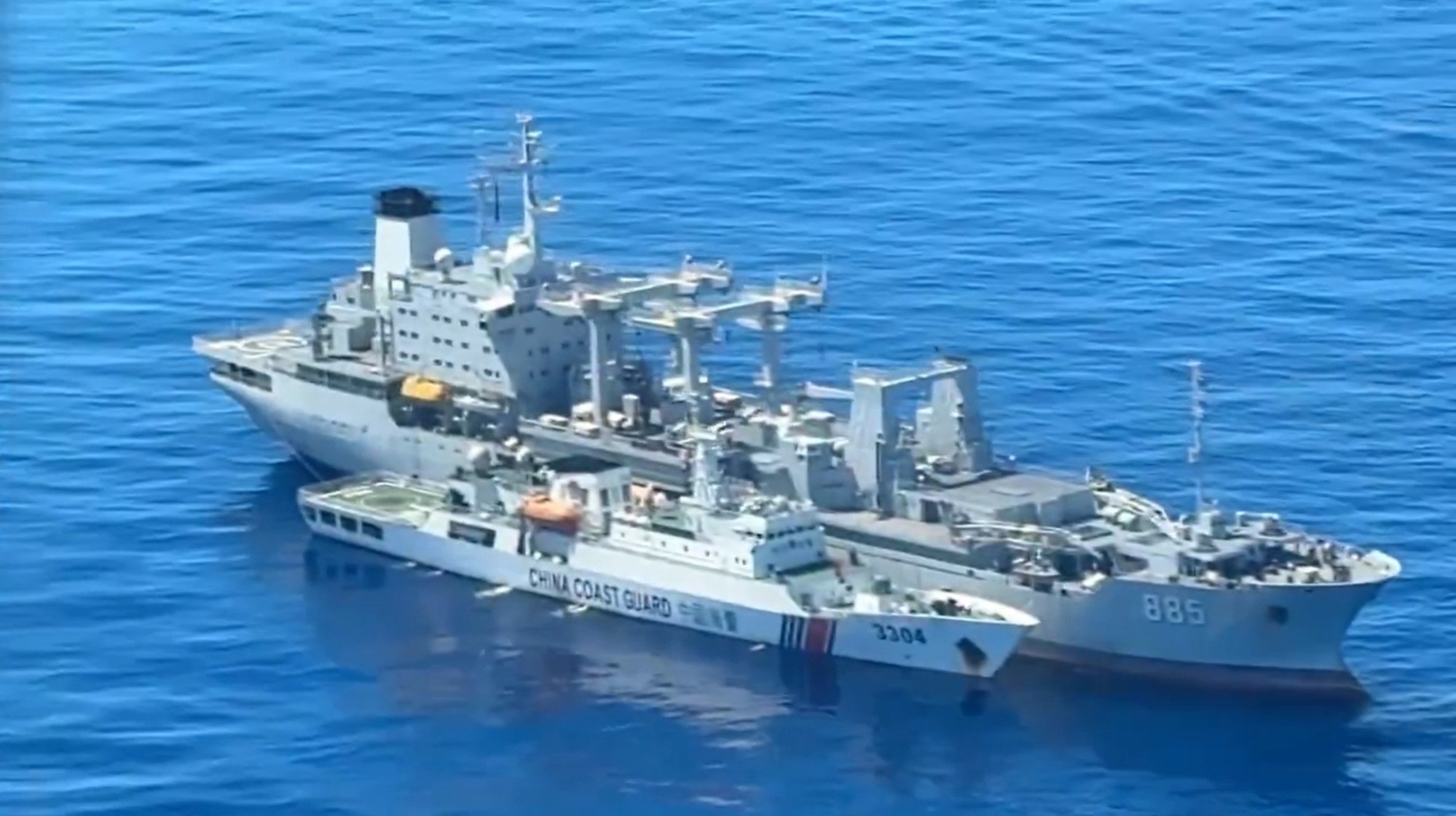
One PLA Navy vessel – a tanker with the bow number 885 – appeared to be conducting a replenishment operation with a coastguard ship, the ABS-CBN report said.
The specifications match that of the People’s Liberation Army replenishment ship Qinghaihu, a Ukraine-built oiler commissioned by China in the late 1990s.
The Philippine Coast Guard was carrying out a maritime domain awareness flight at the time to confirm reports that China was holding military drills near the shoal, which Manila claims as Panatag Shoal or Bajo de Masinloc.
The China Maritime Safety Administration had issued a notice on Thursday about coming “military training” in waters southwest of the shoal, saying all vessels were prohibited from entering the designated area for the duration.
Friday’s Chinese exercise coincided with the final day of a series of joint naval drills between the United States, the Philippines and other nations, code-named Sama Sama.
On October 2, China’s state broadcaster CCTV reported that the PLA Southern Theatre Command supply ship Qinghaihu, with the hull number 885, had sailed to a certain area of the South China Sea to conduct integrated combat support training with various types of destroyers, frigates and naval aviation units. The exercise aimed to boost coordination ability for combat operations and emergency response, it said.
The Qinghaihu is a Type 908 replenishment ship with a full-load displacement of 37,000 tonnes. In service since 1996, it was long the largest vessel in the PLA Navy until the commissioning of the 48,000 tonne Type 901 supply ship Hulunhu in April 2017, according to Chinese media reports.
The ship’s previous training in the South China Sea included providing replenishment for Type 055 destroyers and Type 054A frigates in 2023. It was also part of a Chinese naval escort task force for merchant vessels in the Gulf of Aden in 2018 as part of Beijing’s anti-piracy mission.
Chinese media reports have also highlighted certain limitations of the Qinghaihu, such as a maximum speed lower than the cruising speed of PLA Navy combat vessels, and a large superstructure that affects manoeuvrability during operations.
The rare coordination between a Chinese military vessel and coastguard boat came as stand-offs with the Philippines continue in the South China Sea.
Scarborough Shoal remains a key flashpoint between the rival claimants. Beijing has maintained effective control of the feature since 2012 but Manila asserts that the shoal lies well within its exclusive economic zone.
Recent confrontations have involved collisions, aggressive ship manoeuvres and the use of water cannons.
In the latest confrontation, China said it had expelled two Philippine aircraft on Thursday after they “illegally entered Chinese air space above Huangyan Island”.
In August, a PLA Navy warship collided with a Chinese coastguard vessel while pursuing a Philippine patrol boat near Scarborough Shoal, according to videos posted at the time by the Philippine Coast Guard.
The China Coast Guard, previously under the State Council or Chinese cabinet, was transferred in 2018 to the People’s Armed Police Force to operate under the unified command of the Central Military Commission, the top decision-making body for the armed forces.
Collaboration between the PLA and the coastguard was subsequently strengthened in terms of organisation, personnel and equipment. This included the transfer of retired PLA Navy destroyers and frigates to the coastguard fleet.
There has also been a marked increase in PLA-coastguard joint exercises near Taiwan since last year, after William Lai Ching-te of the independence-leaning Democratic Progressive Party took office as the island’s leader.
Analysts said this could be key to Beijing’s blockade strategy for the island, which it sees as part of China to be reunited by force if necessary.
Most countries, including the United States – Taiwan’s main arms supplier and international backer – do not recognise the self-governed island as an independent state. However, the US is bound by law to arm Taiwan for self-defence and is opposed to any forcible change to the status quo in the Taiwan Strait. -- SOUTH CHINA MORNING POST