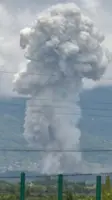
YANGON: On October 18, the Ta’ang National Liberation Army (TNLA) destroyed the Moe Tay Bridge, built across the Myitnge (also known as the Dokhtawaddy) River, along the Hsipaw–Namtu road in northern Shan State.
At present, Namtu and nearby road sections are under TNLA control.
According to a local resident from northern Shan, the TNLA blew up the bridge to prevent the armed forces columns from advancing toward Namtu after the military recaptured Hsipaw on October 17, thereby making it possible for the armed forces to resume operations in that direction.
“The military is now in a position to push toward Namtu," said a local resident from Lashio. "There are two main routes — the Lashio–Innai–Man San–Namtu road and the Hsipaw–Man San–Namtu road, which crosses the now-destroyed Mo Te Bridge. Since that bridge is gone, the Hsipaw route can no longer be used. The military’s main goal is to reclaim control of the 66 KV Man San–Hsipaw and Man San–Lashio power lines, so it’s likely they’ll try to take Namtu soon.”
Under the “1027 Operation”, TNLA, alongside its northern alliance partners, had launched widespread attacks, seizing control of multiple towns — Namsan, Mantong, Namtu, Namkham, Mogok, Kyaukme, Hsipaw, Naungcho and Kutkai.
In response, the armed forces conducted combined air and ground assaults to regain control of these towns. The military successfully recaptured Naungcho on July 16, 2025, Kyaukme on October 1, and Hsipaw on October 17.
The military continues to exert military pressure on TNLA-held territories. While ground forces have not yet reached all remaining TNLA-occupied towns, airstrikes and artillery bombardments have begun as part of ongoing operations.
Meanwhile, reports indicate that representatives of both the military and TNLA are expected to meet in China later this month for discussions.
“TNLA should stop overreaching, said a northern Shan political observer familiar with military developments. "They should negotiate where necessary and avoid unnecessary conflict. What happened in Kokang is an example. These battles harm not only both sides but also local civilians and deplete human resources. China doesn’t want instability along its border — especially not in Myanmar. TNLA leaders should have foreseen this."
"After the upcoming election, a new parliament will emerge, and political changes are inevitable. If TNLA can’t adapt, they’ll be the ones to suffer, and civilians will bear the brunt of it,” the observer added.
During the 1027 campaign, TNLA also blew up several key bridges — including the Kyinthi Bridge on the road between Kyaukme and Hsipaw, and, as the military advanced to retake Kyaukme, the Got Twin Bridge between Naungcho and Kyaukme. The group even destroyed part of the world-famous Gote Twin viaduct, a 125-year-old rail bridge, blowing up a 30-foot section on the Kyaukme side.
When TNLA forces withdrew from Kyaukme and Hsipaw, they also set fire to several government offices and residential buildings, according to reports. - Eleven Media/ANN