
The Bali heat proved too much for Zhang Min, a 30-year-old tourist from Chengdu, one afternoon last month. She had made it to a cliff above one of the Indonesian holiday destination’s most sought-after scenic spots, but was exhausted by the journey.
“The roads are really poor,” Zhang said as her group stopped above the T. Rex-shaped headland – a unique land mass that has made Kelingking one of the world’s most photographed beaches.
Her group opted against hiking down a steep, sun-exposed trail to the beach’s crescent of white sand, which abuts vertical limestone cliffs.
“I’m tired and not going down there myself.”
One year from now, that may no longer be a problem. A Chinese firm is installing a 182-metre (597 feet) glass lift down the cliffside, a highly visible sign of the country’s investment in Indonesia. Despite some public disquiet, officials there have long relied on China for infrastructure development.
Construction cranes operate daily, lowering workers on suspended platforms over the shaft, where pieces of the lift are being attached to the cliff from the beach upwards.
He Zheng, a project worker from China, said construction was progressing smoothly and the lift and a cement platform at the bottom were due to open in October next year. The project would cost well over 10 million yuan (US$1.4 million), he said, with ride tickets expected to sell for about 100 yuan (US$14).
The lift’s developer, China Kaishi Group, is headquartered in northeastern China’s Liaoning province, where a representative reached by phone declined to offer more details. The project planner and contractor are both listed as Indonesian firms.
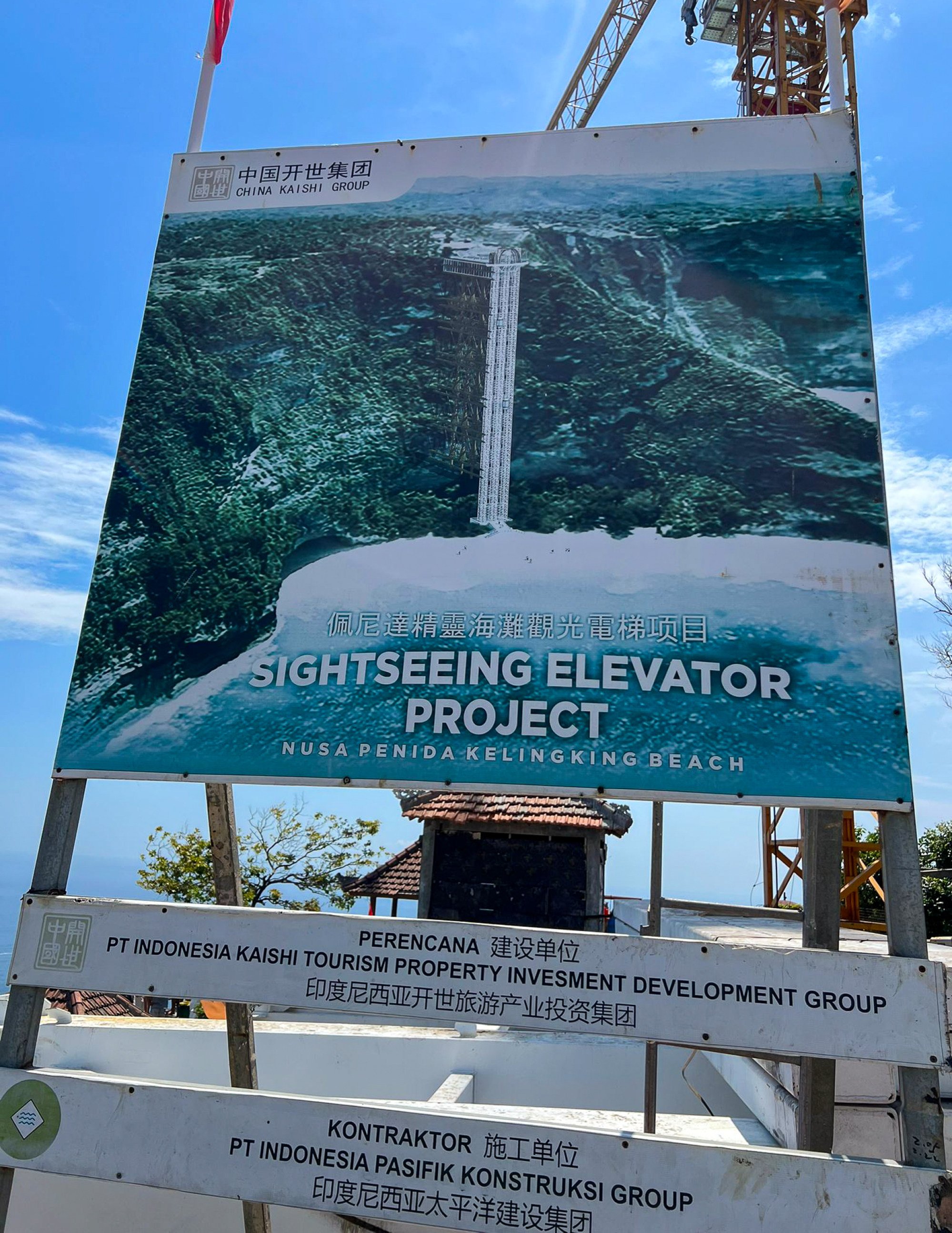
China Kaishi Group got the go-ahead from Bali’s provincial government, according to Chinese media reports, and broke ground in June 2024.
Zhang and other tourists – about 50 in total that day – were jousting for photo ops above the beach after riding rental scooters or hired cars for 40 minutes along a bumpy, roller-coaster road from the pier of Nusa Penida, a small isle southeast of Bali’s main island.
Indri Gultom, a traveller from the Indonesian city of Bandung who visited the Kelingking cliffside with 14 friends last month, said she would use the lift if it was open and expected it would relieve “crowding” at the top.
“It will be a good idea,” said Gultom, surrounded by fellow Indonesians and visitors from China, Germany, France and India. “It will make things easier to approach the beach.”
Some local residents, politicians and activists, however, “strongly reject” the lift, a member of staff at tour operator Smile Nusa Penida said. One well-known critic is Indonesian senator and fashion designer Niluh Djelantik.
“You have to earn that view by hiking down,” she was quoted as saying in a Facebook post in 2024. “A lift just doesn’t feel right.”
Although many Indonesians told the Post last month that they supported Chinese investment in their country, some expressed concerns that local governments had picked unsuitable sites for projects or allowed construction to harm the environment.
“If the purpose is for attracting more tourists, which will increase the government income, it is possible,” Paramitaningrum Supamijoto, an international relations lecturer at Bina Nusantara University in Jakarta, said of the lift. “But this construction will influence the nature of the environment and it might ruin the ecosystem in the future.”
Siwage Dharma Negara, a senior fellow with the ISEAS-Yusof Ishak Institute in Singapore, said the lift project could bring short-term benefits to Bali’s tourism-dependent economy by improving access, but that the local government should consider factors beyond that.
“The local government should play a more active role in ensuring the project will not damage the natural beauty of Kelingking Beach,” Negara said. “Otherwise, it will likely reinforce negative perceptions toward Chinese investment in Indonesia.”
Bali’s outdoor lift will be a first for Indonesia, but similar structures have been employed in other countries for years.
China’s 23-year-old Bailong Elevator rises 326 metres (1,070 feet) in the Wulingyuan Scenic Area of Hunan province, while the Hammetschwand Elevator at Switzerland’s Lake Lucerne rockets passengers up 1,132 metres (3,714 feet). Brazil, Portugal and New Zealand, among other countries, also have high outdoor lifts.
Bali tourism and investment promotion officials did not answer requests for comment.
From 2000 to 2023, China outspent countries including Japan, South Korea, Australia and the United States on Indonesian infrastructure, according to a June report from the AidData research lab at US university William & Mary. Projects included roads, power plants and nickel factories.
AidData said Beijing gave US$70 billion in state-led development financing to Indonesia over those 23 years, and that Indonesian leaders saw China as one of the few partners “willing and able” to mobilise the capital required for infrastructure-led growth.
Not every Bali tourist expects a lift from the lift. French retiree Jean Ginestet, 67, described it as “horrible” when he saw the construction work in September during a month’s stay in Bali.
“Why would you do it? It’s destroying everything about a spiritual place,” he said. “Now the project has begun, and it will go on to the end.” - SOUTH CHINA MORNING POST