Hong Kong’s unexpectedly robust retail sales in August were bolstered by a surge in tourism and a strong local stock market but recovery remains uneven, with businesses of popular consumer goods preparing for potential price wars driven by the lower cost of living across the border.
Government figures released on Thursday showed retail sales grew by 3.8 per cent year on year, marking a fourth straight month of growth.
It followed 14 consecutive months of decline from March 2024 to April 2025 and was the highest since December 2023 when sales soared by 7.8 per cent.
“Tourism helped [but] the rising stock market also created a wealth effect,” Terence Chong Tai-leung, executive director of the Lau Chor Tak Institute of Global Economics and Finance at the Chinese University of Hong Kong, told the Post.
Hong Kong Retail Management Association chairwoman Annie Tse Yau On-yee said that while sales had stabilised they had not yet reached the recovery stage.
She said retailers were beginning to express confidence in the outlook.
An increase in the number of visitors to the city since the start of summer helped partly offset the negative impact of Hongkongers crossing the border to spend, some economists said.
For example, categories that performed the best were those typically favoured by tourists. This included sales of jewellery, watches, clocks and valuable gifts, which jumped by 16.4 per cent, miscellaneous consumer goods which rose 14.2 per cent, and medicines and cosmetics, which saw a 5 per cent increase.
The Hong Kong Tourism Board said provisional visitor arrivals in August rose by 16 per cent year on year to a post-Covid high of 5.15 million.
Meanwhile, the local bourse has risen by nearly 2,000 points over the past month amid a surge in the tech sector and initial public offerings, with the benchmark Hang Seng Index 7.6 per cent higher at 27,287 points on Thursday compared to 25,343 points on September 3.
Shoppers filled the IFC Mall in Central on Thursday, after the eight-day National Day “golden week” holiday got under way on Wednesday.
Mainland Chinese tourists were seen emerging from shops with their newly bought goods, while others sought refuge from the heat outdoors.
Inside the Apple Store, mainlanders crowded around trying to get their hands on the latest iPhones.
One happy shopper was Jack Lee, a 23-year-old from Shenzhen, who walked away with a new Apple Watch.
He said he spent around HK$4,000 (US$514) on his new watch, saving HK$300 compared with the price on the mainland.
“The trade-in offers are more attractive here and I can get a tax rebate on my purchase,” said the student, who travelled specially to Hong Kong to shop.
The Laopu Gold shop in the mall was also packed and had a long line of shoppers outside waiting to enter.
A lawyer from Jiangsu, surnamed Wang, said she splurged more than HK$10,000 on a gold necklace.
“It looked pretty so I bought it,” said Wang, who will be celebrating her 35th birthday on Friday.
She planned to spend three days in Hong Kong, but would spend the first night in a Shenzhen hotel, which she said was cheaper, before moving over to the Disneyland resort on Lantau Island.
“The difference between hotel prices in Shenzhen and Hong Kong is quite significant,” she said.
However, significant drops were also observed in categories typically associated with local spending, with sales of fuels shrinking by 11.4 per cent, motor vehicles and parts down by 8.9 per cent, and furniture and fixtures falling by 3.9 per cent.
Food, alcoholic drinks and tobacco also dropped by 3.6 per cent while supermarket commodities decreased by 0.8 per cent.
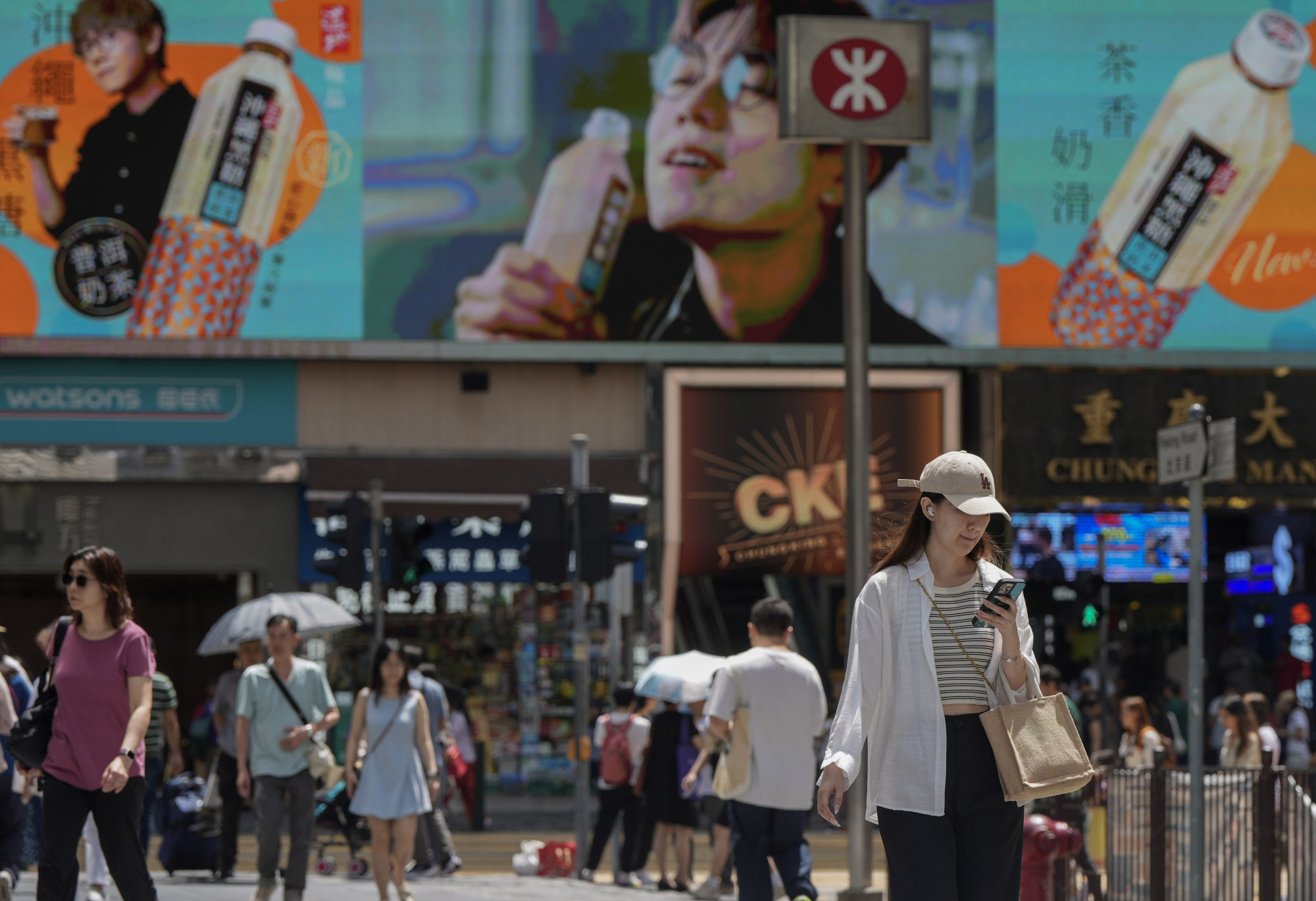
Gary Ng Cheuk-yan, a senior economist with Natixis Corporate and Investment Bank, said Hong Kong retailers of popular consumer goods were adjusting their prices to compete with the mainland.
“The wave of involution from mainland China has reached Hong Kong,” he said, referring to the popular Chinese term used to describe excessive, self-defeating competition, adding residents now had more online shopping choices through mainland platforms such as Taobao and Pinduoduo.
“Hong Kong retailers have reacted by offering more discounts to retain customers. This may be just the start of the battle.”
Taobao is a subsidiary of Alibaba Group, which owns the South China Morning Post.