PHNOM PENH: Cambodia aim to clear more than 41 million square metres of mine-contaminated land across six provinces bordering Thailand, thanks to US$5 million in funding from the “Cambodia Mine-Free 2025 Fund”.
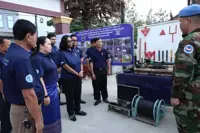
A signing ceremony for the border mine clearance agreement, between the Cambodian Mine Action and Victim Assistance Authority (CMAA), the Royal Cambodian Armed Forces' Army Command, the National Centre for Peacekeeping Forces, Mine and ERW Clearance (NPMEC), and the Cambodian Mine Action Centre (CMAC), took place on Thursday, October 2.
According to the CMAA, the agreement covers 453 known mine fields — across a total of 41,796,263 square metres — in Banteay Meanchey, Oddar Meanchey, Siem Reap, Battambang, Preah Vihear and Pursat provinces.
Senior Minister Ly Thuch, first vice-president of the CMAA, described the agreement as “another new chapter” for the Kingdom’s mine action sector. He said it reflects mutual confidence that mine and explosive remnants of war (ERW) clearance efforts will continue to contribute to peace and protect vulnerable communities.
He believed that the signing was not merely a formality or institutional partnership — it represented a shared commitment and determination to joint efforts to achieve a major goal: freeing Cambodia from the dangers of landmines and ERWs. It also aligns with Prime Minister Hun Manet’s vision and trust in making communities smile again and restoring safe land through tangible mine clearance results.
“Mine clearance is not only about locating and destroying landmines and explosive remnants of war — it is also about restoring dignity, rebuilding communities and reviving people’s hope,” Thuch said.
He noted that Cambodia understands deeply the pain and suffering caused by decades of war, which robbed people of lives and limbs, restricted land use for development and shattered many dreams.
Although mine action has made significant progress, Cambodia remains one of the most heavily mined nations in the world. Currently, 1,723 square kilometres of land are still contaminated by mines and ERWs, including 531 square kilometres of confirmed mine fields.
He warned that these “hidden killers” remain buried underground, threatening lives and hindering Cambodia’s prosperity. Despite challenges, Cambodia remains hopeful, under the long-term vision of Prime Minister Hun Manet and through the dedication of CMAA, partner countries, development agencies, domestic and international operators, brave deminers and the solidarity of the international community.
Thuch added that through strengthening national capacity and ownership, implementing clear policies, ensuring a supportive environment and focusing mine clearance as a human priority, Cambodia has taken significant steps toward its goal of becoming mine-free by 2025,.
On behalf of the Royal Government, he praised the country’s partnerships with friendly nations, development partners, mine action operators and other stakeholders that have helped strengthen Cambodia’s national capacity, elevate knowledge-sharing and provide training in the mine action sector. These efforts have also boosted Cambodia’s leadership and visibility on the international stage.
He expressed his appreciation for the Army, NPMEC, CMAC, operators and donor communities that have stood with Cambodia for over three decades, serving as true partners. They have endured challenges together and achieved success quietly, helping transform minefields into fertile farmland and productive land — turning “minefields into golden fields”, filled with hope and prosperity for the future. - The Phnom Penh Post/ANN