




China’s first crewed airship – the Xiangyun AS700 – has completed its first low-altitude flight over the mountainous region of Guanling in southwestern Guizhou province, passing a critical airworthiness test, state media reported on Tuesday.
Flight data collected during the test verified the airship’s suitability for low-altitude scenarios, state broadcaster CCTV reported, adding that the results would help drive improvements to adapt the airship to a wider range of uses.
“The tests lay the groundwork for future deployment in emergency rescue, aerial surveillance and tailored flight-support missions,” CCTV said.
The domestically built AS700 flew at an altitude of 1,200 metres (3,937 feet) during the test; however, it had a maximum altitude of 3,100 metres, the state broadcaster said.
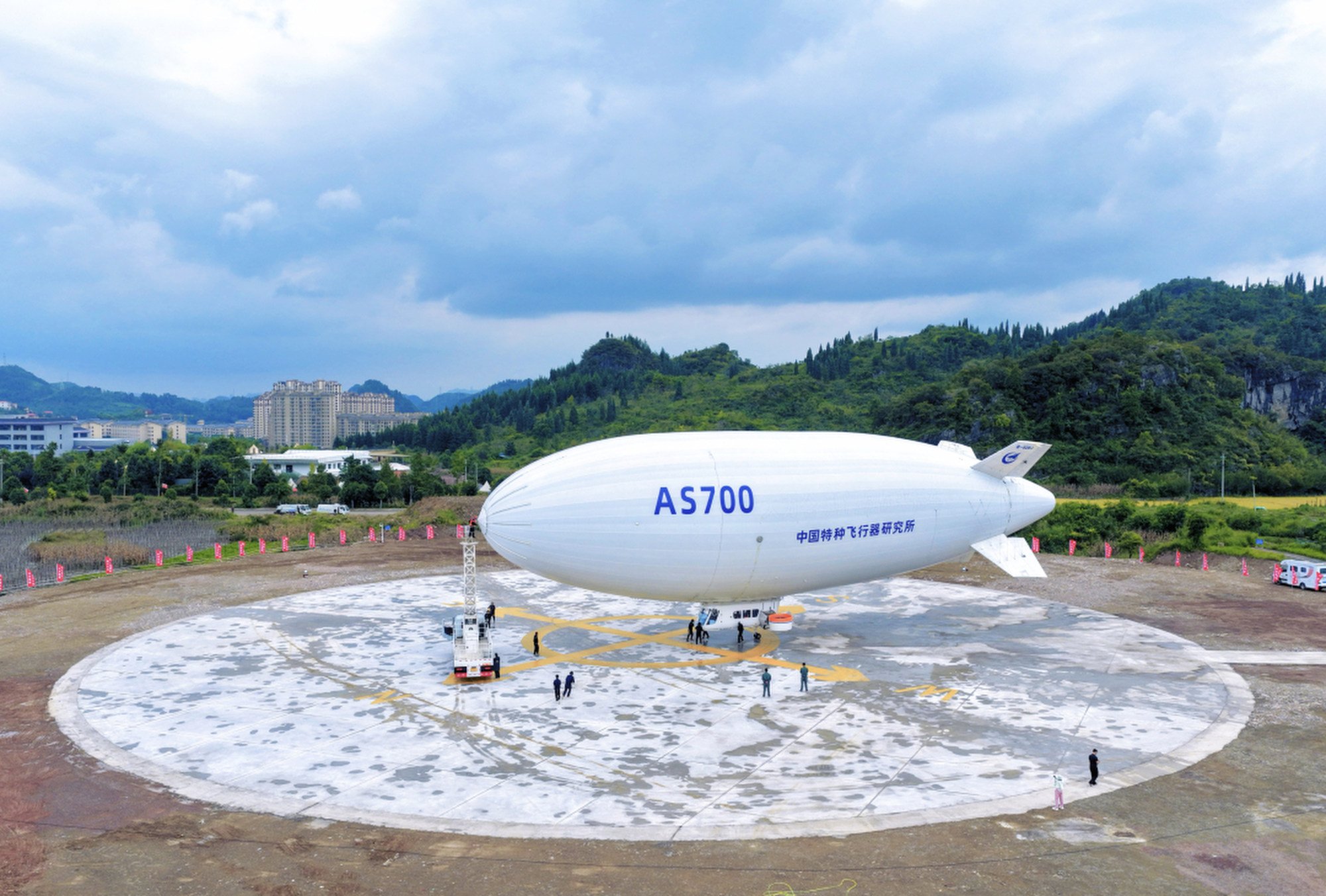
The AS700 recorded video of the Huajiang Grand Canyon Bridge, reportedly the world’s highest suspension bridge, which went into service on Sunday, CCTV reported.
The airship is also expected to have military applications. Last October, Ordnance Industry Science Technology, a Chinese magazine focused on military tech, published a special report on the AS700, highlighting its surveillance capabilities and saying it could be equipped to carry out monitoring tasks similar to geostationary satellites.
Citing US military deployments, the magazine reported that reconnaissance airships in Afghanistan and Iraq were equipped with electro-optical and infrared sensors, 360-degree surveillance radar and precision tracking radar. The systems performed continual day and night surveillance, the magazine said.
The article also said airships offered several advantages over unmanned aerial vehicles, such as longer endurance and hovering ability, improved energy efficiency, low noise, small radar cross-sections, low infrared signatures, high survivability and lower costs.
The magazine said uncrewed airships had advantages over satellites, including the ability to deliver higher-resolution reconnaissance images with better real-time responsiveness, adding that they were far cheaper to operate than satellite systems.
Several Pentagon-led research and development programmes, such as its advanced airship laboratory, have signalled a steady US interest in airborne persistent surveillance platforms. These include the Tethered Aerostat Radar System, integrated sensor island systems, the Rapidly Deployable Aerostat Initial Deployment and high-altitude airship projects.
The AS700 has a maximum range of 700km (435 miles) and can fly for up to 10 hours. Tuesday’s CCTV report said the aircraft’s unique “thrust-vector synchronous servocontrol technology” enabled short-distance or vertical take-offs and landings.
The airship’s maximum take-off weight is 4.15 tonnes and it can reach a top speed of 100km/h (62mph). It can carry up to 10 people, including one pilot.
The AS700 was developed by the Special Aircraft Research Institute under the state-owned Aviation Industry Corporation of China. The institute, a state-designated military-support unit, also developed the Kunlong AG600, a large amphibious aircraft.
CCTV said the airship maker planned to focus on transport and exploration opportunities to help develop low-altitude economies in the southwest region.
Last week, AS700 pilot and instructor Lin Hong, a former fighter pilot, told media in Guanling that instead of hydrogen, the airship envelope was filled with non-flammable helium for improved safety.
In February, the electric variant AS700D completed its first scientific research flight. Chief designer Zhou Lei was quoted as saying that the AS700D relied entirely on lithium batteries for propulsion, cutting emissions nearly to zero while lowering flight noise.
Zhou said the AS700D would be particularly suited to launch locations that were sensitive to noise and emissions. Applications could include aerial cinematography, security and traffic monitoring, as well as communication relays in protected or ecologically fragile areas.
The Special Aircraft Research Institute, based in Hubei province, was given formal project approval for the AS700 in 2018. The AS700 first flew in October 2022 and was certified by the Civil Aviation Administration of China in late 2023.
In August 2024, the AS700 flew nearly 1,000km across Hubei, Hunan and Guangxi in just under 13 hours. The flight set domestic records for endurance and range for Chinese-developed crewed airships. -- SOUTH CHINA MORNING POST


