




Super Typhoon Ragasa may cost Hong Kong billions of dollars in economic losses, but its overall impact may be less severe than past storms, with more people working from home and the stock market trading despite the adverse weather, experts have said.
But they warned on Thursday that as extreme weather became more frequent, significant annual economic losses were becoming a “new normal” for the city.
Ragasa triggered Hong Kong’s highest-level No 10 typhoon warning signal and brought the city to a standstill for nearly two days. Massive waves and storm surges damaged coastal restaurants, with losses running into millions of dollars, according to owners.
“Economic losses from extreme weather will become a new normal for Hong Kong, as well as the world,” said Gary Ng Cheuk-yan, a senior economist with Natixis Corporate and Investment Bank.
Economist Simon Lee Siu-po said the estimated loss from Ragasa was between HK$2 billion and HK$3 billion (US$257 million and US$386 million).
“My guess is, with better preparations of all parties, the estimated loss is less than HK$4.6 billion,” Lee said, referencing the toll from Super Typhoon Mangkhut in 2018.
The loss in revenue from retail and catering alone was HK$1.3 billion, he said.
Terence Chong Tai-leung, an associate professor at the Chinese University of Hong Kong’s economics department, put the figure at under HK$10 billion.
“For a two-day shutdown, it may be less than HK$10 billion, unless there is very large asset damage – for example, if buildings collapse,” he said. “If it is purely people not working and some economic activities are lost, I believe it will be lower than HK$10 billion.”
The financial fallout was comparable with that of Typhoon Wipha, which was estimated to have caused up to HK$2 billion in economic losses in July, according to a Post report.
All three economists said that new policies and technology had helped reduce the financial losses compared with past storms.
Lee and Ng both pointed to the new severe weather trading arrangement, which allows the stock market to remain open, as a key factor in reducing financial losses.
Ng said that after taking into account the new trading rules and more mature work-from-home arrangements, Ragasa could result in a loss of 0.15 per cent of Hong Kong’s gross domestic product.
“Consumption and aviation will be the hardest hit as there is no people movement,” Ng said. “This lost demand cannot be recovered in services.”
Chong also said that some retail sales were merely delayed rather than lost entirely.
“Now that there is technology, you can work from home, and you can trade stocks online, so nowadays the [economic] loss from a typhoon is much less than before,” Chong said.
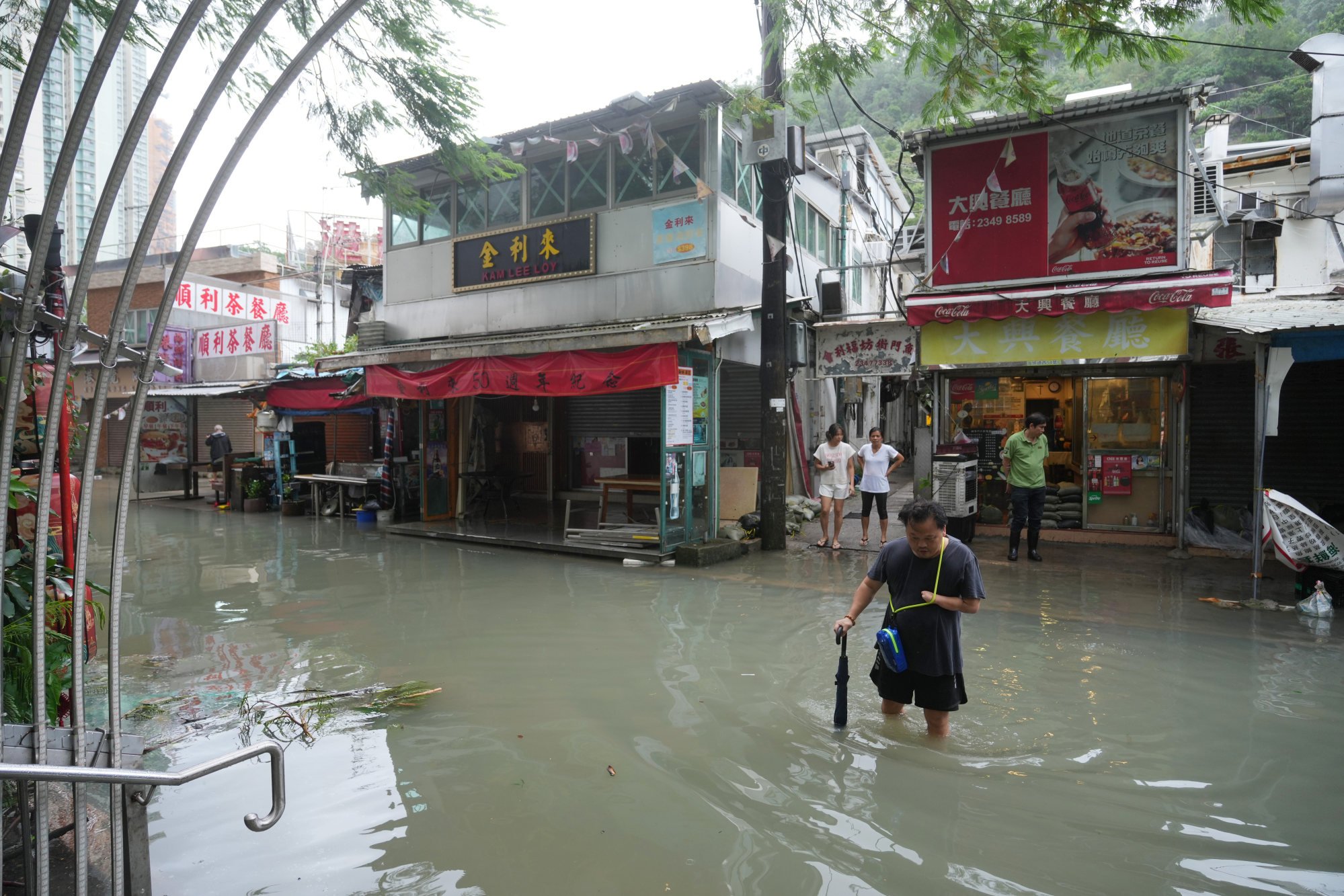
Ragasa wreaked havoc across the city. Waterfront restaurants at the Tseung Kwan O promenade were flooded, with their glass doors shattered and debris and furniture flooding the interiors.
Some owners said it would cost them millions of Hong Kong dollars to repair their outlets, adding an extra burden on their struggling businesses.
Schools were suspended for two days, while downpours caused landslides and flooding. More than 90 people were also injured.
As many as 1,000 flights were cancelled over two days, affecting about 140,000 passengers. -- SOUTH CHINA MORNING POST


