
Hong Kong’s leader will further increase the non-local undergraduate quota at public universities to a maximum of 50 per cent in next Wednesday’s policy address, while the number of places for local students will remain unchanged, the Post has learned.
A source close to the matter said Chief Executive John Lee Ka-chiu would announce an increase in the non-local student quota to no more than 50 per cent, emphasising that locals would not be affected as their annual 15,000 places would remain the same.
“The non-local students are not necessarily from mainland China; they can be from the belt and road countries and the United States,” the insider said.
“Some US students find the city a suitable place to study, given the current political environment in their country.
“Having said that, local students will not be affected, as the annual quota of 15,000 will remain the same.”
The source added the move aimed to align with Lee’s vision to transform the city into an international education hub and strengthen the “Study in Hong Kong” brand, as outlined in the policy blueprint last year. This included measures to develop the city into a world-class tertiary education hub through scholarships and other incentives.
In an exclusive interview with the Post early this month, education minister Christine Choi Yuk-lin said Hong Kong’s eight public universities had the capacity to admit more non-local students and that the quota could be raised further without undue delay.
She revealed that some tertiary institutions had already reached the 40 per cent threshold in the new academic year, while enrolment of non-local undergraduates at public universities was equivalent to nearly 30 per cent of the number of local student places.
From the 2024–25 academic year, the government doubled the non-local admission quota at public universities to the equivalent of 40 per cent of local students.
Choi added that Hong Kong planned to increase recruitment in countries involved in the Belt and Road Initiative – Beijing’s plan to grow global trade – and Southeast Asia to diversify the student profiles at public universities.
Professor William Wong Kam-fai, a lawmaker and an academic at the Chinese University of Hong Kong, said the increased intake of non-local students was acceptable, as he understood the government’s aim to strengthen the city’s status as an international education hub.
“My concern is if there is enough accommodation for these students and whether the government can provide the necessary student life support tied to their hostels,” he said.
“I understand that some hotels will be converted to student hostels. But they aren’t just a place to live, they also serve as an education platform as part of their student life. Will there be student activities held at their hostels? Are there any guardianship services?”
Wong advised the government to plan well for these students and provide appropriate support, including cultural activities that reflected their ethnic backgrounds, to help them integrate into the Hong Kong environment.
Tang Chun-yin, undergraduate representative on the University of Hong Kong’s Council, its governing body, said his main concern was whether the institution had sufficient facilities to accommodate more non-local students.
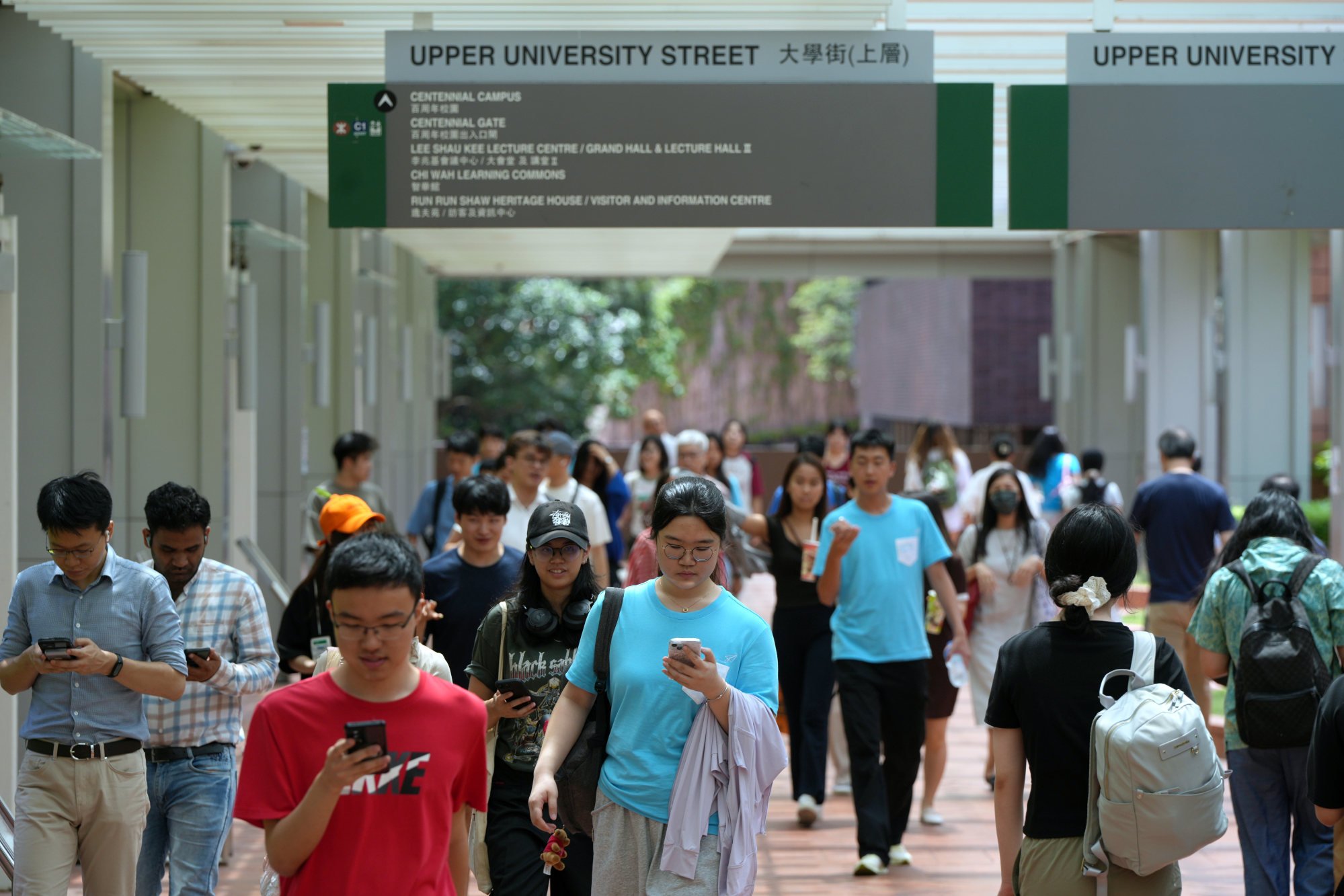
“I am really afraid that there won’t be enough facilities such as student hostels, lecture halls or study rooms to cater to the increase in these students, the lack of which will affect the education quality,” he said.
“Another concern is about the transport, as most of the students come uphill to school via an MTR lift. The long queues during morning peak hours will take them about half an hour to get to school from the MTR entrance.
“If they don’t take the lift, they have to walk about 15 minutes uphill on foot, which is inconvenient for them.”
Tang also said universities needed to ensure they hired enough teaching staff to support the rising number of non-local students.
Except for scholarship recipients, non-local students pay full tuition fees for undergraduate programmes, ranging from HK$160,000 to HK$218,000 (US$21,000 to US$28,000) from the 2025-26 academic year, depending on the university.
Meanwhile, local residents studying publicly funded bachelor’s degrees receive heavy subsidies.
In 2024-25, 17,161 non-local students attended Hong Kong’s public universities, with 12,386 of them, or 72 per cent, from the mainland. -- SOUTH CHINA MORNING POST