
A higher level of engagement in society is among the reasons Hong Kong women’s life expectancy has reached a record high, experts have said, calling for gender-specific solutions to support the city’s ageing population.
Academics and other specialists said that less exposure to high-risk activities and a willingness to seek help were also among factors for women living longer than men in Hong Kong.
Their analysis followed the recent release of a Census and Statistics Department report, “Women and Men in Hong Kong”. It showed that life expectancy at birth for women in 2024 was 88.4 years, increasing from 88.1 years in 2023, and at a record high.
The life expectancy for men in 2024 was 82.8 years, up from 82.5 years in 2023.
Back in 2022, when exceptionally high mortality rates were reported during the Covid-19 pandemic, the life expectancy for women was 86.8 years and 80.7 years for men.
The World Health Organization does not rank Hong Kong in life expectancy as it is not a member state, being a region of China. But according to statistics provider Worldometer, the city ranks first in the world, followed by Japan and South Korea.
Stuart Gietel-Basten, professor of public policy and social science at the University of Science and Technology, said that a relatively high income, social safety nets, proximity to primary healthcare and a relatively healthy lifestyle and diet had contributed to the city’s increasing life expectancy.
But the level of social engagement was different for men and women, he said.
“The mental health in older men can be worse due to lower social engagement with the community. They are less likely to go to community care centres and there’s a bigger stigma around seeking help,” he said.
“Mental health and loneliness issues are more prominent, especially with the ‘hidden’ elderly who are not engaged with the community.”
He said that although Hong Kong had a low smoking rate, more men smoked than women, exposing them to a greater chance of getting lung cancer, their No 1 killer.
Ng Wai-tung, a community organiser with the Society for Community Organisation (SoCO), said elderly women were more open to expressing themselves and attending community events, while older men were often seen alone or in small groups in parks.
“We observed that 80 per cent of the attendees at community centres were women,” he said.
“By being engaged socially and expressing themselves, the elderly can better process their emotions and be in touch with social workers who can point them in the right direction to seek help.”
He added: “Men will work themselves to the bone or borrow money, or even end up sleeping rough because they cannot afford rent, instead of seeking help from the government.”
Census statistics also revealed that more than 67,000 elderly women receive Comprehensive Social Security Assistance (CSSA), compared with 57,000 men.
The department’s report also said women sought psychiatric help far more often than men. The Hospital Authority’s psychiatric outpatient clinics recorded 616,085 attendances by women in 2024, while men had 401,865.
Paul Yip Siu-fai, chair professor of population health at the University of Hong Kong, said that while the trend of women living longer than men was reflective of the global situation, the disparity between the two genders in Hong Kong had been consistently around five to six years.
“Men take part in more high-risk activities, such as working blue-collar jobs ... and a lot of male deaths are caused by liver or lung disease related to drinking and smoking,” he said.
“Biological factors like menstruation and hormones also help women live longer, and they are more sociable compared with men, who experience more loneliness.”
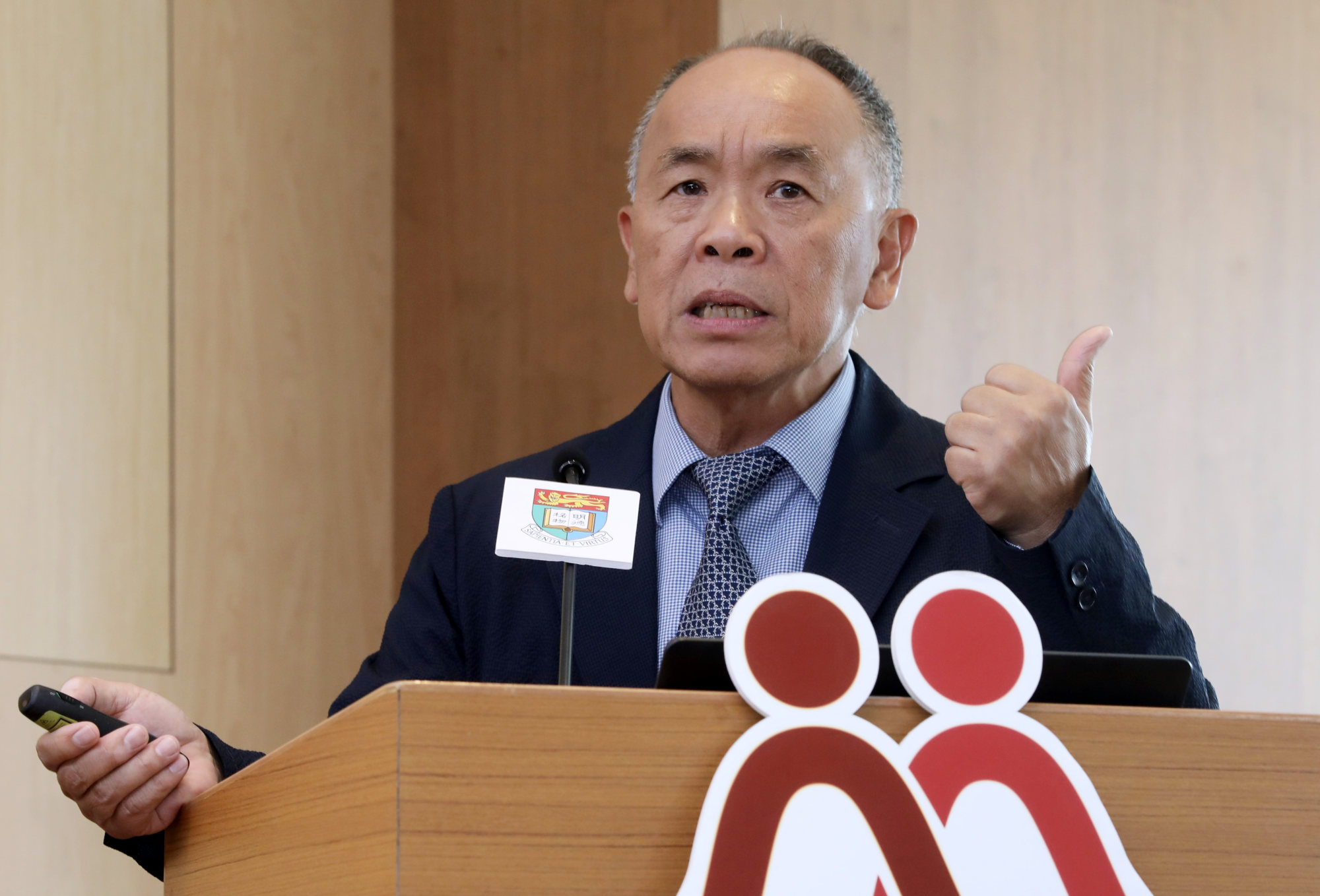
But Yip noted that because women lived longer than men, they could be left alone after their partner had died and had to take care of themselves.
More in-depth research into the elderly population was needed to formulate targeted policies as Hong Kong faced an ageing population, experts said.
Ng of SoCO pointed to the case of an elderly couple, where the 95-year-old wife was assigned a spot in a care home by welfare authorities, but her centenarian husband was not allowed to move in with her, separating the two and adding to their mental stress.
“There is no two-person accommodation in elderly homes. This shows the government is not prepared to handle these situations in a human-first, elderly-friendly way,” he said.
Yip said there needed to be more elderly-friendly infrastructure in the community while encouraging residents to age healthily without relying on the government.
Gietel-Basten said Hong Kong could learn how to better engage elderly men in community activities from experiences elsewhere.
“For example, some studies have shown that men are more likely to attend community events which provide a cooked meal, but we need to learn how to adopt that in the local context,” he said.
However, a single measure was not enough to tackle the ageing population and a society-wide effort, such as building a strong support system among neighbours, was needed, he added.
“More research is needed to understand the specific needs and expectations of different types of older people instead of lumping everyone together,” Gietel-Basten said.
He said breaking down the elderly population into their age groups, genders, ethnicities, living environments and health conditions could provide more data for policy formulation.
“There’s a big difference between what a 60-year-old and a 100-year-old need,” he said. -- SOUTH CHINA MORNING POST