China and Russia have withstood the test of international changes and will continue to support each other, President Xi Jinping told his Russian counterpart Vladimir Putin in a high-profile meeting that demonstrated solidarity amid growing pressure from the United States and its allies.
“Chinese-Russian relations have stood the test of international circumstances and serve as a model of interstate relations, eternal good-neighbourliness, friendship, comprehensive strategic interaction, mutually beneficial cooperation and win-win,” Xi told Putin at their recent meeting.
“China is willing to maintain close high-level interactions with Russia,” Xi said, adding that Beijing would coordinate positions “in a timely manner” on issues concerning each other’s core interests and major concerns.
The meeting, which was followed by a banquet at Xi’s residence in the Zhongnanhai compound, took place amid calls by both powers to establish a new multipolar global order to challenge the one they said was dominated by the US-led West.
Both face what they call “economic bullying” as Beijing fights a heated trade war with Washington. The US is also suggesting slapping fresh sanctions on Russia if it refuses to enter peace negotiations with Ukraine following a summit in Alaska between Putin and US President Donald Trump.
On Monday, Xi and Putin held informal talks on the sidelines of the Shanghai Cooperation Organisation (SCO) summit in Tianjin where Putin briefed Xi about his meeting with Trump, according to Russia’s Tass news agency.
During the meeting on Tuesday, Xi urged “like-minded” countries to work together to push for a “more just and equitable” multipolar order.
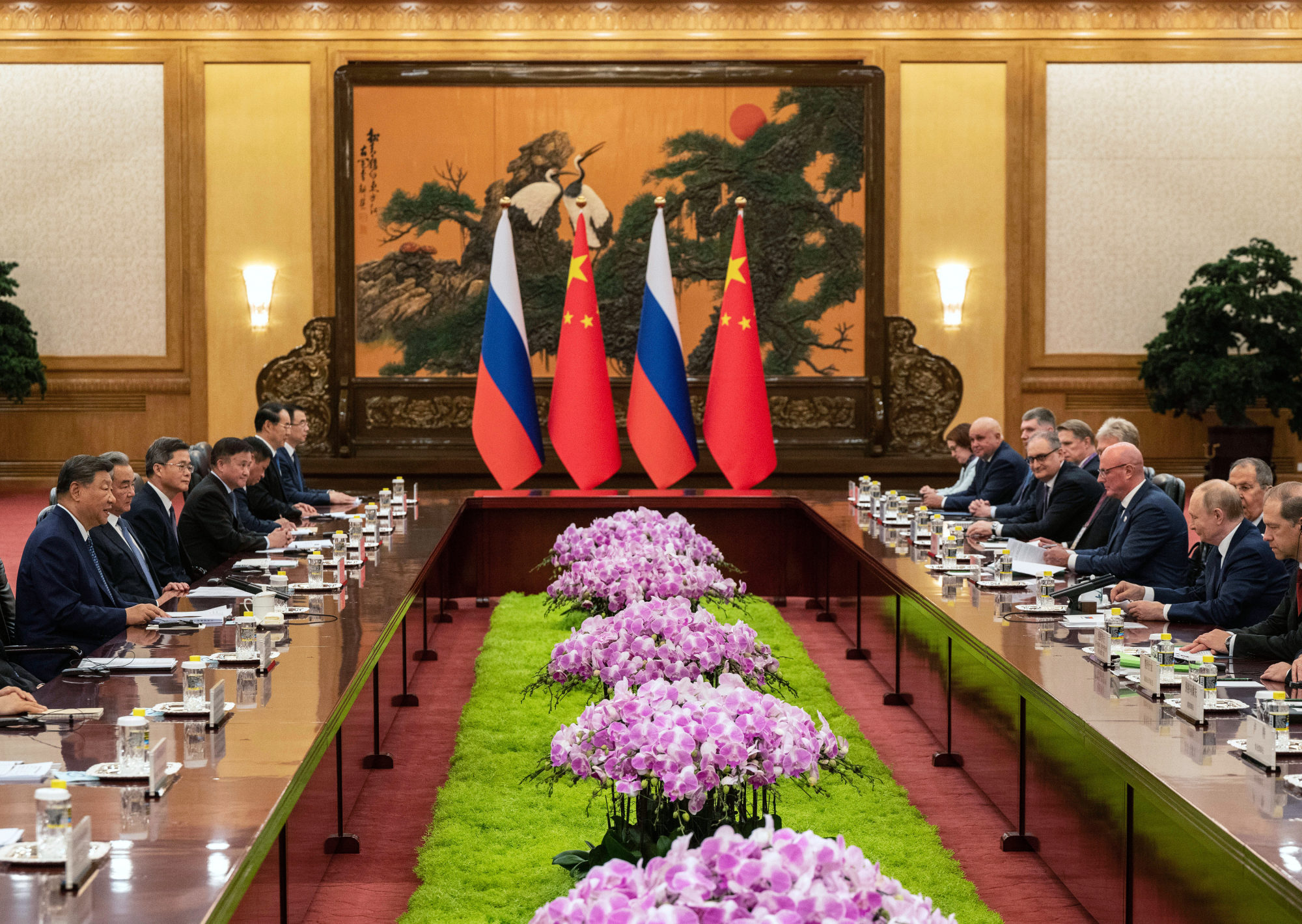
“I proposed the Global Governance Initiative with the aim of working with all like-minded countries to firmly uphold the purposes and principles of the UN Charter and promote the development of a more just and equitable global governance system,” Xi said, referring to the newest policy frameworks to promote the alternative global order announced on Monday.
Positioning China and Russia as strong advocates of “sovereign equality, international rule of law and multilateralism”, Xi said the two powers should continue to strengthen collaboration in multilateral platforms, including Brics, the emerging markets bloc.
While the two countries had strong internal drivers for their own development and revitalisation, major projects should be used to “spearhead cooperation, create model collaborative initiatives and promote the integration of deep-rooted interests,” Xi told Putin.
“It is essential to enhance the resilience of our collaboration, improve tacit coordination and make every effort to consolidate and safeguard the overall picture of bilateral cooperation.”
Both leaders hailed the roles that China and Russia – then the Soviet Union – played in the Allied victory in World War II. Putin said that wartime unity had laid the foundation for today’s bilateral relationship.
Putin, accompanied by a delegation of Russian officials and business figures, is in Beijing for what Kremlin press secretary Dmitry Peskov described as an “absolutely unprecedented” trip to China.
In Beijing are Russia’s Foreign Minister Sergey Lavrov, Minister of Natural Resources and Ecology Alexander Kozlov, Economic Development Minister Maxim Reshetnikov, Deputy Prime Minister Alexander Novak who serves as the government’s point man for the energy sector, and Maxim Oreshkin, the deputy chief of the Kremlin staff, a close aide to Putin and a former economic development minister, according to Tass.
Defence Minister Andrei Belousov and Putin’s aide Yuri Ushakov are also accompanying him.
Alexey Miller, the chairman of Gazprom, Russia’s state gas giant and the world’s largest natural gas producer, and Igor Sechin, CEO of state-owned oil company Rosneft, are also travelling with Putin.
Xi, who has met Putin in person more than 40 times – and had phone calls from time to time – has highlighted their close rapport. After the banquet, Xi hosted Putin in a small-circled tea meeting where they were joined by Lavrov, Oreshkin, Belousov and Ushakov.
The pair took a walk together at Zhongnanhai, trailed by translators and security guards, according to video clips released by the Kremlin.
According to a Chinese readout, the two sides signed more than 20 bilateral cooperation agreements, covering energy, aerospace, artificial intelligence, agriculture, health, scientific research and education.
These include a memorandum of understanding on cooperation to integrate the Russian scientific device “dust monitoring of the moon” into China’s planned Chang’e-7 robotic lunar exploration mission scheduled for next year.
The two sides also agreed to finance research projects, while Moscow State University and Peking University would jointly establish a Russian-Chinese fundamental research institute.
On Wednesday, Putin is expected to join Xi at the Tiananmen rostrum when tens of thousands of military personnel will march in formation through Tiananmen Square in a massive military parade that will also feature some of China’s most advanced hi-tech military hardware.
Beijing is the second stop for the Russian leader during his four-day visit to China. He arrived in the northern city of Tianjin on Sunday for the SCO summit, which was attended by leaders from more than 20 nations, including Indian Prime Minister Narendra Modi, Iranian President Masoud Pezeshkian and Turkish President Recep Tayyip Erdogan.
In what appeared to be a response to Trump’s trade policy, the SCO members reaffirmed a commitment to safeguard an “open, transparent, inclusive, non-discriminatory and rules-based multilateral trading system”.
“Member states oppose unilateral coercive measures, including economic measures that violate the UN Charter and other norms of international law, as well as WTO principles and rules,” the declaration said.
Several members of the SCO – a Eurasian political, economic and security bloc formed in 2001 – face blanket sanctions and punitive tariffs from the United States.
The meeting between their leaders comes as Beijing and Moscow move closer amid growing geopolitical divides with the West, with more coordination across multiple areas under their “no limits” partnership.
A week before his historic summit with Trump in Alaska, Putin had a phone conversation with Xi, briefing him on communication between Russia and the US.
Senior Chinese and Russian officials also frequently convene on matters ranging from national security to investment, while the two countries’ militaries conduct regular joint exercises.
Putin told Chinese state news agency Xinhua that the two sides had agreed to make 2026-27 the Russia-China Years of Education.
He said cooperation in science, technology and innovation would be encouraged as part of efforts to safeguard the technological sovereignty of both nations. - SOUTH CHINA MORNING POST