
The Gates of Hell were flung wide open across East and Southeast Asia last week, at the start of the seventh month of the lunar calendar.
In this Ghost Month (Cantonese gwái yuht), spirits are permitted to cross over into the human realm and roam the earth.
During this period, and especially on the 15th day of the seventh month, festive practices aim to regain the favour of one’s ancestors and other restless spirits in need of honour or appeasement, and, in so doing, to demonstrate filial piety.
Known in English as the Hungry Ghost Festival, this celebration has roots in both Daoism and Buddhism.
For Daoists, this is (Mandarin: Zhongyuan Jie) “Middle Element Festival”. In traditional Daoist belief, the three realms, heaven, earth, and water, are ruled by deities who determine mankind’s fate.

The festival is also known as Yulan Festival (Cantonese yùh làhn jit; Mandarin yú lán jié) or Yulanpen Festival, in reference to the Yulanpen Sūtra Expounded by the Buddha (Fo shuo Yulanpen jing), the earliest known and canonical Buddhist scripture from the mid-fourth century.
The Yulanpen Sūtra is traditionally regarded to be a translation from Sanskrit into Chinese of the Mahāyāna Ullambana Sūtra, which depicts one of the foremost disciples of Buddha, Mulian, as a filial son who, discovering that his mother had been reborn in the hungry ghost realm, received teachings from Buddha on the practice of making offerings of prayers and food.
Hungry ghosts are preta – Sanskrit preta means “departed, deceased, a dead person”, from Sanskrit pra- “before, forward, away”, plus ita “gone”.
Originally referring to any disembodied soul of the deceased, preta later narrowed in meaning to a type of unhappy or malevolent spirit, and was subsequently taken up by Tibetan Buddhists to describe one of six possible realms or states into which rebirth can occur in the Buddhist cycle of samsara, continual rebirth.
The word yulanpen has been theorised as deriving from a hybrid Sanskrit, Middle Indic, or even Iranian term ullambana, sometimes interpreted as corresponding to Sanskrit avalambana, meaning “hanging downward, suspended” – thus a connection is made to the ghost festival rituals that seek the salvation of condemned beings who are “suspended” in suffering in purgatory.
This interpretation is, however, questioned, given the lack of attestation in Indic sources. An alternate explanation comes from the derivation of yulanpen from Pali ullumpana, meaning “raising, rescuing, extracting [from an unfortunate fate]”.
Related festivals from other cultures include Japan’s Obon, comprising the honorific o- attached to -bon, which is clipped from Urabon, which derives from Yulanpen, and Vietnam’s Vu-lan Festival, equivalent to Chinese Yulan, derived from Sanskrit ullambana.
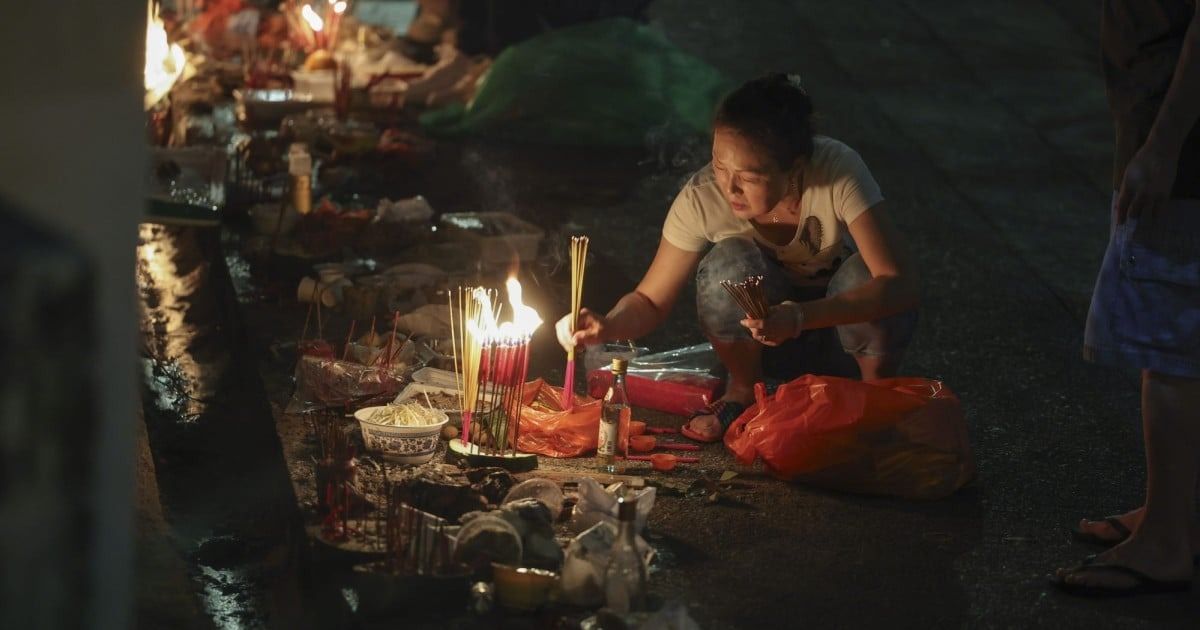
As the preta (“hungry spirit”; Mandarin: è guǐ; Cantonese: ngoh gwái) are constantly consumed by hunger and thirst that can never be satiated, a major dimension of the Hungry Ghost Festival involves offerings of food – at temples, at home, on street corners – to alleviate their suffering.
Other items for the spirits’ use in the afterlife, such as joss paper or spirit money, incense, and other symbols of wealth fashioned from paper – popular foods, clothes, houses, watches, iPhones – are also burnt as offerings to be transmitted to the spirit realm.
A hungry ghost realm exists elsewhere on this earth: the United Nations recently declared famine in Gaza. May the international community take decisive action to release these souls from their fate. -- SOUTH CHINA MORNING POST