
China’s military parade on Wednesday – featuring the latest AI-powered uncrewed vehicles, laser weapons and missiles – signalled an arms race fuelled by scientific and technological advances.
Artificial intelligence, optics and physics and information technologies have underscored how innovations will shape the future of modern warfare, paving the way for futuristic intelligent systems.
“The parade featured unmanned intelligent systems, underwater combat units, cyber and electronic forces and hypersonic weapons, highlighting the growing capacity of the People’s Liberation Army (PLA) to harness emerging technologies, adapt to the evolving character of warfare, and prevail in future conflicts,” state broadcaster CCTV said.
The weapons on parade featured a “high level of informatisation, intelligence and practical combat capability, showcasing the military’s combat abilities, capabilities in new domains and strong strategic deterrence”, Dong Yongzai, a researcher at a centre under Beijing’s Academy of Military Science, told CCTV.
AI-powered equipment and vehicles
The parade showcased a variety of AI-powered uncrewed equipment.
The land combat formation showed vehicles that can perform reconnaissance, assaults, mine and bomb defusing and squad support, according to CCTV.
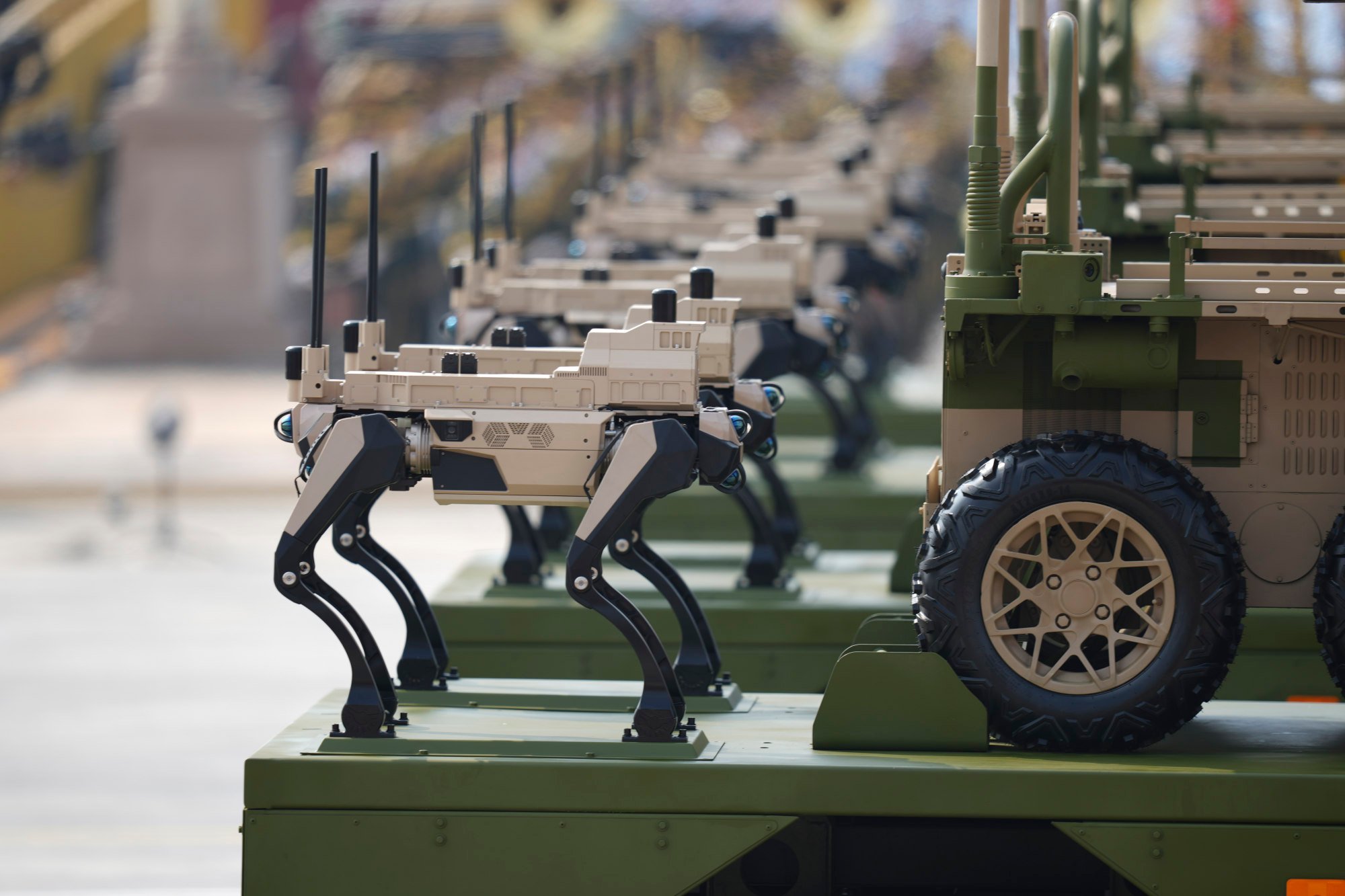
Beyond these traditional tasks, uncrewed tanks can operate in formation with robotic wolves. Small off-road combat vehicles can even launch drones, enabling coordinated air-ground operations.
The maritime formation featured new unmanned underwater and surface vehicles and underwater mine-deployment systems. These systems allow for hidden deployment, blocking, independent target identification and group attacks, according to CCTV.
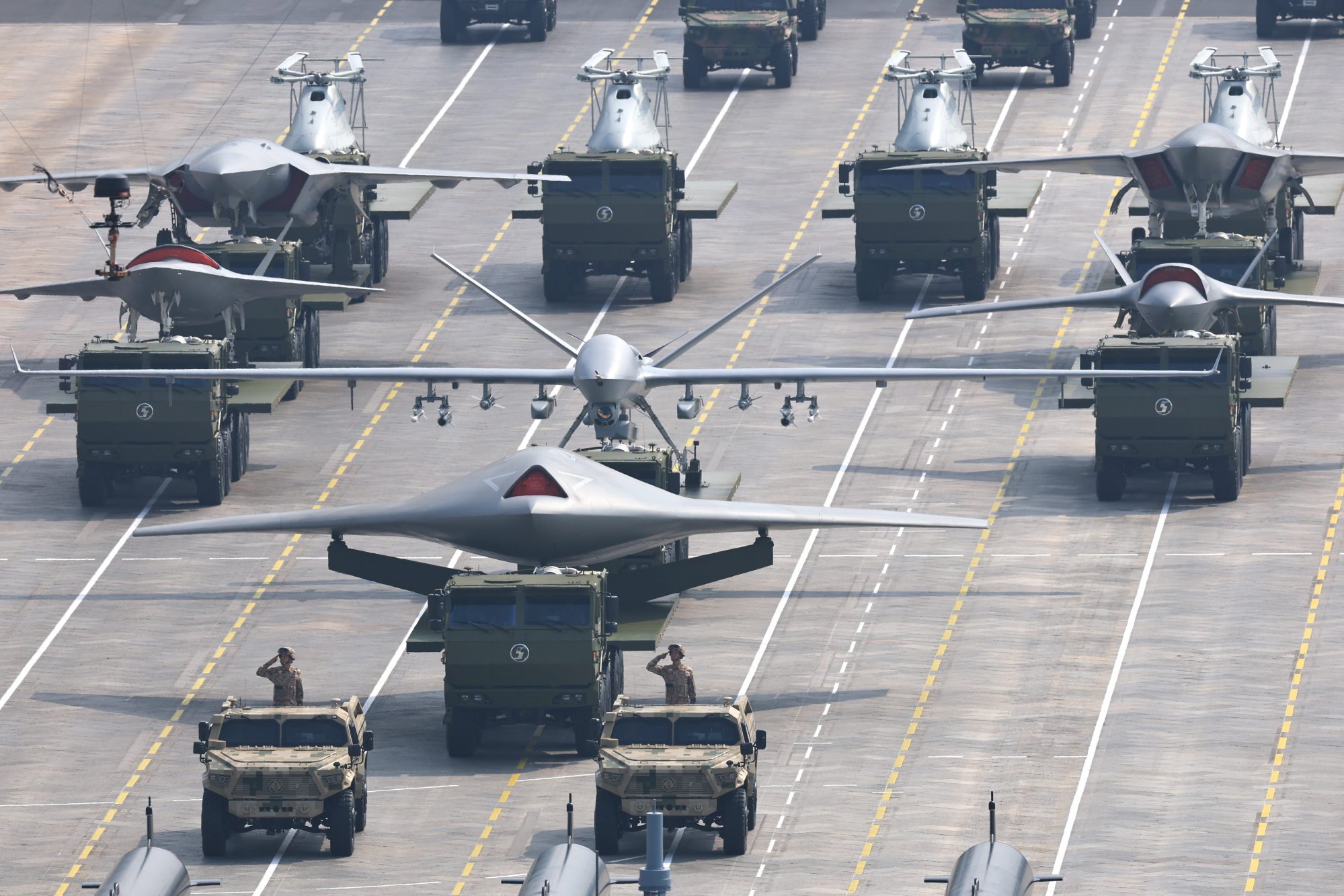
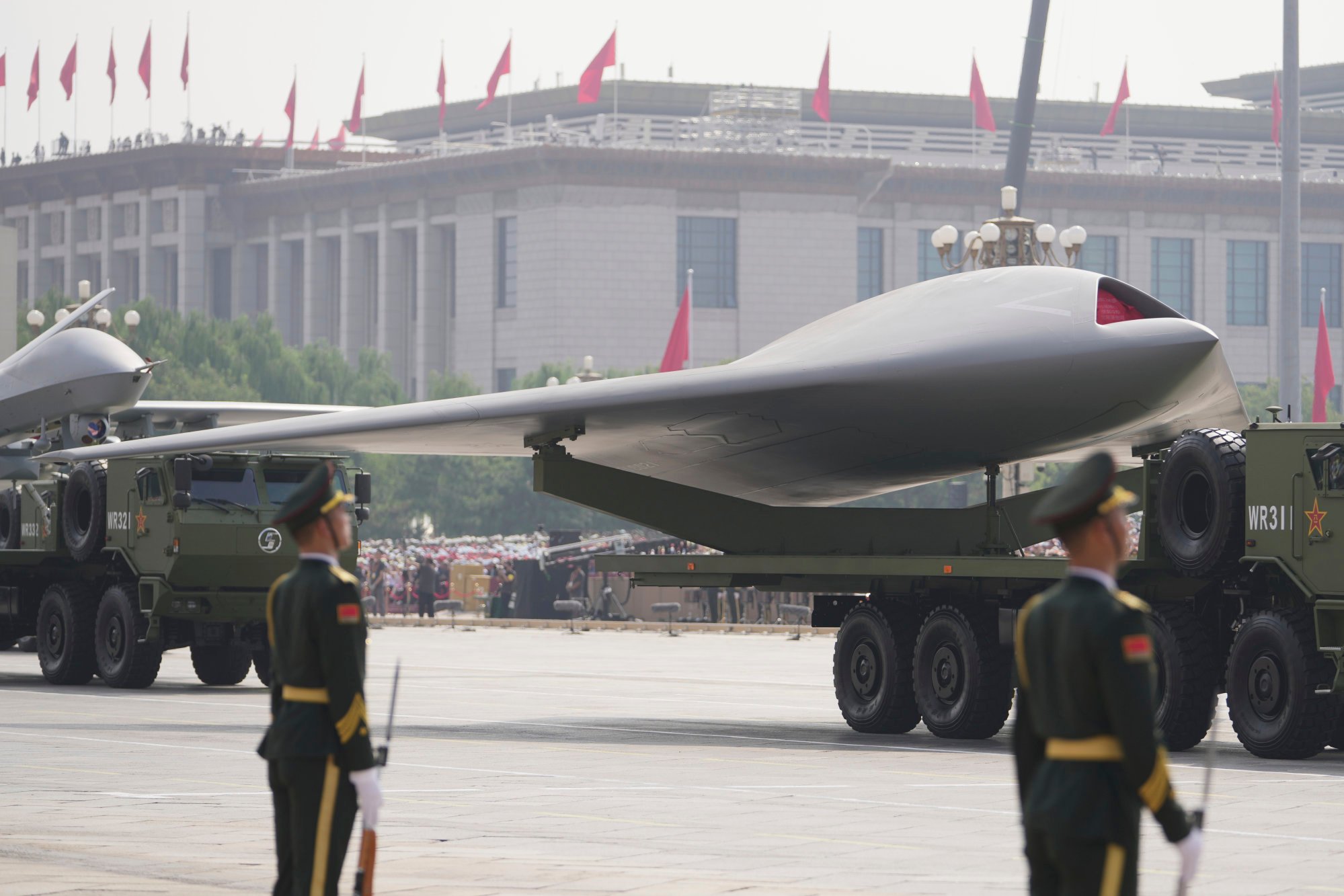
New air reconnaissance and strike drones, uncrewed wing planes, air domination planes and ship-based helicopters were capable of stealth strikes, expansive coverage and autonomous coordination, CCTV said, noting they were “redefining the future of aerial warfare”.
In an earlier CCTV documentary, the WZ-10 and WZ-7 drones were shown on a mission in which one drone conducted wide-area reconnaissance for initial positioning, while the other identified targets for strikes.
Loyal wingman drones, meanwhile, can follow stealth fighter jets to conduct reconnaissance, act as decoys, perform electronic interference and carry weapons, significantly expanding the jet’s combat capabilities.
Such technology is made possible by support from both hardware and algorithms, while flight control chips, battery-powered systems, cameras, radar and other sensors boost the drone’s capabilities.
Using AI algorithms, the drones can process large amounts of data in real time, enabling precise decision-making and autonomous mission execution.
Laser weapons
The shipborne laser weapons seen in the parade were designed for precision strikes and sustained engagement, enabling coordinated operations with other air defence weapon systems. Vehicle-mounted anti-drone equipment first revealed at the commemoration also included a small laser cannon.
CCTV commentator Wei Dongxu said the new laser weapons could instantly neutralise low, slow and small targets, conduct quick multiple attacks and boost efficiency while reducing ammunition costs.
Laser weapons inflict damage by generating high-energy beams. Now, Chinese scientists have developed ways to eliminate the harmful heat of such lasers, operate laser weapons without cooling systems in hot environments, and created new optical materials for high-powered laser weapons.
The advances were made possible by developments in fields such as optics, materials science and thermal management.
Existing laser weapon systems rely largely on semiconductor lasers. According to a Chinese Academy of Sciences report, before 2019, the United States and Germany held a monopoly in the field of high-powered semiconductor laser chips, accounting for over 90 per cent of market share.
In recent years, however, China has promoted industry-university-research collaborations to focus on advances in critical bottleneck technologies such as high-brightness, high-power semiconductor laser chips and advanced laser products.
Domestic laser chip companies like Suzhou Everbright Photonics and Wuhan BD Laser Technology have emerged as leaders in some niche technology areas.
Missiles: physics and aero sciences
Cruise missiles, hypersonic missiles and nuclear missiles were also showcased in Beijing on Wednesday.
During a cruise missile formation, China unveiled its CJ-20A, YJ-18C and CJ-1000 cruise missiles with long-range, precise-strike and multi-domain deterrence capabilities, according to CCTV.
As for hypersonic missiles, the YJ-21, DF-17 and DF-26D missiles excel at breaking through defences and can hit targets with high precision.
The most notable nuclear missile was China’s liquid-fuelled intercontinental strategic nuclear missile, the DF-5C, which “has a global strike range”, according to CCTV.
Missiles are the culmination of multidisciplinary research achievements. Studying the physical properties of air at extremely high speeds requires infrastructure like wind tunnels. New types of sensors are required to perfect control and stability, as well as thermal protection systems based on fundamental materials research.
The heart of the missile – the scramjet engine – represents one of the crown jewels in aerospace technology.
Information combat
Three formations of information warfare equipment – cyberspace warfare, electronic countermeasure and information support – were seen in Tiananmen Square.
The cyberspace warfare formation showcased equipment for command, control, reconnaissance, sensing and network-electronic warfare, CCTV reported.
Domestically developed electronic countermeasure equipment is capable of disconnecting enemy networks, breaking digital chains and providing aerial and space defence and countermeasures.
The information support formation – comprising cloud computing, digital intelligence and air-ground networks and integrated information – could quickly establish new cyber systems to support joint operations, CCTV said.
In recent years, China has made great strides in mastering network attack and defence technologies through computer science and cryptography, while learning how to use electronic countermeasures to generate, transmit and interfere with electromagnetic waves.
China’s rise as a scientific powerhouse
Physics research has underpinned much of China’s emergence as a scientific power and boosted its military strength in areas such as optics, radar and communications.
China is home to eight of the world’s top 10 organisations for high-quality physics research, according to the Nature Index released in February, which ranks research institutions based on their contributions to the world’s most influential scientific journals.
China has also continued to increase research output in the development of new materials and components such as batteries and weapons like explosives.
Chinese universities now hold the top 20 spots in chemistry according to the March Nature Index.