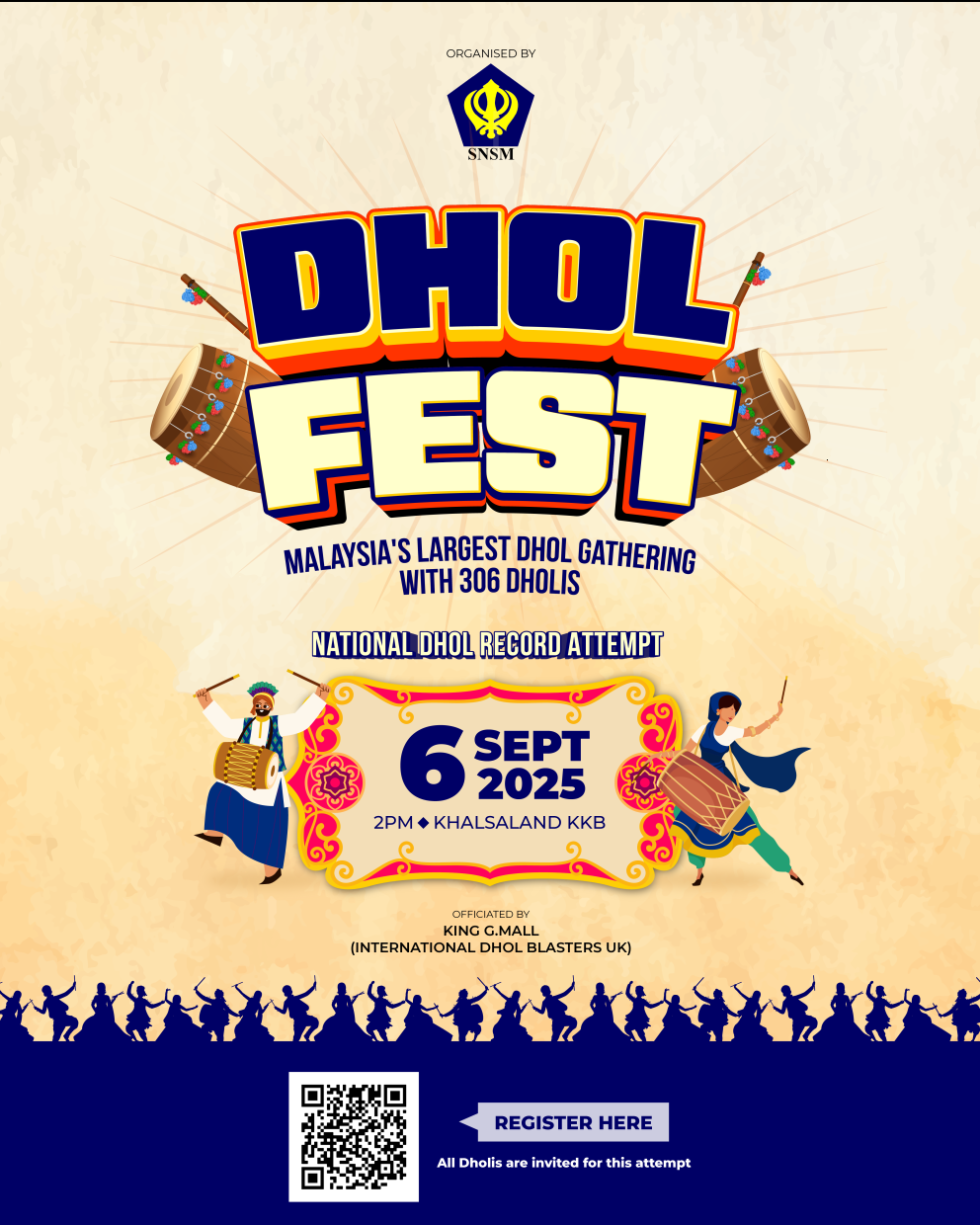
In a vibrant celebration of rhythm, heritage, and unity, Malaysia will witness a very special musical gathering - the Dhol Fest, a national record attempt to assemble the largest number of dhol players in the country. The music festival will take place at Khalsaland KKB on Saturday (Sept 6), and entrance for music fans is free.
Organised by Sikh Naujawan Sabha Malaysia (SNSM), the festival aims to honour and elevate the iconic Punjabi bhangra dhol, a drum that carries centuries of culture in every beat.
The idea behind Dhol Fest is more than just numbers; it's a tribute to the dhol, a powerful double-sided drum that has transcended borders and become a symbol of joy, festivity, and Punjabi identity.
As part of the attempt to etch its name into the Malaysian National Records, the event is expected to bring together dholis (dhol players) from across the country — young and old, seasoned and new — in a booming display of musical unity.
SNSM, a well-known Sikh youth organisation, sees the event as a way to reconnect the younger generation with their cultural roots while promoting national multicultural appreciation. The dhol, after all, is not just a musical instrument; it’s the heartbeat of Punjabi celebration, from weddings to harvest festivals like Vaisakhi.
The Dhol: A Drum with Many Faces
While the Punjabi dhol takes centre stage at this event, it’s worth noting that drums in various forms exist across cultures — each with its own unique rhythm and story. From the Malay kompang to the Chinese tanggu and the Indian tabla, drums are universal instruments of celebration and ceremony.
What makes the dhol unique, however, is its unmatched energy. Played with two sticks, it produces a deep, earthy thump on one side and a high-pitched slap on the other. The combination of these two tones is what drives the high-octane bhangra dance and sets pulses racing. Unlike many traditional drums played while seated, the dhol is often worn with a strap and played while moving, infusing performances with dynamic motion.
Historically, the dhol dates back several centuries, with references found in 15th-century Indian literature and Persian texts. Traditionally used in the Punjab region to announce festivals and battles, the dhol was both an instrument of joy and of command. Over time, it became closely associated with bhangra, a traditional harvest dance of Punjab, which has since evolved into a global symbol of Punjabi culture and celebration.
As Punjabis migrated across the world, the dhol travelled with them, gaining popularity in the United Kingdom, Canada, the United States, and here in Malaysia, where it is now deeply embedded in local celebrations.
Malaysia’s dhol journey has been shaped by passionate individuals and pioneering groups who laid the foundation for its popularity today.
The first documented dhol player in Malaysia was Nashatar Singh Nihang, a cultural trailblazer who introduced the instrument to local audiences and helped seed its presence in community celebrations. His early performances laid the groundwork for what would become a growing musical movement.
Carrying that legacy forward, the Malaysian Dhol Federation played a significant role in popularising the modern style of dhol playing across the country. Their innovative approach combined traditional beats with energetic flair, helping to make the dhol more accessible and appealing to younger generations.
Adding to this rich history, Dholiz Malaysia became the first Malaysian group to perform alongside Bollywood superstar Hrithik Roshan at the IIFA Awards in 2015, marking a proud moment on the international stage and proving that Malaysian dhol talent can stand shoulder to shoulder with the world’s best.
The dhol is more than an instrument. It is a bridge between generations, a symbol of cultural pride, and a call to celebrate life’s moments — both big and small. As Malaysia continues to embrace its rich multicultural identity, events like Dhol Fest remind us that our diversity is our strength.
So when the dhol beats echo through the air at Dhol Fest, it will be more than just a record-breaking attempt — it will be a heartbeat of heritage, resonating through every proud Malaysian who believes in unity through culture.
For more information, music fans can visit SNSM’s official page or follow their social media for updates.