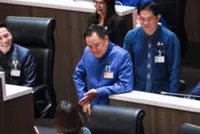
Anutin Charnvirakul leads the race to be Thailand's new PM. -- Photo: Reuters
BANGKOK (Bloomberg): Anutin Charnvirakul appeared poised to lead the next government in Thailand, with the conservative politician promising to call elections within months to end political uncertainty caused by the sacking of Prime Minister Paetongtarn Shinawatra.
Anutin, whose father briefly served as Thailand’s caretaker leader in 2008, said late Friday he had support of enough lawmakers to become prime minister.

Much will depend on the main opposition People’s Party - the largest bloc in the 500-member House of Representatives - which has yet to declare its stance although it’s made clear that any support will be conditional.
Anutin was a deputy prime minister in Paetongtarn’s government until his Bhumjaithai Party exited the coalition following the controversy over her leaked phone call with former Cambodian leader Hun Sen, which eventually led to her sacking by the Constitutional Court.
His party is also known for championing the liberalization of cannabis in Thailand.
An "interim government” under him will dissolve the parliament in four months, hold a referendum on amending the constitution and take steps to resolve the Thai-Cambodia border dispute as demanded by the People’s Party, Anutin said.
"We cannot allow Thailand to come to a standstill,” Anutin told reporters. "After we’ve completed the missions, we will return power to the people within four months by dissolving the house, so the country can be reset once again.”
A fracture within the current coalition headed by Pheu Thai, the political party backed by the Shinawatra clan, may also help Anutin’s bid for power.
While the group said it will attempt to form a government and reached out to the People’s Party for support, Anutin claimed to have the support of about 47 lawmakers who previously supported Paetongtarn’s administration.
Anutin has secured the support of 279 lawmakers, more than the 246 votes required to clinch the job, The Nation reported Saturday. The lower house’s current strength is 492, it said.
On Saturday, the People’s Party said it had not entered into any agreements with any groups and was prepared to consider all proposals if its conditions are met. The party will remain in the opposition even if it backs a candidate for prime minister and its lawmakers will meet on Monday to decide the strategy, leader Natthaphong Ruengpanyawut told reporters in Bangkok.
With its 143 lawmakers, the group is emerging as a key player in the formation of the new government. The party has no prime ministerial candidate left after the Constitutional Court dissolved its earlier incarnation - Move Forward Party- and banned its nominee Pita Limjaroenrat from politics for 10 years.
A parliamentary vote to select a new premier is likely to be held Sept. 3-5. Under the Thai constitution, a prime ministerial candidate needs the support of the majority of the sitting members in the elected lower house.
Read: Thailand Faces Deeper Political Turmoil as Court Ousts Premier
Even if Anutin ascends to power, his administration is unlikely to have a strong parliamentary mandate, potentially leading to a policy paralysis at a time when Thailand’s economic outlook is worsened by the blow from US tariffs and the region’s highest household debt levels.
Paetongtarn, like her immediate predecessor Srettha Thavisin, lasted just about a year in office before being booted out. The judges said her remarks on a phone call with Cambodia’s Hun Sen over a border dispute undermined national interests and the dignity of the premiership.
The court, set up in 1997, has now ejected five sitting Thai prime ministers linked to Paetongtarn’s father Thaksin Shinawatra, including his sister and brother-in-law.
Read: Why Thailand’s Shinawatra Clan Lost Power Once Again: QuickTake
The sackings highlight how the country’s conservative establishment - identified by analysts as an amalgamation of bureaucrats, the military and business elites - can thwart elected governments, disband political parties and engineer long stretches of military-backed rule.
"The court’s removal of Paetongtarn affirms a troubling precedent of unelected judges overruling the mandate of millions,” said Napon Jatusripitak, acting coordinator of the Thailand Studies Program at ISEAS-Yusof Ishak Institute. "With no clear successor, Thailand risks deadlock and a leadership vacuum just as it faces economic turbulence from a US trade deal and renewed border tensions with Cambodia.”
Paetongtarn’s ouster throws into doubt a compromise her father reached with his rivals that kept his hands on the levers of power.
The deal had helped him return to Thailand after 15 years in self-imposed exile and paved the way for Pheu Thai to form a government with conservative groups that were opposed to him previously.
Thailand’s top business group warned that any delay in the formation of a new government could disrupt budget spending and hinder trade negotiations with the US and resolution of border issues with Cambodia. The political turmoil could heighten risks for the $550 billion economy and hurt investor confidence, the Federation of Thai Industries said.
Foreign investors have sold a net $2.5 billion of Thai stocks this year as near-constant political instability worsens the outlook for an economy that has posted an average of 2% annual growth in the past decade, lagging regional peers such as Indonesia and the Philippines.
Thailand will be hurt by shifting priorities within the incoming coalition, which could produce a government more concerned with rent-seeking ahead of the possibility of an early election than with delivering a coherent economic response, Napon said.
"Beyond broader developmental outcomes such as GDP growth, this spells trouble for Thailand’s already faltering economic competitiveness and for its place in the global manufacturing value chain,” he said.
--With assistance from Pathom Sangwongwanich.
-- ©2025 Bloomberg L.P.