The People’s Liberation Army (PLA) is likely to showcase a new type of advanced stealth attack drone during September’s Victory Day parade in Beijing, rehearsal images circulating online suggest.
The FH-97, a single-engine, ground-attack uncrewed aircraft, has been described as potentially China’s first combat-ready stealth drone, capable of coordinated aerial warfare alongside crewed jets.
Photos leaked online over the weekend appeared to show an FH-97 takng part in the rehearsals for the massive military parade on September 3, which will commemorate the 80th anniversary of Japan’s surrender and the end of World War II.
The official debut of the model would make China the first country to have such a drone – dubbed a “loyal wingman” in crewed-uncrewed team-up warfare – ready for combat.
The parade’s second full rehearsal was held from Saturday evening into Sunday morning near Tiananmen Square, involving around 40,000 personnel.
Although the aircraft was covered and mounted on a military truck, enough design features were revealed to suggest it was the FH-97, or Feihong-97, developed by a subsidiary of the state-owned China Aerospace Science and Technology Corporation (AVIC).
The angular shaping of its vertical stabilisers further aligns with the FH-97.
A scale model of the FH-97 was first unveiled at the premier Zhuhai Air Show in 2021. Chief designer Deng Shuai told state-run Global Times the following year that the drone “acts as both a sensor and an ammunition depot, as well as an intelligent assistant for pilots”.
He added that it had earned the “loyal wingman” moniker because it flew alongside crewed aircraft “like an armed bodyguard”.
An article on military website The War Zone said on Sunday that the newly sighted drone “might be a further addition to the FH-97 line” rather than the 2021 version, referring to newer variants. The AVIC arm unveiled an air-to-air variant called the FH-97A in 2022.
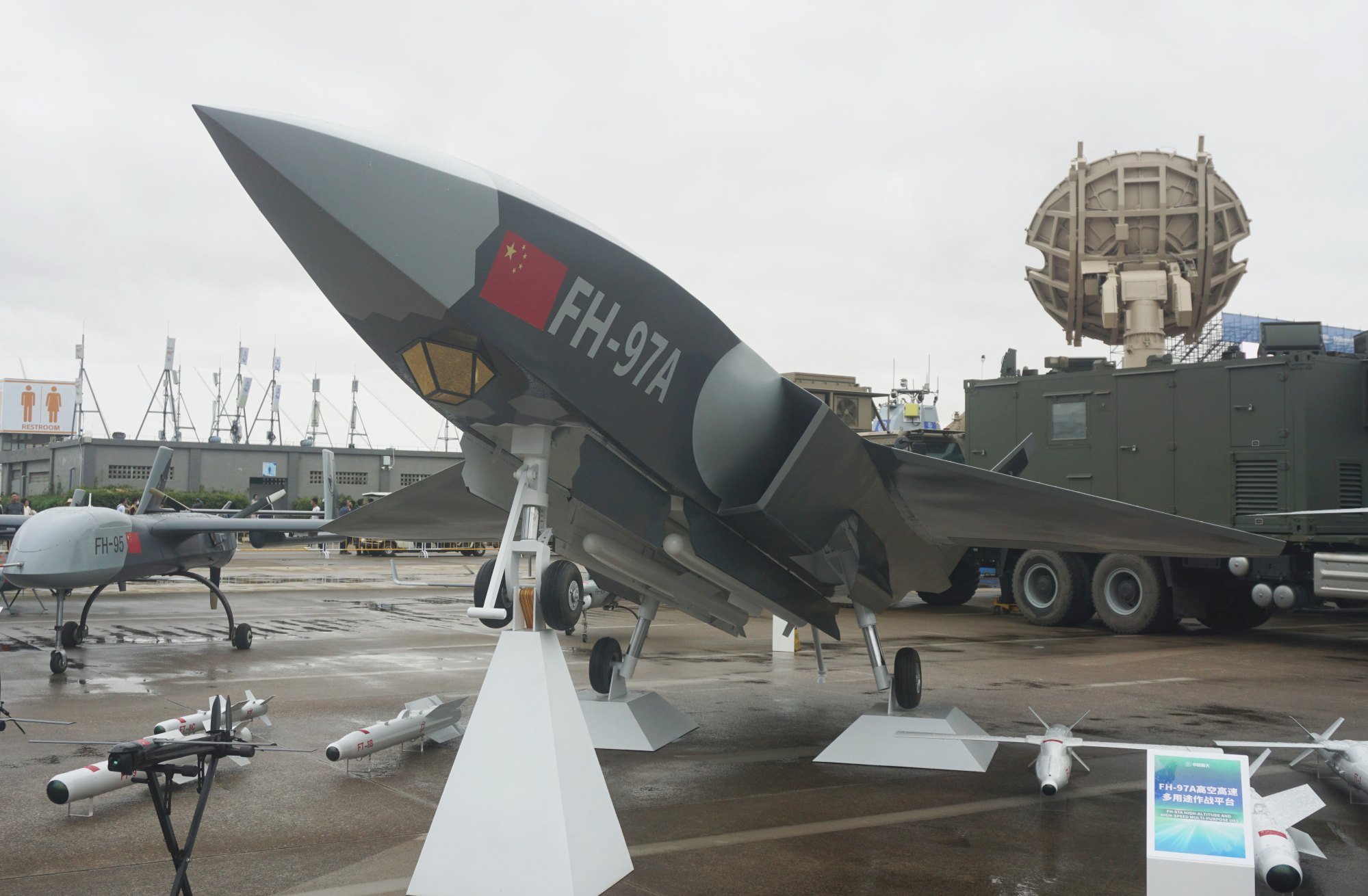
An FH-97 debut at the parade would make China the first country to publicly announce the deployment of fully operational loyal wingman drones. While several nations have advanced to late-stage testing, none has yet confirmed their combat deployment.
“All weapons and equipment to be displayed in the [Victory Day] parade are domestically produced, active-duty main battle gear,” Major General Wu Zeke, the deputy head of the parade organising committee, said in June.
Collaborative combat aircraft (CCA) drones or loyal wingmen are designed to work alongside advanced stealth fighters, their crewed-uncrewed teaming multiplying combat effectiveness while reducing pilot workload and risk to human life.
The United States’ XQ-58A loyal wingman combat drone is expected to be combat ready by 2029.
Australia is the other military close to deploying loyal wingman drones, specifically Boeing’s MQ-28 Ghost Bat, recognisable by its side-mounted air intakes. Market reports say eight Block 1 prototypes have been already delivered to the Royal Australian Air Force and have logged more than 100 flight hours as of this month.
Additional PLA rehearsal images emerging over the weekend also showed two previously unknown drone designs with tailless, modified delta wings. One featured a slender nose leading into a wider fuselage, while the other had a broader nose and central section.
Both remained under covers, obscuring details such as engine placement. But based on their truck-mounted scale, both designs appeared significantly larger than the FH-97-style drones, hinting at higher performance levels.
The War Zone concluded that “all of this reflects China’s clear pursuit of multiple CCA and/or [Unmanned Combat Aerial Vehicle] designs for land-based use, as well as operations from aircraft carriers and big-deck amphibious warfare ships.” - SOUTH CHINA MORNING POST